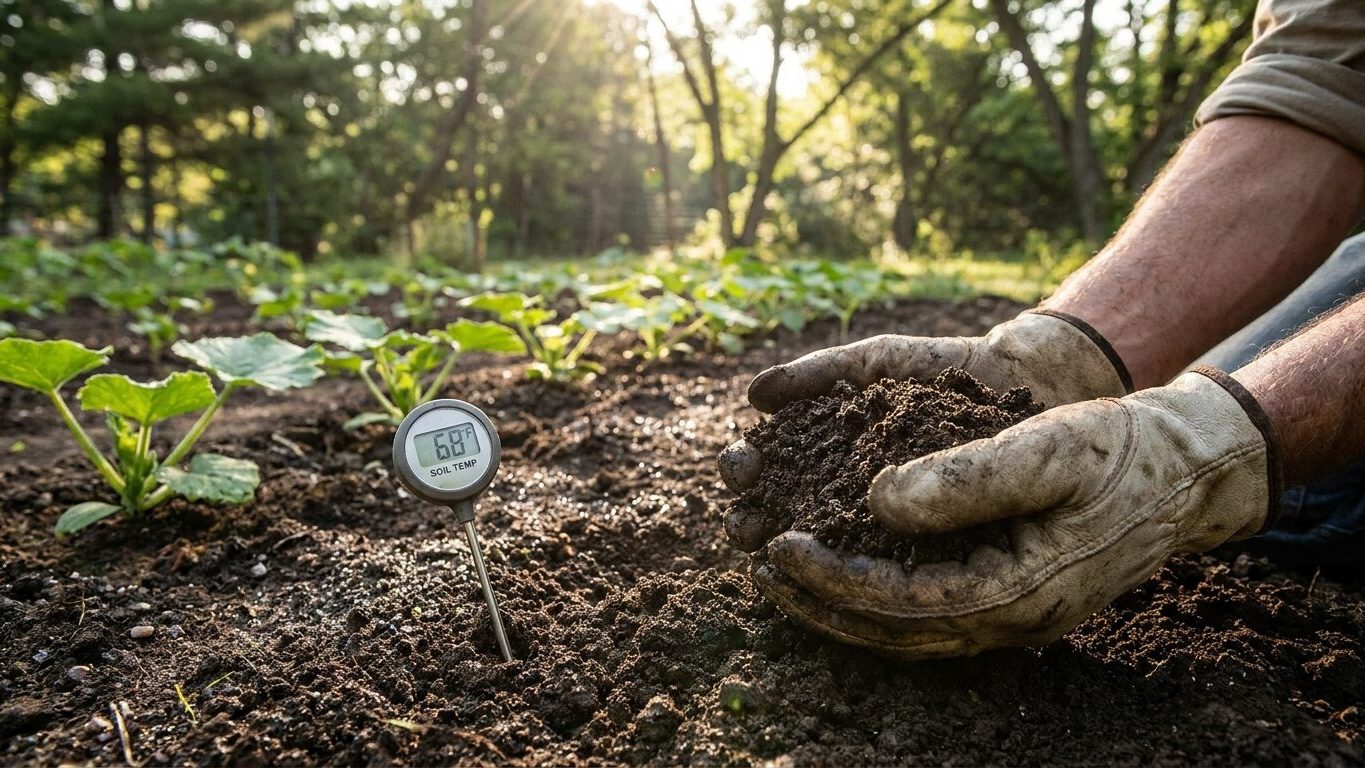

In Kentucky, sow winter squash outdoors between mid-May and mid-June, once the soil has warmed well past the last spring frost (March 24 to April 4) and with enough growing season left before the first fall frost (November 2 to November 12) for an 85-to-110-day crop to mature and cure. That’s the short version. Here’s what actually decides the exact week for your own plot.
The short answer for Kentucky
Those frost dates aren’t guarantees, they’re probabilities. NOAA’s 1991-2020 Climate Normals place Kentucky’s last spring frost and first fall frost in a 30-to-70% probability band for a 32F freeze at the reference station. In plain terms, on any given year there’s still a real chance of frost on either side of that window, which is why squash, a plant with zero frost tolerance, should never go in the ground the day the last frost date arrives. Soil needs to sit above 60F for squash seed to germinate reliably, and that threshold typically lands two to three weeks after the last frost date, not on it.
That pushes the practical sowing window to mid-May through mid-June for most of the state. Winter squash types split by speed: acorn and delicata run 80 to 100 days from seed to harvest, while butternut, hubbard and larger storage types need 100 to 110 days or more. Counting from June 1 forward to the earliest fall frost date of November 2 gives roughly 154 days, more than enough cushion for even the slower varieties, provided the seed goes in by mid-June at the latest.
One caution matters here: the National Weather Service in Louisville has flagged that its own reference station runs later in spring and earlier in fall than the rural county around it. A garden outside the immediate Louisville metro should treat the window as tighter than the raw dates suggest, meaning wait slightly longer in spring before the soil is trusted, and don’t count on the full stretch into early November for harvest.
What will not work here

Kentucky summers average 37.2 days a year at or above 90F, measured at the same reference station as the frost normals. That heat load is what actually damages squash, not the frost dates. Sustained heat above 90F during flowering causes blossom drop and stalls fruit set, and it happens most in July, right when a mid-May planting is trying to bloom. A “plant it and water once a week” approach fails here, because the same stretch of heat that stresses the plant also accelerates evaporation from the soil.
The rainfall numbers make that worse than they first look. Summer rain across June, July and August totals about 12.0 inches, with August, the hottest stretch of squash development, the driest month at just 3.71 inches. That’s not a steady drip; Kentucky summer rain tends to arrive as thunderstorms, which run off rather than soak in, especially on clay soil common across much of the state. A garden relying on rainfall alone through August, or watering on a fixed weekly schedule, will likely underwater right when fruit is sizing up.
Spacing and disease
The same rain pattern, thunderstorm bursts rather than gentle soaking, keeps foliage wet longer after each event, and that favors powdery and downy mildew on winter squash leaves. Tight spacing that might get away with it in a drier climate becomes a liability here; vines packed close trap humidity and slow leaf drying, which speeds disease spread across a planting.
Timing failures are just as common as watering failures. Sowing a 110-day hubbard type in July, after a delayed spring or a replant following a failed first try, leaves too little runway before frost risk climbs in early November, especially once curing time (needed before storage) is factored in on top of the days-to-maturity number on the seed packet.
What changes across Kentucky
Kentucky sits across USDA Hardiness Zones 6a to 7a, based on the USDA Plant Hardiness Zone Map’s average annual extreme minimum temperature. That’s not a small spread. A 6a location and a 7a location within the same state can differ by a full zone band, which on the ground means real differences in how early spring warms and how late fall frost holds off.
Generally, the cooler 6a end of that range sits toward the northern part of the state and at higher elevations in the eastern mountains, while the milder 7a end runs toward the western and southern parts of Kentucky. A reader gardening in a cooler pocket, whether from latitude or elevation, should shift the whole sowing window later in spring by a week or two, and should treat the fall end of the window as arriving earlier than the state-wide November dates suggest.
None of this means picking a zone off a mental map of the state. Hardiness zone boundaries follow terrain and local cold-air drainage as much as latitude, and a valley can sit a full zone colder than a ridge a few miles away. The only reliable way to know which end of that 6a-to-7a range applies to a specific garden is to check the current USDA map directly for that address, not to guess from general geography.
Where to check this for your own county
Everything above is a state-level picture, built from a single reference station’s climate normals. Kentucky counties vary enough in elevation, soil and local frost patterns that a county-specific recommendation will beat a statewide picture every time it’s available. The University of Kentucky Cooperative Extension Service, part of the national land-grant extension network, maintains that local layer at extension.ca.uky.edu.
Two things are worth hunting for once there. First, a county-level planting calendar, if the local office publishes one, will reflect frost patterns and soil conditions specific to that county rather than a statewide reference station. Second, look for variety trial results or recommended cultivar lists for winter squash grown in that county’s extension trials; a variety that performs well in a humid river-bottom county might struggle in a drier upland one, even within the same state.
A county extension agent, or the published materials from that county’s office, has seen actual seasons on actual local soil. That’s a different kind of evidence than a 30-year climate average, and it should carry more weight for a specific garden.
Checking this against your own garden
Every date here is a normal, a 30-year average built from a single reference station. A gardener’s own plot will run ahead of or behind that average most years, and three simple observations settle the question better than any calendar.
Soil warmth by feel is the first check. Squash seed wants soil that no longer feels cool to the back of a hand pushed a few inches down; if it still feels cold in mid-May, the local soil is running behind the regional normal and sowing should wait, regardless of what the calendar says.
The first flush of male flowers is the second signal. Squash plants typically produce male flowers before female ones, and their appearance marks the point where the plant has enough heat and light behind it to start reproductive growth. A garden pushing out male flowers unusually early or late compared to a neighbor’s plot is showing its own microclimate at work, whether that’s a warm south-facing slope or a cooler low spot that holds cold air.
The first true leaves, the second set that appears after the seed’s initial leaves, tell a third story: how fast the plant is actually growing under local conditions. Slow true-leaf development after germination usually points to soil that’s cooler or wetter than ideal, a cue to hold off on the next round of watering or fertilizing rather than pushing the plant on a fixed schedule built for the state average.
Some gardeners also time this by the Moon: when to plant winter squash by the moon, as almanac tradition rather than fact.