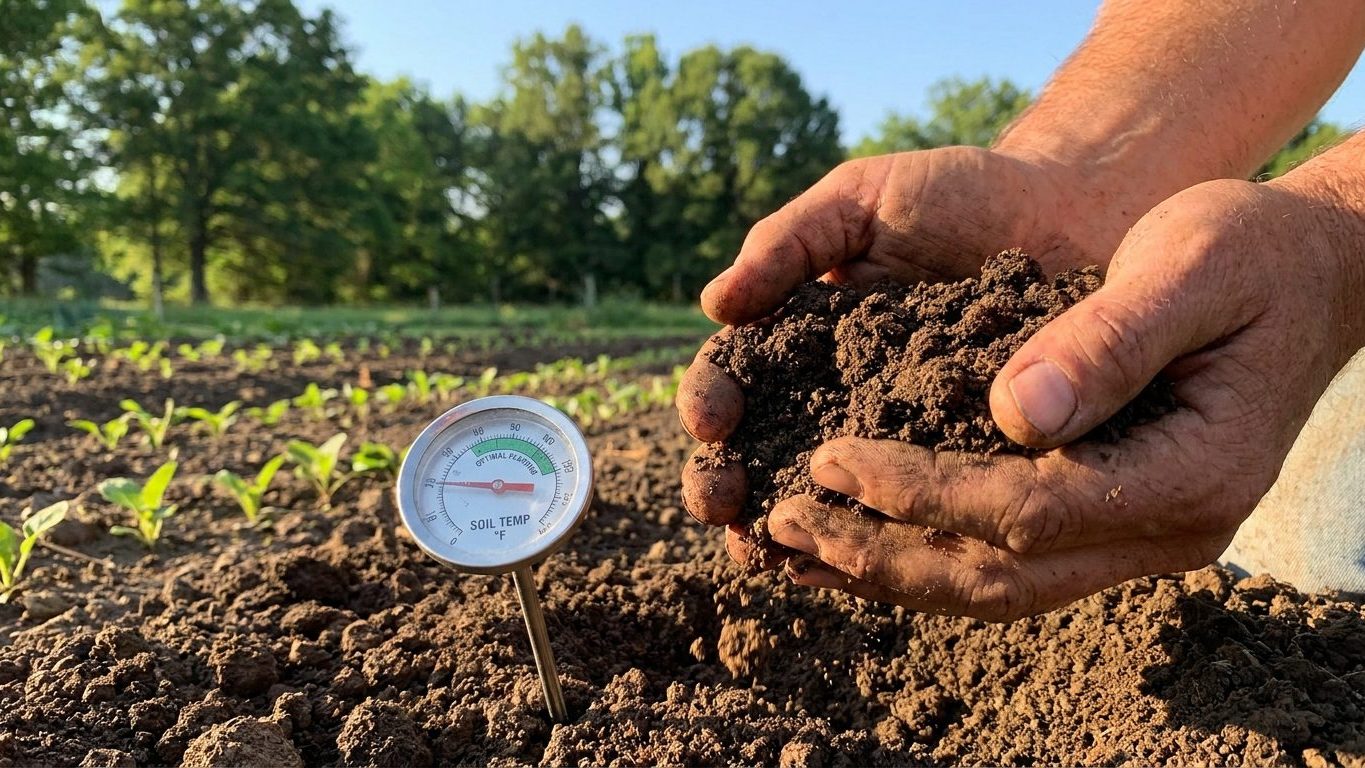

Winter Squash in Kentucky goes into the ground once soil temperatures climb past the mid-60s, typically mid-to-late April, and the fruit needs to finish curing before the first hard freeze in early-to-mid November. Kentucky’s USDA hardiness zone (6a-7a) gives a long enough frost-free stretch for nearly every winter squash type, but summer humidity and disease pressure decide which ones actually make it to harvest looking good.
When the soil is warm enough in Kentucky

The date gardeners actually want isn’t the frost date, it’s the day the soil itself has warmed enough for squash seed to germinate reliably and for transplants to stop sulking. Winter squash seed wants soil in the mid-60s Fahrenheit at planting depth, and that threshold usually arrives one to two weeks after the last frost risk has passed, not on the frost date itself.
For Kentucky, NOAA’s 1991-2020 Climate Normals put the last spring frost (32°F) at the reference station between March 24 and April 4, based on the 30-70% freeze probability band. That’s a probability window, not a guarantee: some years the last frost lands earlier, some years later, and a squash plant set out on the early edge of that window is gambling against a late cold snap.
This figure comes from station USW00093821, the Louisville reference station used in NOAA’s normals. The National Weather Service office in Louisville has flagged something worth repeating here: that particular station runs warmer than the surrounding rural county, meaning it reports later spring frosts and earlier fall frosts than a lot of the farmland and gardens sitting outside the city’s heat footprint. A rural garden an hour from Louisville should treat this window as tighter than the numbers suggest, not wider.
What that means for planting day
Practically, that puts a safe soil-warming window somewhere in the two to three weeks after early April for most of the state, sliding later for gardens at higher elevation or in low-lying frost pockets. Rather than circling a date on the calendar, push a soil thermometer four inches down at midday for a few days running. Consistent mid-60s readings, not a single warm afternoon, is the signal.
Skip any product-based fungicide or insecticide routine at planting time until there’s an actual problem to treat; healthy transplants set into warm soil, with room to breathe between plants, sidestep a good share of the early-season disease and pest pressure before it starts. For variety-specific planting guidance calibrated to local trial data, the University of Kentucky Cooperative Extension Service keeps county-level recommendations that this page can’t substitute for.
How long the season lasts here
Winter squash needs a full, uninterrupted run from seed or transplant to a fully mature, hard-shelled fruit still attached to the vine when frost arrives. Kentucky’s growing window, built from the same NOAA normals, runs from a last spring frost of March 24-April 4 to a first fall frost of November 2-November 12.
Doing the subtraction across both ends of those ranges gives a season length of roughly 212 days in the most conservative combination (late spring frost, early fall frost) up to about 233 days in the most generous one (early spring frost, late fall frost). Either way, that’s a long window by winter squash standards, since most types need somewhere between three and four months of warm growing weather to finish.
| Scenario | Last spring frost used | First fall frost used | Approximate season length |
|---|---|---|---|
| Most conservative | April 4 | November 2 | ~212 days |
| Most generous | March 24 | November 12 | ~233 days |
A window that long changes the math on succession sowing. In territories where the frost-free stretch barely covers one planting, gardeners are locked into a single sowing date and have to get it right the first time. Kentucky’s margin is wide enough that a second sowing in early summer is a realistic option for types that mature faster, giving a hedge against a rough start, uneven germination, or squash bugs taking out the first planting. The general logic of staggering sowing dates, and when it stops paying off, is covered in this site’s succession sowing guide.
The extra length also makes transplanting a genuine choice rather than a necessity. Where the season is tight, every week saved by starting seed indoors matters. Here, direct-sown seed has enough runway to catch up, so the decision comes down to how much a gardener wants to avoid the root disturbance winter squash dislikes at transplant time, not whether the calendar allows it.
Heat and water in Kentucky

Winter squash lives or dies, in a manner of speaking, on whether the fruit has time to fully mature and cure before frost. That’s true everywhere, but what determines the difficulty of getting there is local: heat load and water supply through the growing season.
Kentucky’s reference station averages 37.2 days a year at or above 90°F, per NOAA’s 1991-2020 normals. That’s a moderate heat load, not the kind of sustained triple-digit stretch that pushes squash into heat stress and blossom drop across whole territories farther south and west. It’s enough to raise water demand through midsummer, but it isn’t the defining constraint here.
Rain arrives, but not evenly
Summer rainfall across June, July and August averages about 12.0 inches at the same station, out of 48.3 inches for the year. It isn’t spread evenly: June brings 4.27 inches, July 4.05, and August, the driest of the three, only 3.71.
| Month | Average rainfall |
|---|---|
| June | 4.27 in |
| July | 4.05 in |
| August | 3.71 in |
August is exactly when winter squash fruit is filling out and starting to cure, and it’s the month with the least rain of the three. That gap is worth watching with a rain gauge rather than assuming the season’s rainfall total will cover it, since a dry August after a wet June can still leave a garden short right when the fruit needs steady moisture most.
Neither the heat nor the rainfall numbers here point to a harsh, arid climate. What they point to, combined with Kentucky’s general summer humidity, is a garden environment where moisture lingers on foliage overnight more than one where the ground dries out fast. That favors powdery mildew and downy mildew over drought stress as the more likely problem to manage, especially as vines thicken in July and August and airflow between leaves drops off. Spacing plants for airflow, and watering at the soil line rather than overhead, does more here than any amount of extra water applied badly.
Which winter squash suit Kentucky
None of this points to one named variety, and this page isn’t going to guess at one. What Kentucky’s numbers point to is a set of traits worth prioritizing when picking through what’s available locally.
The long frost-free window, 212 to 233 days depending on the year, means Kentucky gardeners aren’t boxed into the earliest-maturing types the way a shorter-season territory would be. Types that need a longer stretch to finish have room here, which opens up more of the winter squash category than a tighter climate would allow.
The moderate heat load (37.2 days above 90°F) doesn’t demand the shade-and-airflow accommodations that a hotter, drier territory would require to keep fruit from scalding or vines from wilting midday. It’s manageable with normal spacing and consistent watering through the driest stretch of August.
The bigger factor, given Kentucky’s humidity and the way summer rain arrives, is disease pressure. Types and rootstocks bred or selected for resistance to powdery mildew and downy mildew are worth weighing more heavily here than in a drier territory, since foliage that stays damp overnight gives those diseases the conditions they need to spread through a planting by midsummer.
- Long growing window: room for later-maturing types, not just the earliest ones
- Moderate heat: standard spacing and watering, no special shade needed
- Summer humidity: disease resistance is the first trait to check, ahead of size or shape
The specific varieties that hold up against Kentucky’s disease pressure and still finish well within the state’s frost window are exactly what the University of Kentucky Cooperative Extension Service tracks through its own regional trials. That’s the recommendation that actually means something for a given county, and it’s the one this page can point toward but not replace.