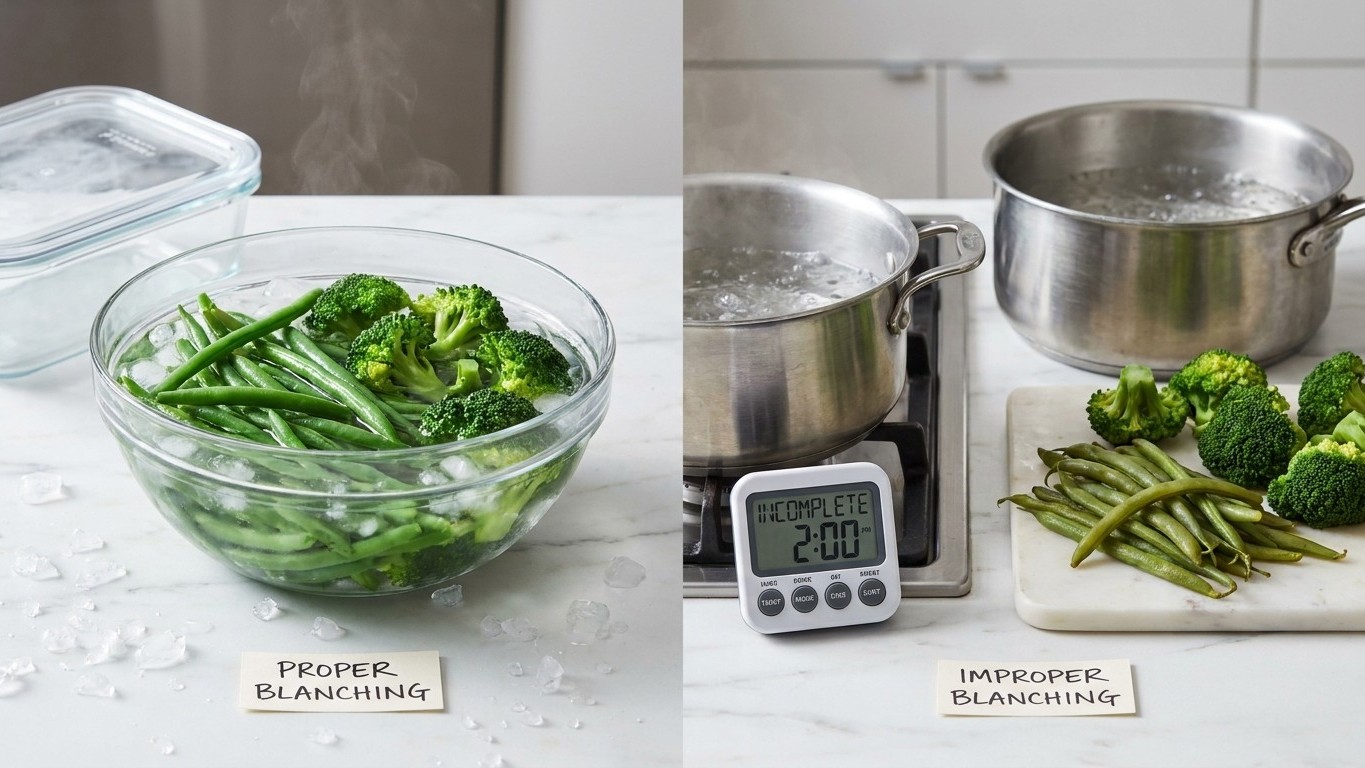

Skipping blanching before freezing is a choice cooks can defensibly make for a handful of vegetables. Half-blanching is not a middle option, it is a mistake. According to the National Center for Home Food Preservation, underblanching stimulates the very enzyme activity blanching is supposed to shut down, which means a rushed or uneven blanch can leave frozen vegetables in worse shape than if you had never blanched them at all.
The short answer
The National Center for Home Food Preservation (University of Georgia) states it plainly: underblanching stimulates the activity of enzymes and is worse than no blanching. That single sentence contradicts the instinct most home cooks have. We assume that a little bit of heat is better than none, that a quick dunk in boiling water must do some good even if it falls short of the full treatment. With blanching, that assumption is backwards.
Here is the mechanism, since the NCHFP source describes what blanching does without giving a single universal number that applies to every vegetable. Vegetables carry natural enzymes that keep working on flavor, color and texture whether the vegetable is still in the ground or sitting in your freezer. Full blanching applies enough heat, for long enough, to deactivate those enzymes across the entire piece of food, not just the surface. A too-short or too-cool blanch heats the outer layer while leaving the enzyme activity inside the vegetable untouched, or in some cases even accelerated by the mild warmth. That partially heated vegetable then goes into the freezer still carrying active enzymes, and freezing does not stop enzyme activity, it only slows it down. Months later, that package of green beans or corn comes out mushy, off-color, or flat-tasting, and the cause traces straight back to a blanch that was started but not finished properly.
The opposite failure carries its own cost. The same NCHFP guidance notes that overblanching causes loss of flavor, color, vitamins and minerals. So this is not a case where more heat is automatically safer. Blanching has a target zone: enough exposure to knock out the enzymes throughout the vegetable, not so much that you’re essentially boiling the food and washing away what made it worth freezing in the first place.
None of this touches on food safety in the botulism sense, worth saying clearly. Blanching is about quality, about the vegetable tasting and looking like itself eight months from now instead of like a gray, waterlogged version of itself. But “just quality” undersells how much difference it makes, and how completely a rushed job can erase the benefit you were trying to capture.
What actually decides it
Three separate mechanisms are at work every time you blanch a vegetable before freezing, and understanding them lets you reason through any vegetable.
Enzymes never sleep, they slow down
Freezing is often described as if it “stops” food, but it doesn’t stop biology, it slows it. The enzymes responsible for ripening, softening and color change in fresh vegetables keep functioning at freezer temperatures, just at a crawl instead of a run. Over weeks and months in storage, that crawl adds up. Blanching’s entire job is to deactivate those enzymes before the food goes into the freezer, so there’s nothing left running, however slowly, while the vegetable sits in your freezer bag. An underblanched vegetable hasn’t achieved that deactivation; it has, per the NCHFP finding, sometimes stimulated the enzymes instead, giving them a head start on the very deterioration you were trying to prevent.
Heat is doing double duty
The same hot-water or steam exposure that deactivates enzymes also removes dirt and microorganisms sitting on the surface of the vegetable, per NCHFP. This is a separate benefit from the enzyme story, and it’s why blanching isn’t simply “cooking a little.” It is a specific window of heat exposure calibrated to hit both targets, enzyme deactivation deep in the vegetable and surface cleaning, without overshooting into the vitamin and flavor losses that come with overblanching.
The cooling step is not an afterthought
What happens right after the hot water matters as much as the hot water itself. The NCHFP instructs cooling the vegetables at once in a large quantity of cold water at 60°F or below, and notes that the cooling takes as long as the blanching did. Skip or rush this step and the vegetable keeps cooking in residual heat, which can tip a correctly blanched vegetable into the overblanched category, losing flavor, color, vitamins and minerals even though the boiling-water portion was done right. The cooling step is part of the process, not cleanup after it.
Put those three mechanisms together and you can reason about any vegetable: does it have enzyme activity worth stopping, does its surface benefit from a cleaning pass, and are you prepared to cool it immediately and for as long as you heated it? If the answer to all three is yes, a full, properly timed blanch is the only version of this step that pays off.
How to do it
- Look up the tested blanching time for the specific vegetable on the National Center for Home Food Preservation site before you start, since times differ for every vegetable and are not interchangeable.
- Prepare the vegetable, washing and cutting it into the size and shape called for, since piece size affects how heat reaches the center.
- Bring the blanching water or steam setup to a full, rolling state before the vegetable goes in, rather than starting the clock on lukewarm water.
- Add the vegetable and start timing for the full duration given for that specific food, resisting the urge to cut it short.
- Have the cold water ready before the blanching timer ends, at 60°F or below, so there is no gap between heat and cold.
- Move the vegetable into the cold water immediately when the blanching time is up.
- Keep it in the cold water for as long as it was in the hot water, matching the cooling time to the blanching time rather than guessing.
- Drain the vegetable thoroughly before packaging, since excess water carried into the freezer affects texture and ice crystal formation.
- Package and freeze promptly once cooling and draining are complete.
What goes wrong
- Starting the timer before the water is fully boiling. Water that hasn’t reached a full boil delivers less heat during the same nominal time, which functionally underblanches the vegetable even though you followed the clock. Wait for a genuine rolling boil, or full steam, before starting to count.
- Crowding too much vegetable into the pot at once. A large batch dropped into the water lowers the water temperature and delays the return to boiling, stretching out the time before real blanching even begins. Work in smaller batches so the water recovers to a full boil quickly.
- Cutting the blanching time short because the vegetable “looks done.” Visual doneness on the surface doesn’t confirm enzyme deactivation at the center. This is the exact underblanching scenario the NCHFP warns stimulates enzyme activity rather than stopping it. Follow the tested time for that vegetable, not appearance.
- Letting the vegetable sit in hot water after the timer stops, rather than moving it to cold water immediately. Residual heat keeps cooking the food, pushing a correctly timed blanch toward overblanching and its flavor, color, vitamin and mineral losses. Have the cold water staged and ready before the timer ends.
- Cutting the cooling time short because the vegetable feels cool to the touch on the outside. The center can still be warm even when the surface feels cold. Cool for the same length of time the vegetable was blanched, not until it merely feels cold in your hand.
- Using a small volume of cooling water that warms up quickly. A small bowl of cold water heats up fast once hot vegetables go into it, weakening the cooling effect partway through. Use a large quantity of water at 60°F or below, and refresh it with ice if it starts to lose its chill.
- Skipping the draining step and packaging wet vegetables. Extra water carried into the freezer bag affects texture on thawing. Drain thoroughly before packaging.
Where the exact figures come from
Blanching times, steam durations and quantities differ for every specific vegetable. Those figures differ for every vegetable, and the National Center for Home Food Preservation publishes a tested table covering them individually. The only universal figures given here are the ones the NCHFP states apply generally: cool in a large quantity of cold water at 60°F or below, for as long as the blanching itself took.
Freezing does not sterilize food; it stops what is already there, which is why blanching’s enzyme and surface-cleaning role matters so much for quality, and why the tested times exist at all. A guessed or rounded-up time for one vegetable does not transfer safely or reliably to another, since vegetable density, piece size and enzyme load all vary. Look up your specific vegetable on the National Center for Home Food Preservation site before you blanch, rather than estimating from a vegetable that seems similar.
Common questions
Is it better to skip blanching entirely than to blanch for too short a time?
Based on the NCHFP finding, yes for that specific vegetable and that specific attempt: underblanching stimulates enzyme activity and is worse than no blanching at all. If you can’t commit to the full tested time, it’s better to look up whether that vegetable freezes acceptably unblanched than to give it a partial blanch.
Does overblanching make food unsafe?
No, overblanching is a quality problem, not a safety one. The NCHFP describes overblanching as causing loss of flavor, color, vitamins and minerals, which affects how the vegetable tastes and looks, not whether it’s safe to eat.
Why does the cooling step need to match the blanching time?
Because the vegetable keeps cooking from residual heat until it’s actually cooled through. The NCHFP specifies cooling in cold water at 60°F or below for as long as the blanching took, so the center of the vegetable gets the same duration of cooling that the surface got of heating.
Can I reuse the same cold water for multiple batches?
This page doesn’t have a published answer to that specific question. The safest approach is to check that the water stays at 60°F or below throughout, refreshing it with ice as needed rather than assuming one batch of cold water stays cold enough for several rounds.