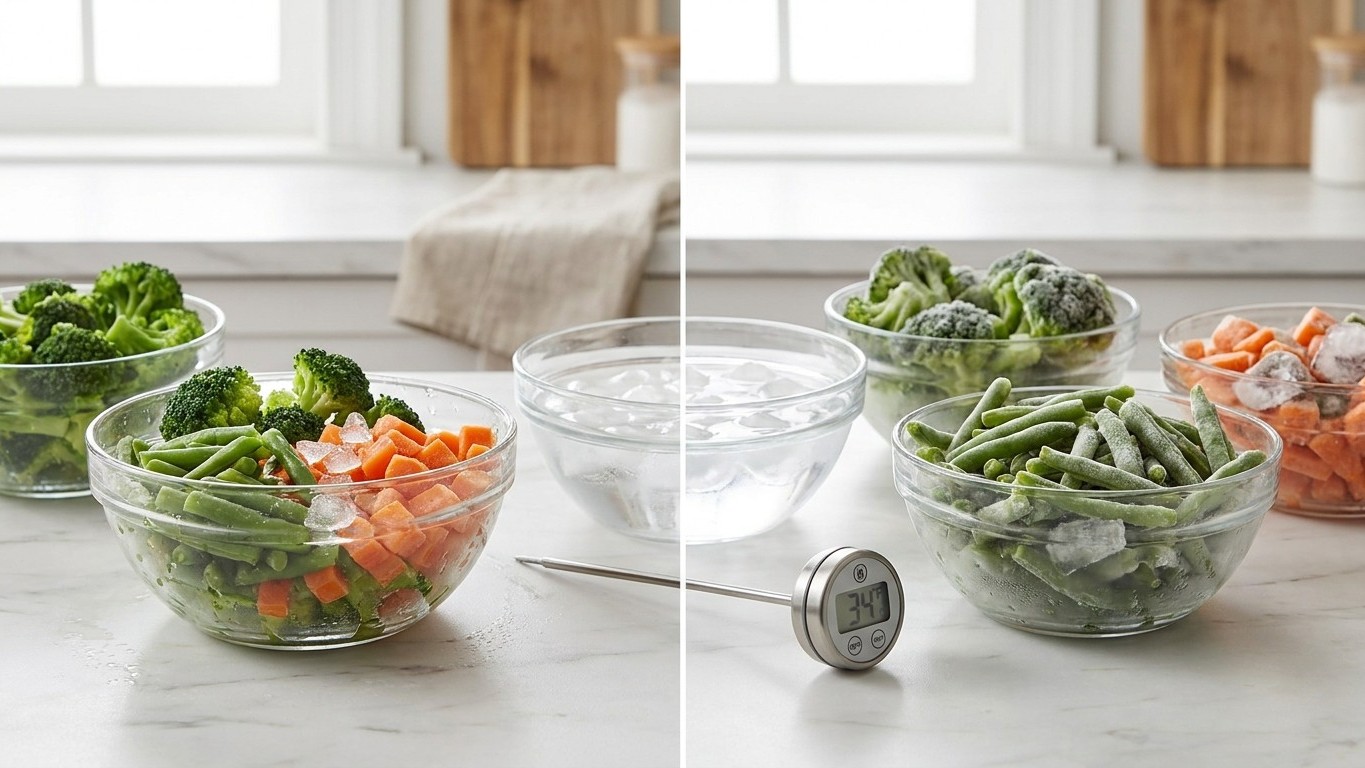

Losing texture, color or flavor after freezing usually traces back to what happened before the food ever went into the freezer, not to how it comes back out. The National Center for Home Food Preservation is blunt about this: freezing does not sterilize food, it only pauses what’s already there. What you saved is what you’ll get back, for better or worse.
The short answer

There’s no single number that answers “how do I thaw this without ruining it,” because the National Center for Home Food Preservation publishes tested guidance separately for each food category, and that guidance differs by what the food is and how it was prepared going into the freezer. What the Center does state plainly is the mechanism that governs everything downstream: freezing does not sterilize. It stops what is already there. That single fact reframes the whole question. Thawing isn’t really the moment where quality gets lost or preserved. It’s the moment where whatever was already true about the food, its enzyme activity, its microbial load, gets to resume.
That’s why the real answer to “will thawing ruin what I saved” starts earlier than most people expect. If vegetables went into the freezer without being properly blanched, the enzymes that cause loss of flavor, color and texture were never stopped. Freezing slows them down. It does not shut them off. So when you thaw that food, you’re not discovering a thawing problem. You’re discovering a blanching problem that’s been sitting dormant.
The same logic applies on the microbial side. Freezing doesn’t kill bacteria, molds or yeasts already present on the food. It arrests them. Thaw the food and you’re simply returning it to conditions where those organisms can become active again, at whatever rate the temperature and time allow. Nothing about the freezing process cleaned the food or reduced what was on it to begin with.
This is why the National Center for Home Food Preservation’s guidance is organized around the food, not around a generic “how to thaw” formula. A method that’s appropriate for one food can be inappropriate for another, because the starting conditions, moisture content, density, whether it was blanched, whether it’s raw meat or a cooked dish, all change what’s actually at stake during the thaw. Anyone looking for one blanket number is asking a question the science doesn’t support. The tested figures live in NCHFP’s food-specific references, and that’s where they need to stay.
What actually decides it
Two separate mechanisms determine what you get back when you thaw frozen food, and they operate independently of each other. Understanding both means you can reason through any food, not just the ones named here.
Enzymes don’t stop working just because you froze the food
Vegetables carry natural enzymes that keep working after harvest, breaking down color compounds, softening texture, degrading flavor. Blanching, a brief heat treatment before freezing, exists specifically to stop those enzyme actions. It also removes dirt and microorganisms from the surface and slows vitamin loss. The catch is that blanching has to be done right in both directions. Underblanching actually stimulates enzyme activity rather than suppressing it, which means a rushed or incomplete blanch can leave vegetables worse off than if they’d never been blanched at all. Overblanching swings the other way, cooking out flavor, color, vitamins and minerals before the food ever reaches the freezer. Both failures happen at the blanching stage, weeks or months before anyone opens the freezer door, but both show up as disappointment at thawing time.
Freezing doesn’t kill anything, it only pauses it
The second mechanism is entirely separate from enzymes. Whatever bacteria, yeast or mold was present on the food when it went into the freezer is still present when it comes out. Cold temperatures don’t reduce microbial counts the way heat processing does. They simply slow metabolic activity to a near standstill. That means the safety of thawed food depends heavily on what condition it was in before freezing and how it’s handled as it warms back up, since resuming activity is exactly what happens once temperatures climb. This is the mechanism that makes generic thawing advice risky to generalize: a food that was heavily contaminated before freezing carries that same risk after freezing, regardless of how carefully it was packaged or how long it sat frozen.
How to do it
- Before freezing, determine whether the food is one the National Center for Home Food Preservation recommends blanching, since this decision is food-specific and drives everything that follows.
- If blanching applies, follow the tested time listed in the NCHFP reference for that exact food, rather than estimating, since underblanching and overblanching each damage the food in different ways.
- As soon as blanching ends, cool the food at once in a large quantity of cold water at 60°F or below.
- Continue cooling for as long as the blanching itself took, matching the duration rather than cutting the cooling step short.
- Drain the food thoroughly before packaging it for the freezer, since trapped water affects texture on thawing.
- Package and freeze the food promptly, since freezing only pauses whatever condition the food is already in at that point.
- When it’s time to use the food, look up the thawing method the National Center for Home Food Preservation recommends for that specific food category before proceeding, since the appropriate method depends on the food itself.
What goes wrong
- Underblanching before freezing: a rushed blanch stimulates the very enzyme activity it’s meant to stop, leaving the food worse off than if it had never been blanched. The remedy is following the full tested time for that food rather than shortening it to save a few minutes.
- Overblanching before freezing: extending the blanch past what’s needed strips away flavor, color, vitamins and minerals before the food ever reaches the freezer. The remedy is stopping at the tested time, not adding a margin “just in case.”
- Slow or delayed cooling after blanching: letting hot vegetables sit before cooling lets residual heat keep cooking them and gives up the benefit of the blanch. The remedy is dropping them into cold water at 60°F or below immediately, and keeping them there as long as the blanching took.
- Assuming freezing “cleaned up” the food: freezing does not reduce whatever bacteria, yeast or mold was present beforehand, it only pauses them. The remedy is treating thawed food with the same care as fresh food, not less, since resuming activity is exactly what happens as it warms.
- Applying one thawing method to every food: a method suited to one food category isn’t automatically safe or effective for another, since starting moisture, density and prior preparation all differ. The remedy is checking the food-specific NCHFP guidance rather than reusing a method that worked for something else.
Where the exact figures come from
The National Center for Home Food Preservation, at the University of Georgia, maintains the tested tables that cover specific vegetables, meats and prepared foods, and that’s the source to check before freezing or thawing anything. A borrowed or estimated figure isn’t a shortcut, it’s a gap in the food safety testing that produced the real number, and gaps like that are exactly how enzyme damage or microbial risk slips through undetected, since neither one announces itself with taste or smell.
Common questions
Does freezing food longer make it safer?
No. Freezing pauses microbial activity, it doesn’t reduce it over time. A food that carried a risk when it went into the freezer carries the same risk however long it stays frozen.
Why did my frozen vegetables turn mushy even though I blanched them?
Both underblanching and overblanching cause quality problems, just in opposite directions. Underblanching leaves enzymes active enough to keep degrading texture in the freezer, while overblanching cooks the vegetable past the point of holding its structure. The fix is following the tested time for that specific vegetable rather than approximating it.
Is blanching only about food safety, or does it affect taste too?
Both. Blanching stops enzyme actions that cost flavor, color and texture, and it also removes dirt and microorganisms from the surface and slows vitamin loss. Skipping it or rushing it affects the food on every one of those fronts at once.
If I froze food without blanching it, is it unsafe to eat?
Safety and quality are separate questions here. Blanching mainly protects flavor, color, texture and vitamin content; freezing itself doesn’t sterilize food regardless of whether it was blanched. For guidance specific to a food that wasn’t blanched before freezing, check the National Center for Home Food Preservation’s reference for that food rather than assuming either way.