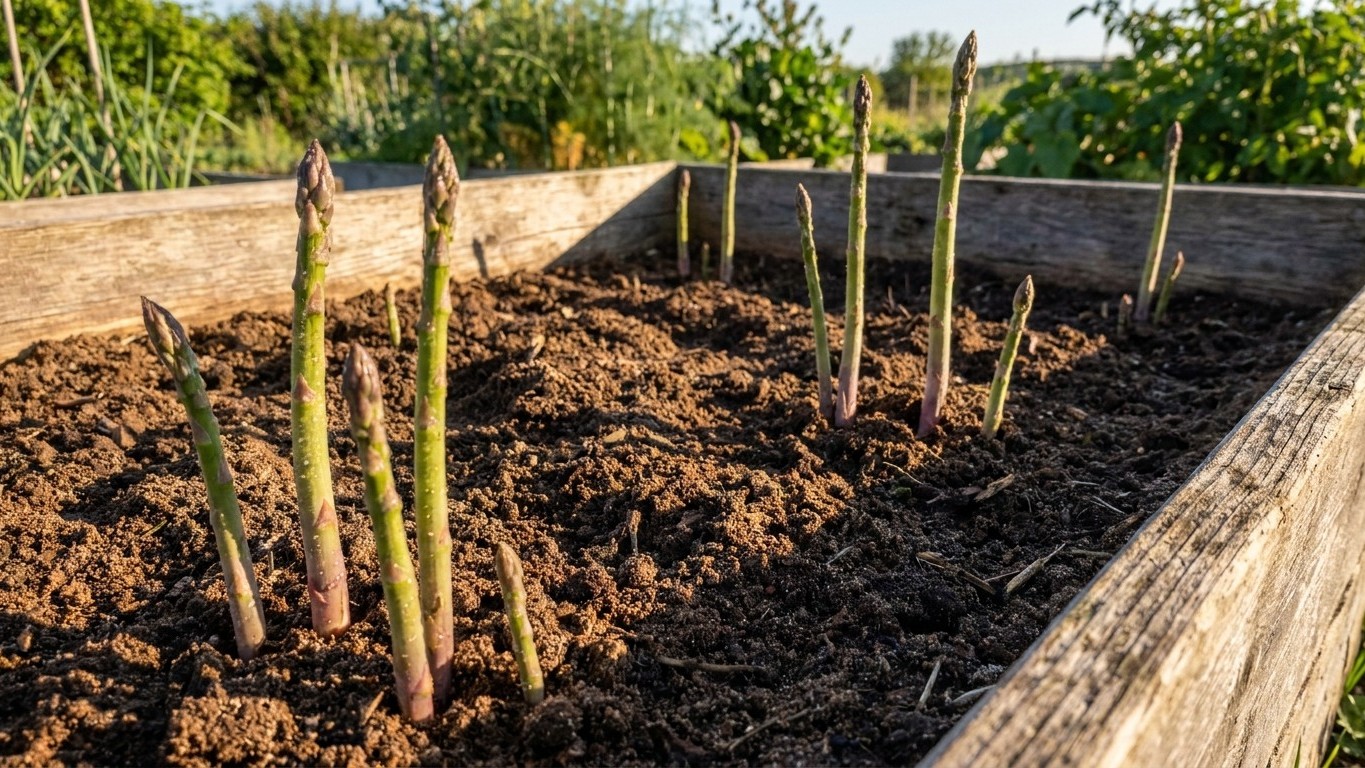

Yes, in most cases, and the reason has nothing to do with fertility. Asparagus doesn’t ask for rich ground or a particular pH here, it asks for drainage, and the soil type that represents Louisiana at the state level is sandy enough to shed water well. But “represents the state” is not the same as “matches your yard,” and that distinction is the whole story below.
The short answer
The soil USDA lists as representative of Louisiana is the Ruston series, an Ultisol, which is a technical way of saying it’s old, heavily weathered, and stripped of a lot of its natural fertility over time. Its surface runs slightly acid, around pH 5.5, and it’s built from about 65 percent sand, 11 percent clay, and 24 percent silt, with organic matter sitting around 1.8 percent. The one detail that matters most for a fifteen-year planting decision: it’s classified as well drained.
That’s the good news for anyone eyeing a permanent asparagus bed. Utah State University Extension, the source behind the asparagus figures used here, says the crop tolerates most soils as long as water doesn’t sit on the roots. A sandy, well-drained profile like Ruston clears that bar without much effort. Asparagus crowns go in once, and if the site is chosen well, that bed produces for 10 to 15 years, with no harvest at all in the first two seasons and the first real cutting arriving in year three. Once established, the harvest window itself grows over the following years, starting short and lengthening, and the rule for when to stop cutting each spring isn’t a date on the calendar but a look at the spears themselves: when most of them come up thinner than a pencil, the harvest is over for that year.
None of that works if the roots sit in standing water. A heavy, slow-draining spot turns a fifteen-year asset into a fifteen-year problem, because crowns that rot at the base can’t be dug up and moved next season the way a tomato plant can. If a gardener’s own ground holds water after a rain, a soil test, and not the state soil series, is what settles the question. Raising the bed six to ten inches above grade, or working coarse sand and organic matter into a native clay pocket, solves most drainage problems before the crowns ever go in the ground. What the source doesn’t say matters too: it’s silent on soil pH preference and silent on any chilling requirement, so neither belongs in a planting decision here, no matter how tempting it is to borrow a number from a different crop or a different region.
The state soil is a starting point, not a diagnosis of one garden. A single mapped series can’t account for a river-bottom lot, a hillside clay seam, or a yard where a builder scraped the topsoil and backfilled with something else entirely.
Will the summer here water it for you?
Asparagus has a simple watering script: 1 to 2 inches every other week for the first two years while the root system establishes, then a lighter schedule of the same amount roughly every three weeks once the planting matures. Louisiana’s summers deliver plenty of rain on paper, but paper totals and a thirsty root zone don’t always line up.
- What the sky delivers. Summer rainfall averages about 21.3 inches across June, July, and August combined, with June at 7.62 inches, July at 6.79 (the driest of the three), and August at 6.91, based on 1991-2020 normals from the reference weather station used for this region.
- What that means on paper. A young bed’s target of roughly 2 to 4 inches a month is well under what a typical summer month brings here, so on average, the sky alone appears to more than cover it.
- Why the average lies. Southern rain rarely falls in tidy, evenly spaced inches. It tends to arrive as a heavy afternoon thunderstorm that dumps an inch in twenty minutes and runs off a sandy surface before it soaks in, followed by a stretch of dry, hot days when evaporation outpaces anything left in the ground.
- What the sand does with it. A Ruston-type surface, sandy and well drained, lets water through fast, which is good for the crowns’ roots but bad for moisture retention between storms. That combination can leave a bed thirsty in week two even after a wet week one.
- The practical fix. A rain gauge on the actual bed, not a regional average, tells a gardener whether the last two weeks delivered the 1 to 2 inches asparagus needs. If a dry stretch runs past that window, supplemental watering fills the gap, especially through the July dip when the driest normal of the summer coincides with the hottest stretch of the year.
- Once the bed matures. The wider three-week window in later years gives the region’s rain patterns more room to even out on their own, though the same rain-gauge check still beats guessing.
When to put the crowns in
Crowns go in the ground in early spring, set into furrows about 8 inches deep. In this part of Louisiana, “spring” is a loose word. The last spring frost here falls, on average, somewhere between around January 18 and around February 8, and that range should be read as a mean, not a guarantee. A 32-degree freeze only shows up in about 86.8 percent of years at the reference station behind that figure, which means roughly one winter in seven skips a hard freeze entirely. Frost is a minor character in this region’s growing calendar. Summer heat, not a late cold snap, is the bigger factor shaping when and how a bed gets established.
Once the crowns are set in their furrows, the trench isn’t filled in all at once. Soil gets added back gradually, about 2 inches every other month across the first year, rather than mounded up in a single pass. That slow backfill lets the emerging shoots keep pushing through loose soil instead of fighting their way up through a deep, compacted trench.
Four named varieties turn up in the Utah State University Extension guidance, though the source stops short of ranking them on flavor, yield, or anything else: Jersey Giant and Jersey Knight are both all-male types, while UC 157 F1 and Purple Passion are male-and-female mixes. That’s the extent of what’s published, no nursery is named as a preferred source, and no variety is flagged as better suited to a sandy Southern soil than another.
Seed is the alternative route for gardeners who don’t start with crowns. It adds a season to the front end of the process, since the seedlings need to grow to crown size before transplanting into their permanent furrows, and the three-year wait for a first harvest starts only after that transplant. For most home gardeners working around this region’s frost window, starting from crowns in early spring stays the more direct path to a bed that’s still producing well over a decade later.
Common questions
Does asparagus need a specific soil pH?
The source behind these figures doesn’t publish a pH preference for asparagus, so no number should be attached to it here. What’s known is that the crop’s real requirement is drainage, not a particular acidity or alkalinity.
Can asparagus handle clay soil in Louisiana?
Not well, if that clay holds water. The state’s representative soil series is sandy and well drained, which suits asparagus fine, but a clay-heavy pocket in an individual yard needs a raised bed or amended drainage before crowns go in for a planting meant to last over a decade.
How many years until the first harvest?
None the first two years. The first cutting comes in year three, and the harvest window itself lengthens in the seasons after that, stopping each year once most spears come up thinner than a pencil rather than on a fixed date.
Does a hard freeze threaten young asparagus crowns here?
A 32-degree freeze happens in most years at the reference station for this region, but not all of them, roughly one winter in seven sees none at all. The source used here is silent on any winter chilling requirement for the plant, so that question doesn’t have a published answer at this level of detail.