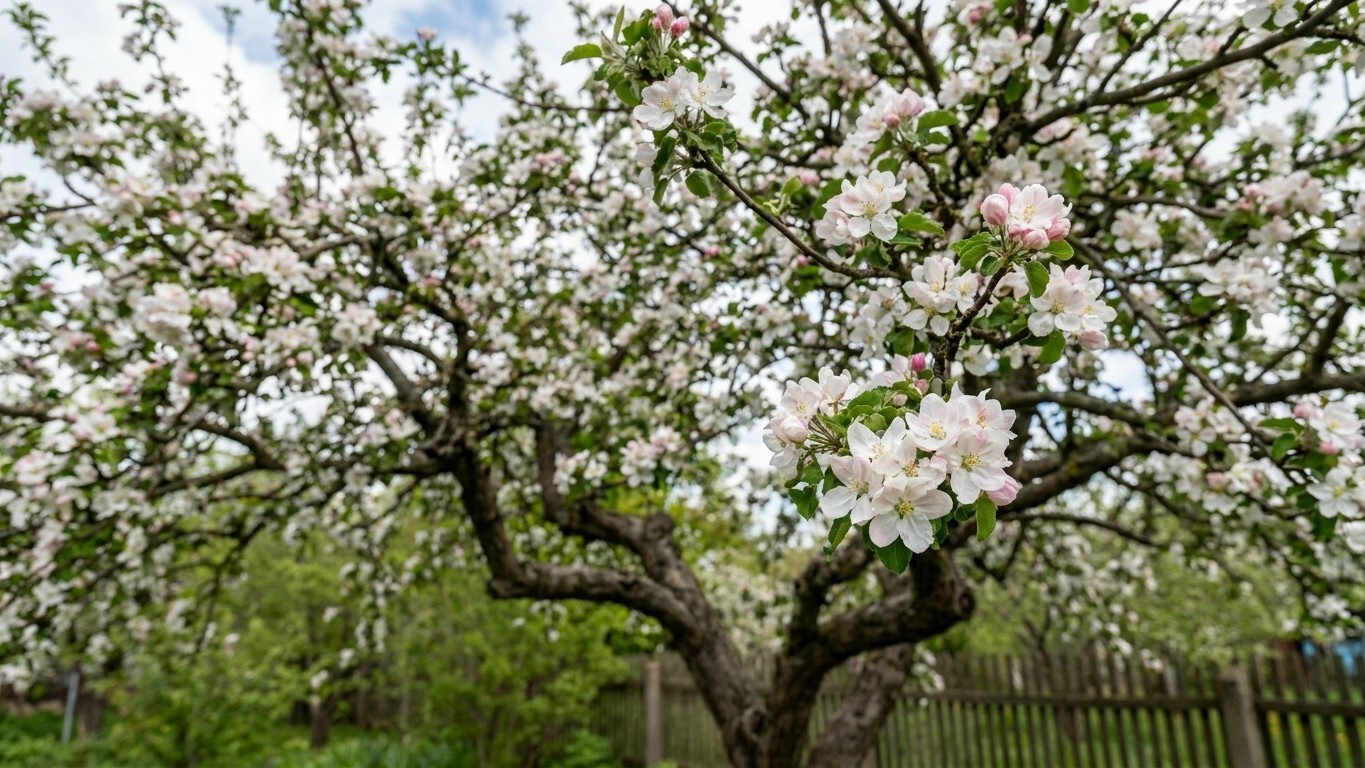

Prune fruit trees in Louisiana in late winter, after the hardest freezes have passed and before the buds swell. On the Gulf Coast, that means the weeks around the last spring freeze, which NOAA places between January 18 and February 8 for New Orleans. North Louisiana freezes harder and later, so the work slides back there. Fruit trees are pruned in late winter or early spring, after the coldest weather has passed and before growth begins.
The pruning window in Louisiana
The University of Minnesota Extension states the rule this way: “Fruit trees should be pruned every year in late winter or early spring, preferably after the coldest weather has passed and before growth begins.” That is a condition, not a date. Louisiana gardeners have to translate it using their own freeze records (and the answer differs a lot between Lake Charles and Shreveport).
For the New Orleans reference station, NOAA’s 1991-2020 Climate Normals put the last spring 32°F freeze in a band running from January 18 to February 8. That band marks where the chance of one more freeze sits between 30 and 70 percent. Plan to prune in the weeks around January 18 to February 8 on the coast, once no hard freeze is in the forecast, and finish before the buds swell. Move that plan later as you go north, because colder ground and a later last frost push every spring task back with them.
Why does pruning in deep winter risk cold injury?
A pruning cut opens living tissue that cannot seal itself until the tree starts growing again. If a hard freeze follows a cut made in January’s coldest stretch, the wood around the wound can die back past the cut, and the tree loses more than you intended. The risk is highest in the northern part of the state, where deep winter really is cold. Cutting after the coldest weather has passed means the wound can begin to heal as growth starts.
A forecast matters more than a calendar here. Check the extended outlook before you climb the ladder, and skip the day if a hard freeze is expected within the next several nights.
What changes in south Louisiana, where winters barely freeze?
The northern idea of waiting out a long, frozen dormancy does not fit the coast. NOAA’s normals give a mean daily minimum of 46.1°F in the coldest month at the New Orleans station, well above freezing. A 32°F freeze happens there in only 86.8 percent of years, so roughly one winter in eight has no freeze at all. Trees in those years never get the hard cold the textbook rule assumes.
So watch the buds and use the calendar as a guide. In a mild winter the trees may be close to waking up by the time the last-freeze band arrives, and the window shuts early. Here, summer heat and humidity are as much of a challenge for fruit trees as winter cold, which is why disease timing drives many of the decisions below.
The USDA Plant Hardiness Zone Map (2023, built on 1991-2020 normals) lists zones from 8b to 10a across the state, so conditions vary widely. New Orleans is the reference point for the dates above. If you garden farther north or inland, use your own area’s First and Last Frost Dates in Louisiana and shift your pruning date to match.
Apples and pears, then stone fruit
The right order is apples and pears first, then peaches and the rest. Pome fruit (apples and pears) tolerates pruning in the dormant window, while stone fruit does better when pruning is delayed. The reason is the same on both sides: which diseases can use a fresh wound, and when they are active.
When should apples and pears be pruned?
Apples and pears can be pruned during the dormant window, from after the worst cold until the buds begin to swell. Fire blight, a bacterial disease that blackens shoot tips and can kill whole branches, spreads in warm, wet spring weather and enters through wounds. Pears are the more vulnerable of the two. Cutting while the trees are still dormant means the wounds close or dry before conditions favor the bacteria.
Keep pear pruning lighter than apple pruning. Pears respond to heavy cuts with a burst of soft, upright shoots, and that kind of growth is exactly what fire blight likes best. If you see blackened, hooked shoot tips in spring, cut them out on a dry day, well below the damage into healthy wood, and clean your pruners before the next cut.
When should peaches and cherries be pruned?
Prune peaches and cherries after the coldest weather has passed and before growth begins, and avoid the depth of winter. Stone fruit is prone to canker diseases that enter through fresh wood, and those diseases are less of a threat when the tree is warming up and can seal the cut quickly. A wound made in cold, damp midwinter weather stays open longest and stays exposed longest.
Bloom arrives early in the Deep South, especially after a mild winter, so go by the buds and not by a set date. On the coast, that moment can come in the weeks following the last-freeze band. Pruning near bloom has a second benefit: you can see which flower buds survived a late freeze and which did not, and prune with the real crop in mind.
Cherries need an honest note. Cherries generally struggle in Louisiana’s heat, humidity and mild winters, so choose varieties carefully, but all follow the stone fruit timing. Peaches are a popular stone fruit in Louisiana home orchards, and an open, vase-shaped tree suits them better than a tall central trunk.
What to cut first
Start with the wood that is already a problem, then move to the wood that is about to become one. A reliable order is dead branches, damaged or diseased branches, branches that cross or rub, and finally thinning to let light into the canopy. Doing it in that order keeps you from removing healthy wood you would have lost anyway.
Dead wood is easy to spot because it is dry, brittle, and often has shriveled bark. Damaged wood includes broken limbs, storm-split crotches, and cankered branches. Crossing branches create friction wounds, and in a humid climate those wounds invite rot. Take out the weaker of each pair and keep the one that points away from the center of the tree.
How much can you remove in one year?
Avoid taking more than a modest share of the canopy in a single year. When too much goes at once, the tree answers with a flush of vertical water sprouts that shade the interior and carry no fruit. If a neglected tree needs major work, spread it over two or three winters. That staged approach follows the same logic as renewal pruning for shrubs, where an overgrown shrub is rebuilt a little at a time.
Make each cut just outside the swollen collar at the base of a branch, and leave no stub. Wound paint is not needed. For apples specifically, the step-by-step details on training and spacing are in the guide to pruning an apple tree in winter.
How do you open the canopy in a humid climate?
Thinning matters more here than in a dry state. Louisiana’s humidity keeps leaves wet after rain and dew, and wet leaves in a crowded canopy mean scab, leaf spot, and brown rot on fruit. Cut so that sunlight reaches the inner branches and air moves freely through the tree. A good test is whether you can see daylight through the canopy from a few feet away.
Aim for strong, well-spaced scaffold branches rather than a dense tangle of small ones. Remove growth that heads straight up or straight down into the center, and keep branches that angle outward. That shape also puts the fruit within reach, which counts for something when summer harvest means ladder work in 90°F heat.
What goes wrong
Pruning damage often comes from timing and from enthusiasm. A few common mistakes are behind much of it, and each has a simple fix.
Pruning during a cold snap leaves fresh cuts exposed to freezing temperatures. The fix is to check the forecast and wait for a milder stretch. Do not prune in fall. Cuts made then prompt new, tender growth, and in Louisiana the first freeze may not arrive until around the turn of the year, or in some years not at all. That soft growth never hardens off properly, and a late cold night can kill it back into older wood.
Topping, which means chopping the main branches back to stubs, is a poor way to control height. The tree responds with a thicket of weak shoots below each cut, the stubs often decay, and the canopy ends up denser than before. If a tree has outgrown its space, reduce it gradually by cutting back to a side branch large enough to take over as the new leader.
Heavy cutting leads to water sprouts, the fast, vertical shoots that crowd the interior. Pruning them off in summer is fine, but the real remedy is to avoid the heavy cut in the first place. Summer pruning should stay light, because sudden exposure to full Louisiana sun can scald bark that was shaded the day before.
Common questions
Can I prune fruit trees in summer in Louisiana?
Light summer work is fine, such as pinching off water sprouts and removing a broken limb. Major cuts should wait for the dormant window. Heat stress is already a major problem for fruit trees here, and removing a large share of leaves in July gives the tree one more thing to cope with. Newly exposed bark can also scald in strong sun.
When do I prune figs and citrus?
Figs can be pruned in late winter before growth resumes, and old, crowded ones can be thinned a little each year. Citrus is more cold-sensitive. Wait until the danger of a hard freeze has passed, then trim lightly in spring, because cuts stimulate new growth that a freeze would damage.
What if a warm spell in January wakes the trees early?
Prune soon if the buds are still tight and the forecast looks safe. If the buds are already swelling, cut only what must go, such as dead or broken wood, and leave the rest of the shaping until just after bloom for stone fruit. Avoid pruning right before a forecast freeze, since open wounds and early growth are both vulnerable.
How can I tell the buds are about to break?
Look at the tips of last year’s shoots. Buds that are plump, lighter in color, and beginning to show green or pink at the tip are close to opening. Tight, dark buds still have time. When in doubt, your parish extension office can tell you how far along local trees are. Seasonal timing for other garden jobs is laid out in the Louisiana guides.
Sources: ncei.noaa.gov | extension.umn.edu