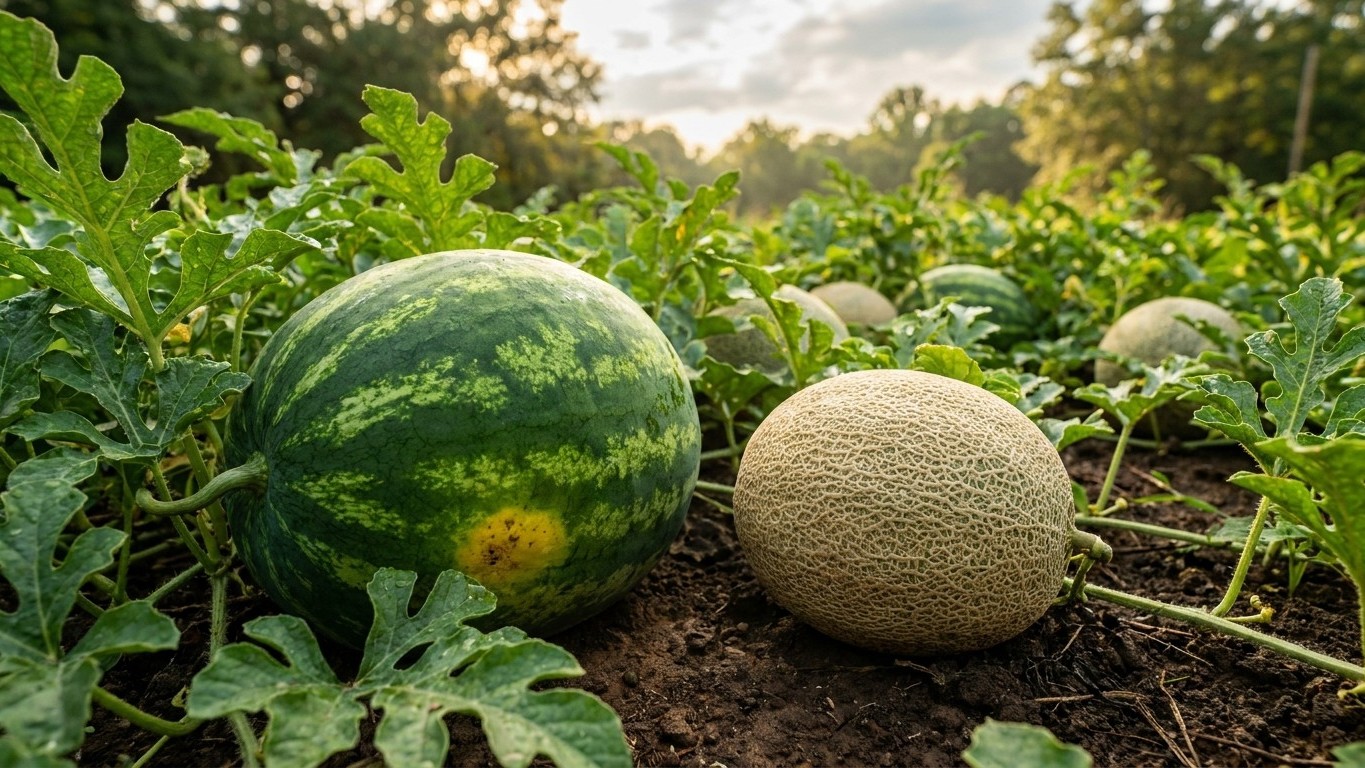

Louisiana’s long, muggy growing season rewards melons chosen for heat and disease tolerance over sheer size or sweetness claims on a seed packet. Watermelon handles the climate best, cantaloupe works with the right disease package, and honeydew is the riskiest bet of the three. The deciding factor isn’t the calendar. It’s what survives a Louisiana July.
The short answer for Louisiana
Start with the numbers that actually run this state’s growing season. New Orleans averages 70.7 days a year at or above 90°F. That’s not a heat wave, that’s ten weeks of sustained stress on pollen viability and fruit set. Pair that with summer rainfall of roughly 21.3 inches across June, July and August, on top of 63.4 inches for the year, and you’ve got a climate that’s less “hot and dry” and more “hot and wet,” which is a completely different set of problems for a vining crop.
Watermelon is built for exactly this. Its vines tolerate high heat better than any other melon crop grown in home gardens, and modern disease-resistant lines handle Fusarium wilt, a soil fungus that thrives in warm, damp ground like Louisiana’s. Smaller, icebox-type watermelons mature faster than the 80-pound heirloom types, which matters here because a shorter time from flower to harvest means fewer weeks of exposure to disease pressure building in humid air.
Cantaloupe, sometimes called muskmelon, can do well too, but only with varieties bred for resistance to powdery mildew and downy mildew, the two fungal diseases that spread fastest in the kind of summer humidity Louisiana produces on a near-daily basis. Skip cantaloupe varieties marketed for arid Western growing regions. They weren’t tested against this kind of moisture load.
Honeydew is the outlier. It generally prefers lower humidity than what Louisiana summers deliver, and its thinner disease-resistance packages compared to modern watermelon and cantaloupe cultivars make it the hardest of the three to bring to a clean harvest here. That doesn’t mean it’s impossible. It means a gardener choosing honeydew is accepting more risk than a gardener choosing watermelon, and should budget for it with tighter disease monitoring.
None of this decision comes from a “days to maturity” number printed on a seed packet. It comes from matching a variety’s built-in resistance traits to the two things Louisiana’s climate actually throws at a melon vine: sustained heat above 90°F for ten-plus weeks, and humidity levels that keep foliage wet longer than in a drier state.
What will not work here
Slow-maturing heirloom melons are the first casualty. A variety that needs 90 or more days from transplant to harvest pushes its critical fruit-set window into the hottest stretch of the year, when Louisiana is logging most of its 70.7 annual days above 90°F. Above certain temperatures, pollen becomes less viable and pollinator activity drops off during the hottest parts of the day, which means blossoms open, don’t get pollinated, and drop. A gardener who planted a 95-day melon expecting a long harvest window is instead watching flowers fail during the peak of summer heat.
Varieties bred for the arid West are the second failure point. Those melons were selected for regions where 21.3 inches of summer rain would be a wet anomaly, not a normal expectation. Here, that same rainfall total, spread across June’s 7.62 inches, July’s 6.79 inches, and August’s 6.91 inches, arrives on top of heat that speeds evaporation and humidity that keeps leaf surfaces damp between storms. A melon without built-in resistance to downy mildew or gummy stem blight will show yellowing, spotted foliage by midsummer, and the vine often collapses before fruit finishes ripening.
Weekly watering schedules copied from a drier-climate gardening guide also fail here, but not for the reason most people expect. The issue isn’t too little water, it’s mistimed water on top of what the sky is already delivering. July’s rainfall averages 6.79 inches, the lowest of the three summer months, but that figure is a normal, not a guarantee, and it still arrives as periodic downpours rather than a steady drip. Adding a fixed weekly irrigation schedule on top of unpredictable summer storms can leave soil saturated exactly when the vine needs air at its roots, encouraging root rot and the same fungal problems the humidity already favors.
Tight vine spacing is the last common mistake. Standard spacing guidelines built for drier states don’t account for how much longer leaves stay wet in Louisiana’s humidity. Crowded vines trap moisture at the canopy level, and that trapped moisture is what lets powdery mildew and downy mildew spread from plant to plant. Wider spacing than the seed packet suggests, with airflow prioritized over squeezing in an extra plant, matters more here than in a drier growing region.
What changes across Louisiana
Louisiana spans USDA hardiness zones 8a to 10a, and that range covers a real climate difference, not a technicality. The zone system is built on one measurement only, the average annual extreme minimum temperature, so it doesn’t describe humidity or heat directly. But it’s still a useful proxy for how differently the state’s north and south ends behave for a melon grower.
The reference station used for the frost dates in this article sits near New Orleans, deep in the warmer end of that zone range. There, a 32°F freeze happens in only 86.8 percent of years, meaning roughly one winter in seven sees no freeze at all, and the fall frost window straddles the New Year. That’s a climate where the limiting factor on a melon crop is summer heat load, not frost risk. A South Louisiana gardener isn’t racing a frost date so much as racing the hottest stretch of the calendar.
North Louisiana, sitting toward zone 8a, freezes far more reliably every winter. A gardener there is working with a shorter, more clearly bounded frost-free window than someone near the Gulf Coast, which changes how much margin there is for a slow-maturing variety or a delayed planting.
There isn’t one answer for “when does the season end” across a state with this much internal spread. A gardener in the northern parishes is managing a real frost boundary; a gardener near the coast is managing a summer heat ceiling instead, with frost as a much smaller factor most years. This page can’t tell an individual reader which zone their county falls into. The USDA Plant Hardiness Zone Map does that, and it’s worth checking before betting a planting date on a statewide range.
Where to check this for your own county
This page describes Louisiana at the state level, and that’s its limit. A county recommendation will always beat a state one, because it accounts for local soil types, microclimates, and the actual disease and pest pressure documented in that specific area over multiple growing seasons.
The LSU AgCenter is the state’s land-grant extension service, and it publishes exactly the two things this article can’t: a local planting calendar tuned to the reader’s own parish, and variety trial results showing which specific melon cultivars have actually performed well in Louisiana test plots, not just in theory.
When checking the AgCenter’s resources, look for planting date guidance broken out by region within the state, since the frost and heat differences between the north and the Gulf Coast are significant enough to shift a recommended sowing window by weeks. Look also for any published lists of melon varieties trialled at Louisiana research stations, since those trials test performance against the state’s actual humidity and disease pressure, not against a generic national average.
A statewide article like this one is useful for understanding why certain melon types are favored over others here, the mechanics of heat load, humidity, and disease resistance that shape the decision. It is not a substitute for a parish-level planting calendar. Treat this page as the reasoning, and the AgCenter’s county-level guidance as the specific dates and variety names to act on.
Checking this against your own garden
Every fact in this article is a regional average, built from station data collected over a 1991-2020 period. A reader’s own backyard, with its own soil, drainage, and sun exposure, will always outrank a climate normal, and there are three simple things worth watching that don’t require any equipment.
Soil warmth, checked by hand, is the first. Melon seed germinates poorly in cold soil no matter what a calendar date says. Pressing a hand into the planting bed and feeling for warmth well below the surface, not just at the top inch, gives a better read on whether the ground is actually ready than any printed date.
The first flush of male flowers is the second signal. Melon vines produce male blossoms before female ones, and a garden that’s pushing out male flowers early is telling the grower that the plant considers conditions favorable for reproduction to begin soon. A garden that lags behind a neighbor’s on this timing is running on its own, slightly cooler or shadier, microclimate.
The appearance of first true leaves, the leaves that emerge after the initial seed leaves and actually resemble a mature melon leaf, is the third. Their timing and vigor show how well the plant is handling the specific combination of soil, sun, and moisture in that exact spot, which is the only combination that actually matters once seed is in the ground. A calendar date is a starting estimate. What the vine is doing in front of the gardener is the correction.