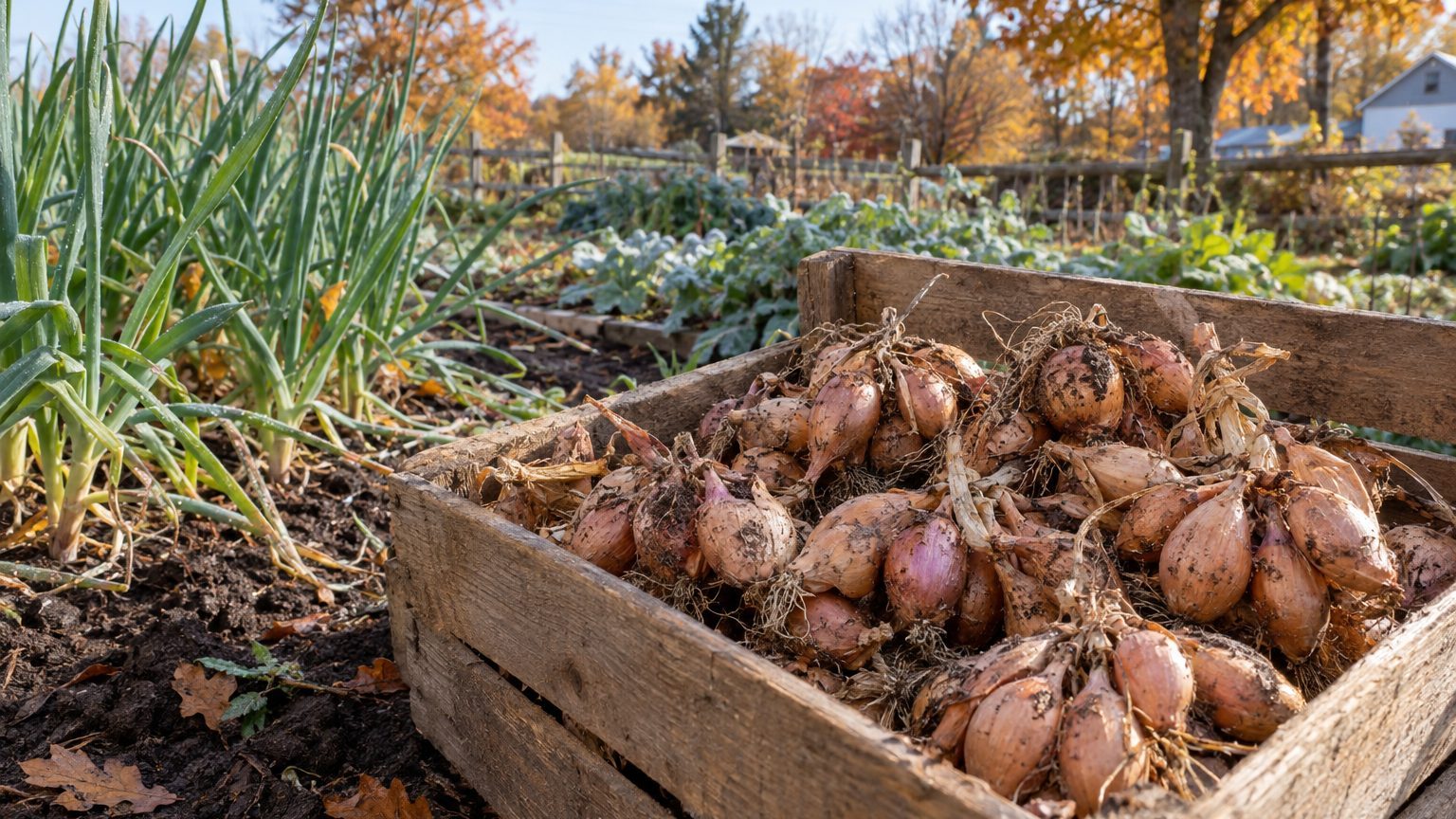

For most Louisiana gardens, the best shallots are multiplier types grown from small bulbs and planted in fall, because they size up before summer heat arrives. Seed-grown shallots can work but carry more risk, and spring-planted northern types usually disappoint. Frost barely enters the picture here. Heat and humidity decide the outcome.
The short answer for Louisiana
Choose by type, not by catalog name: fall-planted multiplier shallots from bulbs or divisions first, seed-grown shallots second, and anything that needs a long, cool spring to finish last. That ranking follows from the numbers. The page’s reference station, New Orleans, has a last spring freeze window of January 18 to February 8 and a first fall freeze window of December 17 to January 8. Both are a probability of a 32°F freeze, specifically the band where that chance runs between 30 and 70 percent. Neither is a guarantee of when frost arrives.
Those windows are unusually close together, and the station itself explains why. A 32°F freeze occurs in only 86.8 percent of years there, so roughly one year in seven has no freeze at all. The fall window also straddles the New Year. The coldest month’s mean daily minimum is 46.1°F, which is nowhere near cold enough to threaten a hardy allium. So a shallot planted in autumn is not racing a killing frost. It is racing the arrival of summer.
That is why the sensible types are the ones that grow through the mild months and finish early. A multiplier shallot planted as a small bulb already has a head start, because it skips the slow seedling stage. A seed-grown shallot has to build leaves from nothing, which eats into the cool weeks you have.
| Type | Fit for Louisiana | Reason |
|---|---|---|
| Multiplier shallots from bulbs, planted in fall | Best bet | Quick start, finishes before peak heat |
| Seed-grown shallots, started early | Workable, riskier | Slow seedling stage uses up cool weather |
| Spring-planted northern types | Poor | Heat arrives before bulbs fill |
| Perennial “green” shallots for tops | Reliable | Harvest leaves, not bulbs |
One local wrinkle: in many Louisiana kitchens, “shallots” means green onions, the leafy bunches. If that is what you want, the multiplying types are close to foolproof. For the true bulbing kind, the Growing Shallots in Louisiana overview covers the basics, and the When to Plant Shallots in Louisiana page handles timing.
What will not work here
Spring planting is the first casualty. Gardeners moving south from colder states bring the habit of setting shallots out as soon as the soil thaws. In Louisiana the last freeze window is already over by early February at the latest, and the warm months come fast afterward. A shallot started then has only a short stretch of cool weather to bulk up, and the bulbs often stall or sprout again in the heat.
Waiting on a freeze
Do not plan around frost the way a northern gardener would. With a 46.1°F mean minimum in the coldest month, and about one year in seven with no 32°F freeze at all, winter here is a growing season, not a dormancy. Cold-dependent routines, such as holding bulbs for a hard chill or timing planting to a killing frost date, have no reliable cold to lean on. Frost cloth is a rare tool, not a routine one.
Slow types and tight spacing
The slowest shallots, the ones bred for long northern seasons, run out of cool weather before they finish. Humidity punishes the next habit, which is crowding. Northern spacing advice often puts bulbs 4 inches apart. In a damp climate that leaves foliage wet for long stretches, and fungal disease and bulb rot follow. Giving plants closer to 6 inches, and a bed with fast drainage, keeps air moving. Raised beds help on heavy clay soils, and so does keeping mulch thin and pulled back from the bulb necks.
Watering is the quieter mistake. A weekly soaking that suits a dry-summer state can drown shallots in a place where rain arrives in heavy bursts. Bulbs sitting in saturated soil as they mature are the ones that rot in the bed. Stop supplemental watering as the tops begin to fall over.
Curing fails too. Pulled bulbs need dry air to form their papery skins, and a humid late spring stalls that. Cure them under cover with plenty of airflow, not stacked in a closed shed, or you will find soft, moldy bulbs a month later. This page does not have summer temperature figures for any Louisiana station, so treat “heat” here as the direction of the problem, not a measured threshold.
What changes across Louisiana
Louisiana is not one garden. The USDA Plant Hardiness Zone Map (2023 edition, built on 1991-2020 normals) places the state in zones 8a to 10a. That runs through 8a, 8b, 9a, 9b and 10a, so there is no single zone and no single answer. The zone rests on one variable, the average annual extreme minimum temperature, so it tells you about cold survival and says little about summer heat or humidity.
The dates on this page are tied to New Orleans as the reference. North Louisiana freezes much more reliably than the coast, so a reader there should expect real winter cold, a later spring warm-up and a somewhat longer bulking window. That reader can lean toward the earlier part of the fall planting window, accept a slower type, and keep frost cloth handy for the odd hard freeze after growth starts. A reader near the Gulf should favor the quickest-finishing multipliers and treat the frost windows as background.
No page can tell you which zone your yard sits in. Look your location up on the USDA Plant Hardiness Zone Map by ZIP code, then read the result as a hint about winter cold only. Two gardens in the same zone can still differ by weeks in when the heat shuts bulbing down.
Where to check this for your own county
Your state extension service is the next stop. In Louisiana that is the LSU AgCenter, the land-grant university’s extension arm. Louisiana divides into parishes rather than counties, but the idea is the same: every parish has a local extension office staffed by agents who know your soil, your rainfall and your disease pressure.
Two things are worth finding there. The first is a local planting calendar for onions and shallots, ideally one written for your part of the state and not the whole of it. The second is a list of varieties trialled in your parish or nearby, with notes on which ones finished early, held up in the wet and stored well. A trial result from a research station a few hours away is worth more than any general ranking, including this one.
A county or parish recommendation beats a state one, and this page is the state one. It gives you the decision by type and the reasons behind it, drawn from one reference station and a statewide zone range. It cannot know whether your lot drains well or sits in a frost pocket. If the local calendar and this page disagree, follow the local calendar. Once you have a date from your parish office, the planting calendar page shows how it fits with the broader window.
Checking this against your own garden
Your own observations outrank every date here. Three are worth watching, and none needs equipment.
- Soil warmth by feel. Push your hand a few inches into the bed in the morning. If it still feels cool and a little damp, you are in the shallot window. If it feels like bathwater, you are late. Beds that warm early are your hot spots, so plant there first and expect earlier finishing.
- First true leaves. After planting, note how fast green shoots appear and thicken. Quick, sturdy growth means your microclimate is kind. Slow, spindly growth in a shaded or waterlogged corner says that bed will not carry a crop.
- Flower stalks and falling tops. A flower stalk pushing up from a shallot is a warning that stress, often from temperature swings, has triggered bolting. Tops falling over signals bulbs nearing maturity. Whichever you see first tells you how much margin your yard really has.
Write down the dates you see these in a notebook. After two seasons, your own log will be a better calendar than anything printed.
Common questions
Can I plant grocery-store shallots?
Sometimes they sprout, but you will not know the variety or how the bulbs were stored. Try a few in a test row before committing a bed, and favor bulbs sold for planting.
Are Louisiana “shallots” the same thing?
Often not. Locally the word frequently means green onions. Bulbing shallots are a different crop with different timing, though the multiplying types can supply both leaves and bulbs.
Do shallots need a freeze to grow well?
No. Freezes occur in only 86.8 percent of years at the New Orleans reference station, and the coldest month’s mean minimum is 46.1°F. Shallots handle that without trouble.
Can I plant in spring instead?
You can, but results are weaker. Heat arrives before the bulbs fill, so fall planting is the safer plan.