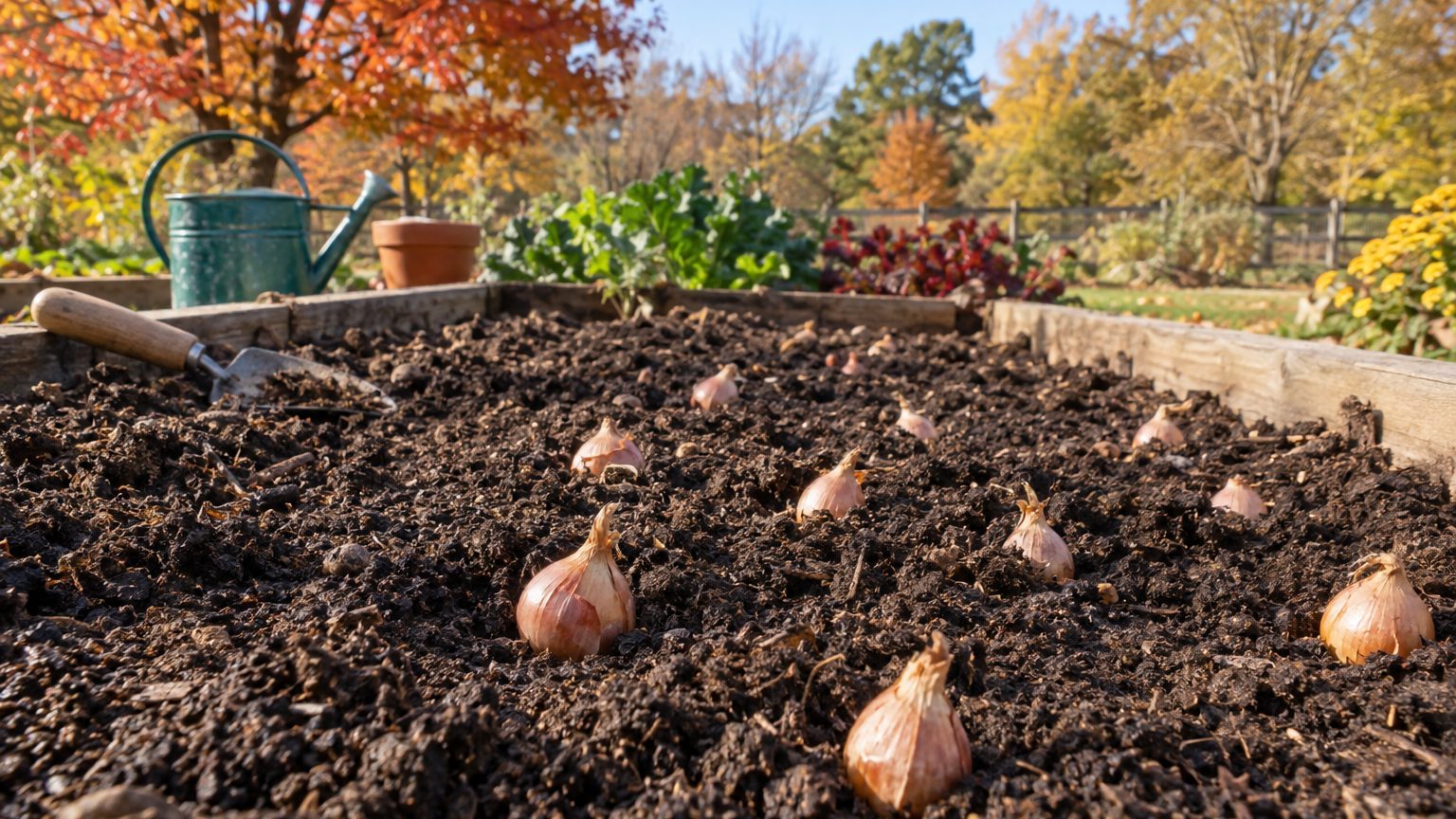

Plant shallots in Massachusetts in fall, roughly four to six weeks before the ground freezes, or in early spring as soon as the soil can be worked. Near Boston, the fall window runs from late September to mid-October. Inland and in the Berkshires, it opens and closes earlier. With today’s date being October 8, coastal gardeners still have time, while hill-town gardeners may be running out of it.
The short answer for Massachusetts
Federal climate data gives the planting calendar for shallots in Massachusetts its anchor points. NOAA’s 1991-2020 Climate Normals, measured at Boston’s Logan Airport, put the last spring frost at April 1 to April 8 and the first fall frost at November 3 to November 14. Both ranges are probabilities of a 32°F freeze, not promises: they mark the band where the odds of a freeze on or after (spring) or on or before (fall) that date sit between 30 and 70 percent. A frost can still show up outside them.
The fall window comes from counting backward. Shallots need time to grow roots before the soil locks up, but not so much time that they send up tall tops. A common rule of thumb is four to six weeks before hard freezing. Counting back from November 3 to 14 gives a rough span of late September to mid-October at Logan. That is my arithmetic from the frost dates, not a published Massachusetts recommendation.
| Planting season | Logan frost anchor (NOAA 1991-2020) | Working window |
|---|---|---|
| Fall | First frost November 3 to November 14 | Late September to mid-October, counted back four to six weeks |
| Spring | Last frost April 1 to April 8 | As soon as the soil is workable, without waiting for the frost date |
That spring row surprises people. Shallots shrug off light frost, so the last-frost date is a reference point rather than a starting gun. A bed that crumbles in your hand in late March is ready, even if the calendar says a freeze is still possible.
Fall planting tends to produce larger bulbs, because the roots are already working when spring growth starts. Spring planting is the fallback for anyone who missed October. For the full growing picture, see Growing Shallots in Massachusetts. Variety choice is a separate decision, covered in The Best Shallots to Grow in Massachusetts.
What will not work here
Copying the Logan dates inland is the first mistake. The station sits on the harbor, and the data comes with a warning: it is the mildest spot in the state. Inland suburbs and the Berkshires frost earlier in fall and later in spring. A gardener in the hills who counts back from November 3 will plant weeks after the ground has started to turn hard. Treat the coastal window as the latest possible, not the typical.
Planting too early fails too, in a quieter way. A bulb set in late August or early September, while the soil is still summer-warm, can push out a tuft of green before winter. Soft top growth is exposed growth, and Massachusetts winters bring plenty of cold. In Boston, the average daily minimum in the coldest month is 23.1°F (NOAA 1991-2020, Boston reference station). That figure describes the city, not the state, and the hills run colder. Fall shallots need roots, not a tall top, which is why the four-to-six-week count matters.
Skipping mulch is the third failure, and it matters more as you move away from the coast. Where winters swing between freezing and thaw, bulbs can heave out of bare soil and sit exposed. A few inches of straw or shredded leaves laid after the ground has begun to freeze keeps the soil steadier. Pull it back in spring once growth starts.
Waiting for spring to feel like spring is the fourth. A gardener who holds off until the last frost has passed may plant in mid-April or later at Logan, and later still inland. Late-planted shallots have less time to size up before the tops fall over and bulbs mature. The season is long enough on paper: from early April to early November is about seven months on the coast. But it shrinks inland, and the early weeks in cool soil are where shallots do their best root work.
One more thing doesn’t work: treating frost dates as a switch. The 30-to-70-percent band means some years the first freeze comes before November 3 and some years well after November 14. A gardener who plants on the very last day of the window, in a cold-air pocket, is betting against the odds.
What changes across Massachusetts
Massachusetts is not one garden. The USDA Plant Hardiness Zone Map 2023 (built on 1991-2020 normals) places the state in zones 5a through 7b, six half-zone steps. The zone system rests on a single variable, the average annual extreme minimum temperature, so it says how cold the worst nights get and nothing about how long the season runs. There is no single answer for the whole state, and a planting date for Cape Cod should not be copied in Pittsfield.
The direction of the shift is predictable. Near the coast, the water holds heat longer in fall and releases it slowly in spring, which stretches the window in both directions. Moving inland and uphill, fall frost arrives earlier and spring thaw later, so the fall window moves earlier and the spring window later. In the Berkshires, a gardener should plan to plant earlier in the fall than the Logan count suggests and mulch more heavily. The Logan figures are the mildest case, so any shift from them runs one way: sooner in fall, later in spring.
Microclimate adds a second layer inside any one zone. A south-facing bed against a foundation warms faster than a low, shaded corner where cold air pools on still nights. Raised beds drain and warm earlier in spring than flat ground. Two gardens a mile apart can differ by a week or more, and no state map will capture that.
To find which zone applies to you, use the USDA Plant Hardiness Zone Map and look up your ZIP code. This page cannot tell you which zone you are in, and the answer matters mostly for deciding how much mulch and how early to plant.
Where to check this for your own county
The best next stop is UMass Extension, the state’s land-grant extension service. Its staff work with Massachusetts growers across very different conditions, from the coast to the Connecticut River Valley to the Berkshires. Look for two things there: a local planting calendar for alliums (garlic and onions are close relatives and often covered together), and notes on varieties trialled in your county. A shallot that sizes up well in a trial plot near you is better evidence than a catalog description.
Plainly, a county recommendation beats a state one. This page is the state one. It rests on one coastal station and a statewide zone range, so it gives you a defensible starting point, not a verdict for your yard. Extension offices know local soil, local frost pockets and the pests that show up in your area, none of which a state page can see.
If you can’t find a shallot-specific page, garlic planting guidance is often the nearest proxy, since both are fall-planted bulbs with similar timing. Treat it as a proxy, though, and say so to yourself: the dates are close, not identical. The frost data behind this page comes from NOAA’s 1991-2020 Climate Normals, and it covers one station only. Use it for context, not for your own address.
Checking this against your own garden
Your own observations outrank every date above. Three are easy and need no equipment.
- Soil warmth by feel. In fall, push a hand into the bed: if it feels cool but not cold and crumbles rather than clumps, roots can still grow. If it’s already stiff, you are late. The spot that stays warmest longest is your mildest microclimate.
- First green shoots. If fall-planted bulbs show more than a short green tip before freeze-up, you planted early or the bed is warm. Next year, plant a week later. In spring, the day shoots break through tells you how your bed compares with the neighbors’.
- First frost on your own lawn. Note the morning that frost whitens the grass or blackens basil, and compare it with the November 3 to 14 range. Earlier means your site is colder than Logan, and your window should shift earlier too.
Keep a note of those dates for two or three seasons. A short log of planting day, first shoots and first frost will serve you better than any statewide table.
Common questions
Is it too late to plant shallots in Massachusetts on October 8?
Not on the coast, where the working window runs to about mid-October by the count above. Inland and in the Berkshires, it may be closing or closed, so plant now and mulch once the ground begins to freeze. If the ground is already hard, spring planting is the fallback.
Can I plant shallots in spring instead?
Yes. Plant as soon as the soil is workable, which can be before the April 1 to April 8 last-frost range at Logan has passed. Expect smaller bulbs than from fall planting, since roots have less time before summer.
Do the frost dates on this page apply to my town?
Probably not exactly. They come from Logan Airport, a waterfront urban station and the mildest spot in the state. Inland towns and the Berkshires frost earlier in fall and later in spring, so adjust accordingly and check with UMass Extension.
How much mulch do fall-planted shallots need?
Enough to keep the soil from swinging between freeze and thaw: a few inches of straw or shredded leaves, applied after the ground starts to freeze. Pull it back in spring as shoots emerge. In the hills, where winters run colder than Boston’s 23.1°F mean daily minimum, lean toward the thicker layer.