
Louisiana gardeners get two shots at winter squash: a spring sowing once the region’s brief freeze risk clears in February, and a second sowing in late July or August aimed at a fall harvest. Frost barely limits either window here. Summer heat does the real damage, and that changes how this calendar should be read compared to almost anywhere else.
The short answer for Louisiana
Sow winter squash directly in the ground between mid-February and March for a summer harvest, then again from late July into August for a fall crop. Those two windows come straight from the NOAA station data for this region (station USW00012916), and they need a little unpacking because Louisiana’s frost dates don’t behave like a normal planting calendar.
The last spring frost here falls between January 18 and February 8, and the first fall frost arrives between December 17 and January 8. Read that again: the fall frost window opens in mid-December and the spring frost window can still be running in early February. That’s not two seasons bracketing a long freeze-free summer, that’s a narrow, mild winter squeezed between two long growing seasons. And even within that narrow window, a 32°F freeze only shows up in 86.8 percent of years at this station. Roughly one winter in seven skips a freeze entirely.
That’s why the frost dates aren’t the limiting factor for Winter Squash in most of Louisiana. The limiting factor is the 70.7 days a year averaging 90°F or hotter, most of them stacked between June and August. Winter squash flowers stop setting fruit reliably once daytime heat gets that extreme and humid, so the spring sowing exists to get pollination done before the worst of that heat load arrives, not to dodge a freeze.
| Window | Sowing dates | What it’s racing | Main risk |
|---|---|---|---|
| Spring | Mid-February to March | Fruit set before peak summer heat (June-August) | Pollination failure above roughly 90°F |
| Fall | Late July to August | Maturity before first frost (Dec 17-Jan 8) | Seedling stress during the tail end of summer heat |
One caution worth stating plainly: these dates come from a single reference station representative of south Louisiana. The page doesn’t have separate frost data for the northern part of the state, and that matters, because north Louisiana freezes far more reliably than the coast does.
What will not work here

Watering on a fixed weekly schedule fails in a Louisiana summer. The region gets about 21.3 inches of rain across June, July and August, which sounds generous, but it doesn’t arrive evenly. July, the driest of the three summer months, still averages 6.79 inches, while June brings 7.62 and August 6.91. That rain tends to fall as heavy, short thunderstorms rather than steady soaking rain, and with 70.7 days a year hitting 90°F or above, evaporation eats into that supply fast. A garden that gets an inch of rain in one afternoon storm can still be bone dry three days later if the heat doesn’t let up. Squash roots need consistency, not a single weekly dose that half runs off before it soaks in.
Close spacing is another common failure. The same heat and rainfall that stress the plants also create ideal conditions for powdery mildew and downy mildew on squash foliage, and tight spacing traps the humidity right where those fungi thrive. Vines that don’t get airflow between rows tend to collapse from disease before they ever finish producing, regardless of how well the fruit set.
Long-season varieties run out of runway
Slow-maturing winter squash, the kind bred for 110 to 120 days to harvest, struggle to fit either Louisiana window cleanly. Planted in spring, they hit their peak growth right as the 90°F-plus days stack up in June and July, and a stretch of extreme heat during flowering can wipe out a week or two of productive pollination that a shorter variety would never have needed. Planted for the fall window, the same slow variety is racing a fixed endpoint, the first frost arriving somewhere between December 17 and January 8, while its first six to eight weeks in the ground are still spent inside the tail of summer heat. That’s not a generous runway for a plant that needs four months.
And betting on the freeze skipping altogether is its own kind of failure. Because a 32°F freeze misses roughly one year in seven, some gardeners treat the fall frost date as optional and push fall plantings later than the window allows. That works right up until the year it doesn’t, and there’s no way to know in advance which year that will be.
What changes across Louisiana
Louisiana spans USDA hardiness zones 8a to 10a, and that’s a wide enough range that there’s no single frost calendar that fits the whole state. The USDA system is built on one number, the average annual extreme minimum temperature, and the gap between an 8a winter and a 10a winter is the difference between a garden that regularly dips into the low 20s and one that almost never sees a hard freeze at all.
| Zone | Typical winter character | What shifts |
|---|---|---|
| 8a (northern Louisiana) | Colder extreme minimum, more reliable freezes | Earlier, more dependable fall frost; less margin for late fall sowing |
| 10a (far southern parishes) | Rare hard freezes, mild winters | Frost dates become probabilities more than deadlines; heat stress dominates planning |
The frost and heat figures used above come from a station representative of the southern part of the state. A reader gardening closer to the 8a end of that range should expect the last spring frost to run later than February 8 in a typical year, and the first fall frost to arrive earlier than December 17. That shrinks both sowing windows described in the first section, and it means less room for the kind of late, “the freeze might skip us” fall planting that’s a reasonable gamble further south.
Zone boundaries in Louisiana wind through parishes, and microclimates near the coast, a river, or an urban heat pocket can push a property a half-zone warmer or colder than its neighbors. The USDA’s Plant Hardiness Zone Map is the tool for finding out which end of that 8a-10a range applies to a specific address.
Where to check this for your own county
The LSU AgCenter, Louisiana’s land-grant extension service, is the right next stop. Its site is lsuagcenter.com, and it publishes planting information at a finer grain than a statewide calendar ever can, because the AgCenter’s agents work parish by parish and see which varieties actually perform in local trial plots rather than in a generic regional average.
Two things are worth looking for specifically. First, the local or parish-level planting calendar, which will adjust the spring and fall windows described above for the actual frost pattern in that county rather than the single reference station used here. Second, any list of winter squash varieties the AgCenter has trialled in that part of the state. A variety that shrugs off humidity in the trial plots of one parish might mildew out in another with heavier clay soil and less airflow, and that kind of local performance data doesn’t show up in a statewide frost table.
The answer here is a state-level one. It’s built from a single reference station’s climate normals, and it says up front where that station’s numbers stop applying cleanly, in north Louisiana especially. A county-level recommendation from the AgCenter will always beat a state-level one, because it accounts for local soil, local disease pressure, and frost data specific to that county rather than to south Louisiana broadly.
Checking this against your own garden
No planting calendar, including this one, replaces what a gardener can observe directly in their own bed. Three signs matter more than any date.
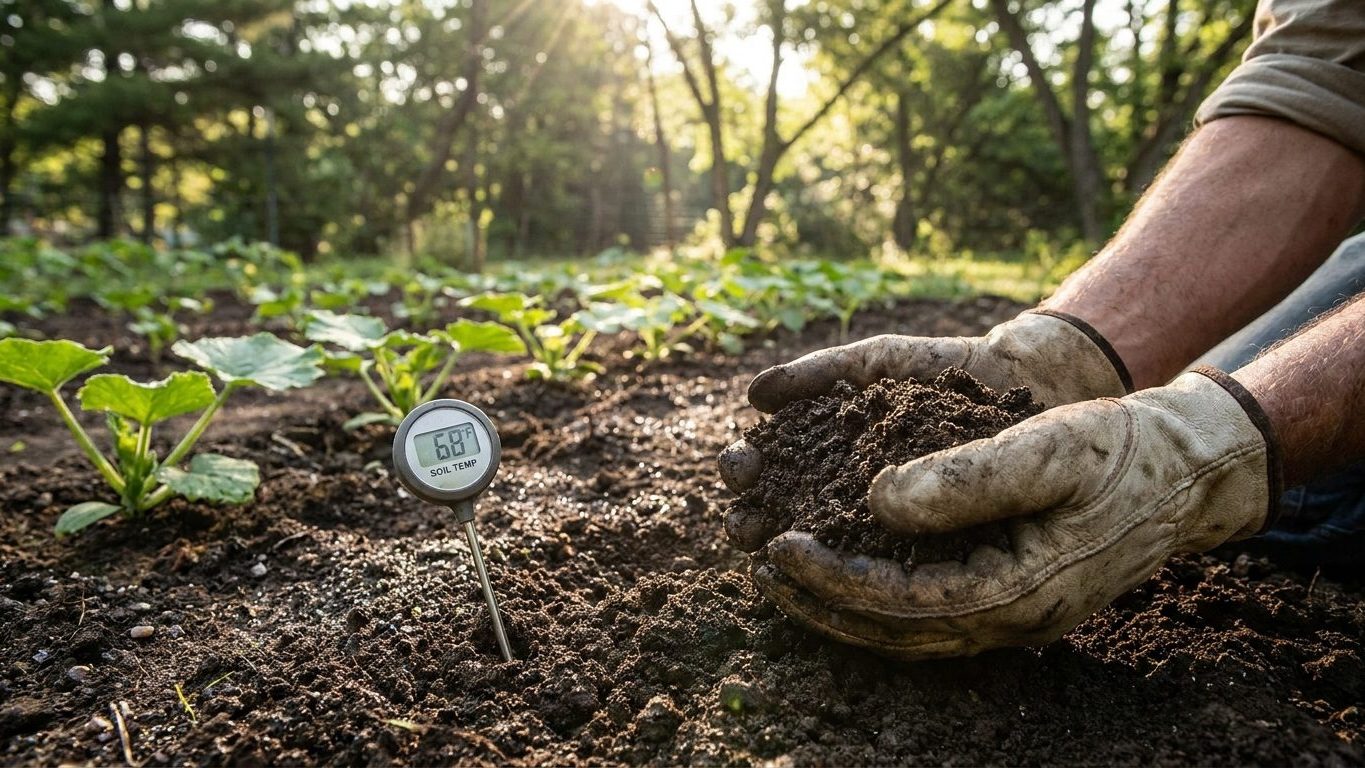
- Soil warmth by feel: winter squash seed sits and rots in cold, wet soil rather than germinating. If the top few inches of soil still feel cool and damp to the hand in mid-February, that’s a sign the local microclimate is running behind the regional average, and it’s worth waiting rather than sowing on schedule.
- The first flush of male flowers: squash plants typically produce male flowers before the female flowers that actually set fruit. Their appearance signals the plant has moved into reproductive growth, and it’s a useful check on whether the timing lines up with the cooler stretch before the heaviest heat arrives.
- The first true leaves: the initial round leaves that emerge from the seed aren’t the plant’s real leaves. Once the first true, lobed squash leaves appear, growth speed picks up noticeably, and how fast that happens says a lot about whether the bed is warm and fertile enough to keep pace with the calendar above.
A garden that lags behind these markers isn’t wrong, it’s telling the gardener something the regional averages can’t: that this particular yard, with its own soil, shade pattern and drainage, runs on its own slightly different clock.
Some gardeners also time this by the Moon: when to plant winter squash by the moon, as almanac tradition rather than fact.