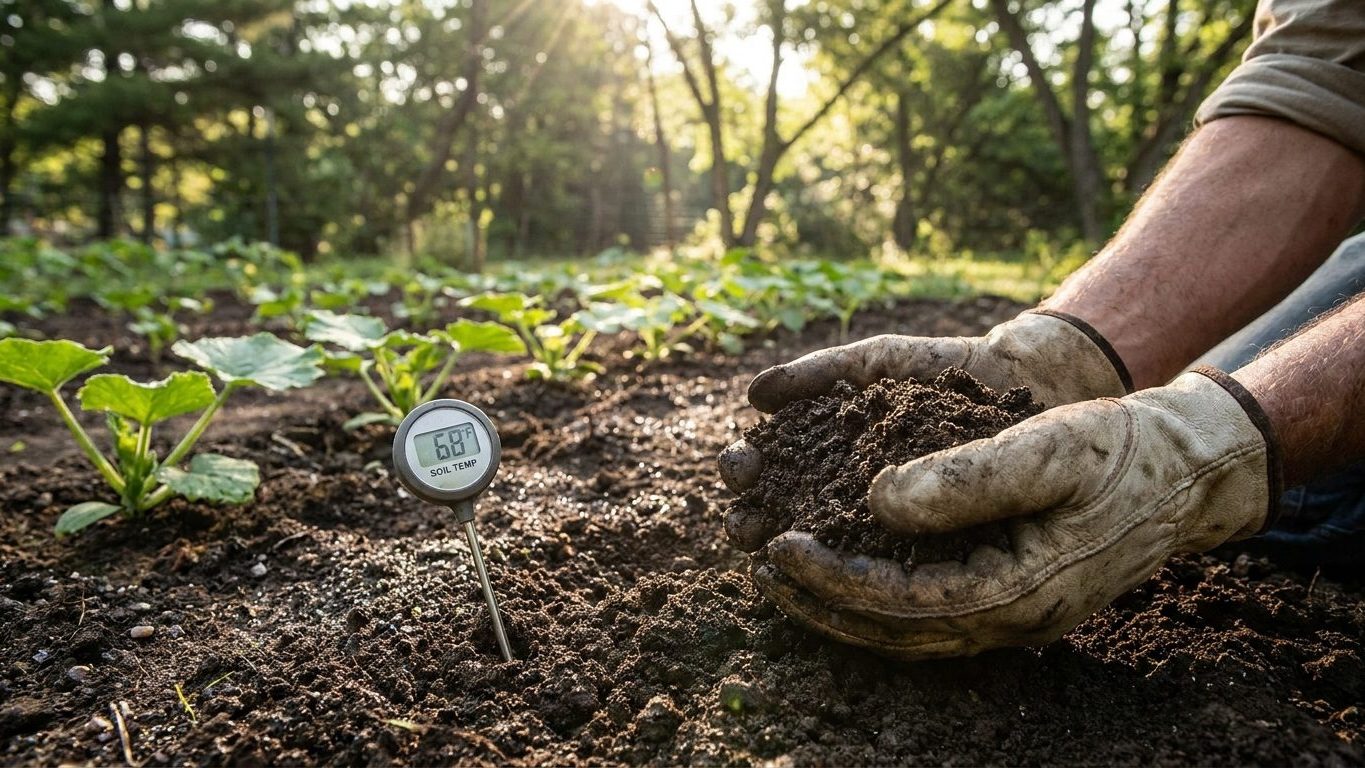

Direct-seed winter squash outdoors only after the last frost risk has passed, which in Maine runs from mid-May into early June depending on where in the state you garden. That window isn’t a fixed date on a calendar, it’s built from freeze probabilities and the number of days each variety needs to mature before the first fall frost. Here’s how those numbers actually work.
The short answer for Maine
At the Portland reference station, there’s a 30 to 70 percent chance of a 32°F freeze occurring after April 22, and that same probability band holds through May 1. That’s not a guess dressed up as a date, it’s a stated range of risk, meaning even by May 1 there’s still up to a 30 percent chance of frost in a given year. Winter squash, which can’t tolerate any frost on tender seedlings, should go into the ground only once that window has closed: direct seeding from roughly mid-May through the first week of June, or transplants set out no earlier than early June with row cover on hand as insurance.
The other end of the calendar matters just as much. First fall frost at the same station lands somewhere between October 9 and October 21, again as a probability range rather than a guarantee. Winter squash varieties need anywhere from 80 to 110 days to reach full maturity, depending on the type.
| Squash type | Typical days to maturity |
|---|---|
| Acorn, delicata | 80–100 days |
| Butternut | 90–100 days |
| Hubbard, large kabocha | 100–110+ days |
Run the math from the mild end of the frost window (planting around May 1 to mid-May, harvesting before October 9) and coastal southern Maine has roughly five months, or 160 to 175 days, to work with. That’s comfortable for acorn, delicata, and most butternut varieties. It gets tight for hubbard and other slow, large-fruited types, especially in a year that lands on the early side of both frost windows.
What will not work here
The biggest mismatch isn’t timing, it’s borrowing assumptions from a different climate. Maine averages just 3.8 days a year at or above 90°F. That’s a low heat load compared to most of the country, and it means the “wait for a heat wave to push growth” strategy that works in warmer states simply doesn’t apply. Winter squash here grows on a steadier, cooler curve, and pushing a 110-day hubbard or giant pumpkin-type squash into a short-season Maine garden, hoping late-summer heat will catch it up, is the single most common way gardeners end up with unripe fruit still on the vine at the first fall frost.
The second failure mode runs the opposite direction from what many gardeners expect. Summer rainfall across the state averages about 11.2 inches over June, July, and August, with July, the driest month, still bringing 3.43 inches. Combined with low evaporation from those few 90-degree days, that means Maine gardens rarely face the drought stress that drives weekly watering routines in hotter, drier states. Treat a Maine squash bed like it needs constant supplemental water and you’ll likely overwater it, especially on heavier clay soils that hold moisture for days after a rain rather than draining it within hours the way sandy soil does.
That same rainfall pattern creates a different problem: foliar disease. Winter squash planted at the tight spacing recommended for dry, low-humidity regions traps moisture around the leaves in a climate that gets regular summer rain. Powdery mildew and downy mildew both thrive when foliage stays damp and air can’t move through the canopy. Wider spacing than a seed packet written for a drier state might suggest, plus watering at the soil line rather than overhead, does more to prevent crop loss here than any fungicide schedule. In short: Maine’s failure points are a season too short for the slowest varieties, and a moisture pattern that punishes crowding rather than one that punishes under-watering.
What changes across Maine
Maine spans USDA hardiness zones 3b to 6a, under the USDA Plant Hardiness Zone Map system, which is built on a single measure: the average annual extreme minimum temperature. That’s a wide spread for one state, and it means there is no single planting date that fits Millinocket the same way it fits Kittery. The frost and heat figures above come from the Portland reference station, which sits at the mild end of that range. Inland valleys, higher elevations, and the northern two-thirds of the state run measurably later springs and earlier falls than the coast.
What that means in practice: a gardener working land in the cooler interior or at higher elevation should treat the mid-May to early-June direct-seeding window as a starting point to push later, not earlier, and should expect the fall frost cutoff to arrive closer to the early side of the October 9–21 range, or before it. The margin that coastal growers have for hubbard and other 100-plus-day squash shrinks fast once you’re working with a shorter, cooler season. In those areas, leaning toward the 80- to 90-day end of the maturity spectrum, or starting seedlings indoors a few weeks ahead of the outdoor window to bank extra growing time, does more to protect a harvest than trying to squeeze a long-season variety into a short one.
None of this replaces knowing your own zone. The USDA’s own zone map, cross-referenced with a local extension office, settles that question far better than a state-level estimate can.
Where to check this for your own county
Everything above describes Maine as a whole, anchored to one reference station. The University of Maine Cooperative Extension, at extension.umaine.edu, is the place to get that county-level detail.
Two things are worth looking for once there. First, a local planting calendar, if the county office publishes one, will reflect the actual frost pattern for that specific area rather than the coastal-leaning average used here. Second, and often more useful, is a list of winter squash varieties that extension agents or master gardener programs have actually trialed in that county’s soil and season length. A variety that performs well in a demonstration garden a few towns over is a far stronger bet than a seed catalog’s generic maturity date, because it’s already been tested against the real frost windows and disease pressure of that specific ground.
The state-level shape of the answer comes down to the probability bands, the season length, and the hardiness zone spread. It isn’t a substitute for that county-specific data, and it isn’t trying to be. Think of it as the map before the compass, useful for orientation, but not the last word before seed goes into a particular patch of ground.
The Moon calendar is a separate, older custom: see when to plant winter squash by the moon, written as tradition rather than fact.
Checking this against your own garden
Every date here is a normal built from thirty years of station data, not a promise about this particular spring. The garden itself gives better information, and it doesn’t take a thermometer to read it.
Soil warmth by feel is the first check. Winter squash seed sits and rots in cold soil rather than germinating, no matter what the calendar says. Push a bare hand a couple of inches into the bed in the morning; if it feels cool rather than merely cool-damp, the soil hasn’t caught up to the air yet, and seed should wait regardless of the date.
The first flush of male flowers, which open before the female flowers that actually set fruit, tells you the plant has shifted from vegetative growth into reproduction. If that flush arrives noticeably early relative to a neighbor’s garden a few miles off, it’s a sign that particular spot runs warmer, likely from a south-facing slope, a sheltered corner, or reflected heat off a wall or driveway.
The first true leaves, the ones that follow the rounder seed leaves and actually look like squash foliage, mark the point where a seedling has moved past its most frost-vulnerable stage. Their timing, and how fast they show up after germination, is a rough read on how much heat that specific bed is actually banking, which matters more than any station-wide average once seed is already in the ground.