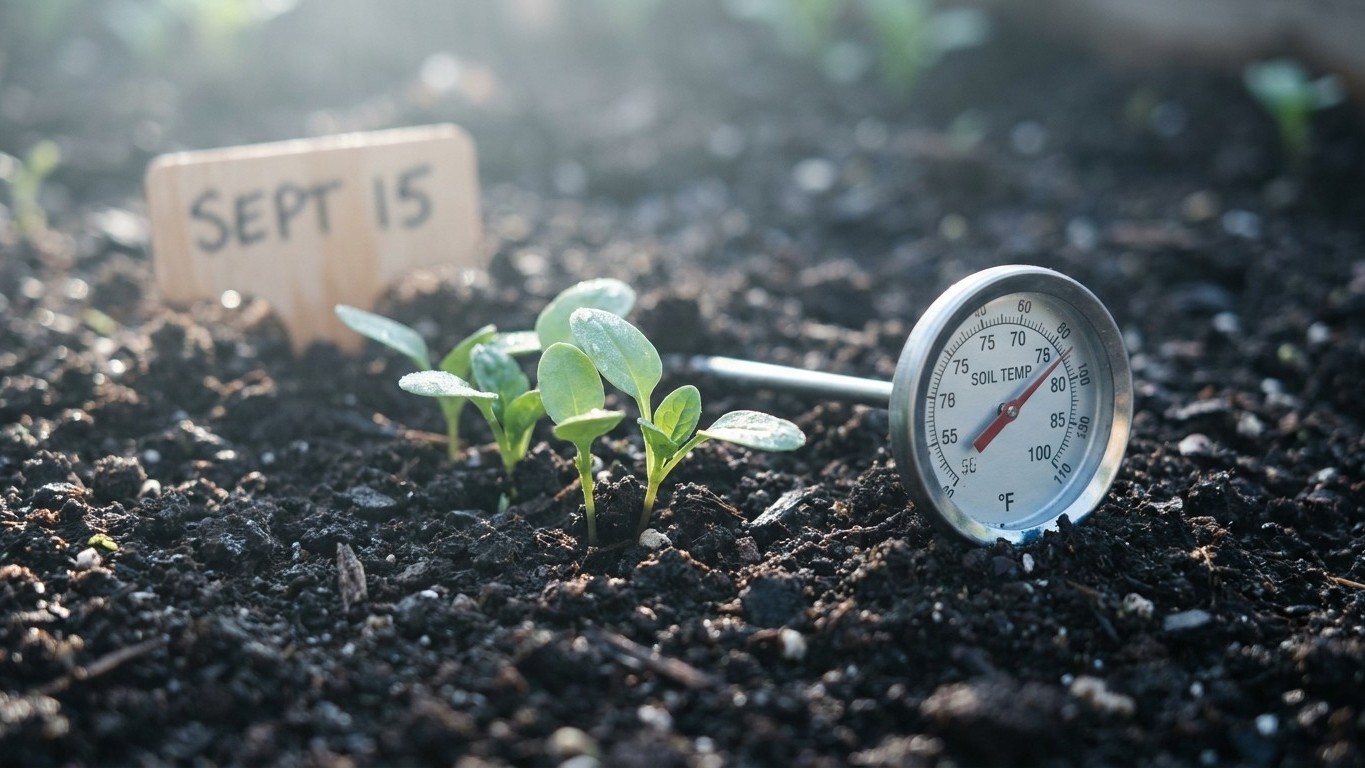

In coastal Maine, sow spring spinach in early April, about two to three weeks before the April 22 to May 1 average last frost. For a fall crop, count backward 50 to 75 days from a harvest date before the first fall frost, which falls October 9 to 21 near the coast and earlier inland. The soil, not the cold, decides when that fall window opens.
The short answer
Portland sits at a latitude where the longest day of the year delivers 15 hours and 15 minutes of daylight. That number matters more than most gardeners assume, because spinach bolts under long days as reliably as it bolts under heat. A cool Maine summer does nothing to cancel that clock. Once the calendar tips past the solstice and days stretch out, the plant reads the light and starts pushing up a flower stalk, whether or not the thermometer ever climbs.
Here’s where Maine’s climate actually helps: the reference station records an average of only 3.8 days a year at or above 90 F. That is a thin margin of extreme heat compared to warmer states, and it means the 75 F growth ceiling for spinach, the point above which growth slows and leaves turn bitter, gets crossed less often and for shorter stretches than it would farther south. Heat stress is a real but secondary problem here.
So which one actually ends the spring crop in Maine: day length or heat? The evidence points mostly to day length. With such a low heat load, a Maine garden rarely bakes hot enough for long enough to explain why spinach bolts by early summer. The daylight hours are doing most of the work. Heat adds a smaller, secondary push, mostly on the handful of days that do reach into the 80s and 90s, but the dominant trigger is the sun staying up past 15 hours as June arrives.
This is the opposite of how day length works for a crop like onions, where long days are the mechanism that builds the bulb. For spinach, the same long days are the mechanism that ends the harvest. That distinction matters because it changes the strategy: you cannot wait out a long Maine day the way you might wait out a heat wave. The only real lever is timing the sowing date so the plant reaches usable size before the days get long enough, and cool enough weather returns before winter, to grow more without bolting.
Four spinach varieties commonly discussed for home gardens are Bloomsdale, Melody, Teton, and Olympia. No verified data on days to maturity, bolt resistance, or yield for any of these four is available here, so none of that is claimed. What is established is the climate mechanism they all have to work within: long Maine days on one side, a modest but real heat ceiling on the other, and two frost dates that bracket the growing season.
How long the spring window really is
- Start with the sowing rule. Spinach goes in the ground two to three weeks before the last frost. With the last spring frost falling April 22 to May 1 near the coast, that puts sowing around April 1 to April 17, depending on how close to the coast the garden sits and how the season is running.
- Add the germination and early growth period. Cool spring soil is not a problem for spinach; the crop actually prefers it. The obstacle in spring is not the soil, it is the calendar catching up to the 15-hour-15-minute day length by the June solstice.
- Mark the point where day length starts working against the crop. As April rolls into May and May into June, daylight lengthens steadily toward that mid-June peak. Spinach sown in early April gets roughly eight to ten weeks of decent growing conditions before the combination of long days and the occasional 75 F-plus stretch pushes it toward bolting.
- Count the realistic harvest window. That gives a usable spring harvest period running from roughly mid-May, once the earliest sowings size up, through mid-to-late June, after which quality drops fast as bolting sets in.
- Recognize how narrow that really is. Compared to a full growing season, a spring spinach window of about two months is short. It is bounded on one end by frost risk and on the other by a fixed solar clock that no amount of mulching or shade cloth can push back for long.
Inland and northern Maine gardens should shift this whole sequence later, since the last frost date there runs substantially behind the coastal date used here. The day length trigger, though, is regional rather than local. It hits inland gardens at close to the same point in the calendar as it hits Portland, which compresses the inland spring window even more once the later frost date is factored in.
The autumn crop, and when the soil lets you sow
The fall crop runs on a different clock than spring. Instead of racing daylight, it races the calendar toward the first hard frost, while waiting for the ground to stop being an obstacle in its own right.
Soil still too warm to germinate
Spinach seed germination drops off once soil temperature climbs above 80 F. Late July and much of August in Maine can still carry that kind of soil heat, especially in gardens with full sun exposure, even though the state’s air temperature rarely spends much time above 90 F. That low heat load is an advantage here: Maine soil generally cools below the 80 F threshold earlier in late summer than soil in hotter states, which opens the fall sowing window sooner. Waiting for an evening watering or a stretch of cooler, cloudier days before sowing is a reasonable way to judge when that threshold has passed, since no specific soil-cooling date for Maine is published in the source data used here.
Counting back from frost
The other boundary is the first fall frost, which falls October 9 to 21 near the coast and earlier inland and in the north. Working backward 50 to 75 days from a harvest target around mid-October puts the sowing window between roughly early August and late August. Sowing in early August aims for the fuller 75-day range and a harvest before the earliest frost risk; sowing in late August banks on the shorter 50-day range and a harvest closer to the frost date itself, with less margin for error if an early cold snap arrives.
Put together, the practical fall sowing window for coastal Maine runs from roughly the first week of August to the last week of August, contingent on the soil having cooled past that 80 F germination barrier. Gardens inland or farther north should sow earlier in that range, since their frost date arrives sooner and their counting-back math shifts the whole window forward by however many days their own frost date runs ahead of the coastal one.
| Factor | Coastal Maine (reference) | Inland / Northern Maine |
|---|---|---|
| Last spring frost | April 22 to May 1 | Later than coastal |
| First fall frost | October 9 to 21 | Earlier than coastal |
| Spring sowing | ~April 1 to April 17 | Shift later |
| Fall sowing | ~Early to late August | Shift earlier within that range |
Common questions
Does a cooler-than-usual Maine summer let spinach grow longer before bolting?
Not by much. Bolting in spinach is triggered by long days as well as by heat, so even a mild summer with days at or near the 15-hour-15-minute peak will push the plant toward flowering on schedule. Cooler weather may slow the process slightly, but it does not cancel it.
Is heat or day length the bigger problem for spinach in Maine?
Day length is the dominant factor here. Maine’s climate normals show only 3.8 days a year reaching 90 F, a low heat load compared to warmer regions, which means the long daylight hours around the solstice are doing most of the work in ending the spring harvest.
Why does the fall sowing date depend on soil temperature instead of frost?
Because spinach seed germination drops once soil rises above 80 F, and late-summer soil in Maine can still be that warm through much of August. The frost date sets the far end of the fall growing season, but warm soil sets when sowing can actually begin.
Are Bloomsdale, Melody, Teton, and Olympia good choices for Maine’s short spring window?
These four varieties are commonly named in spinach growing guides, but no verified data on their days to maturity, bolt resistance, or yield is available in the sources used for this article, so no comparison between them can be made here.