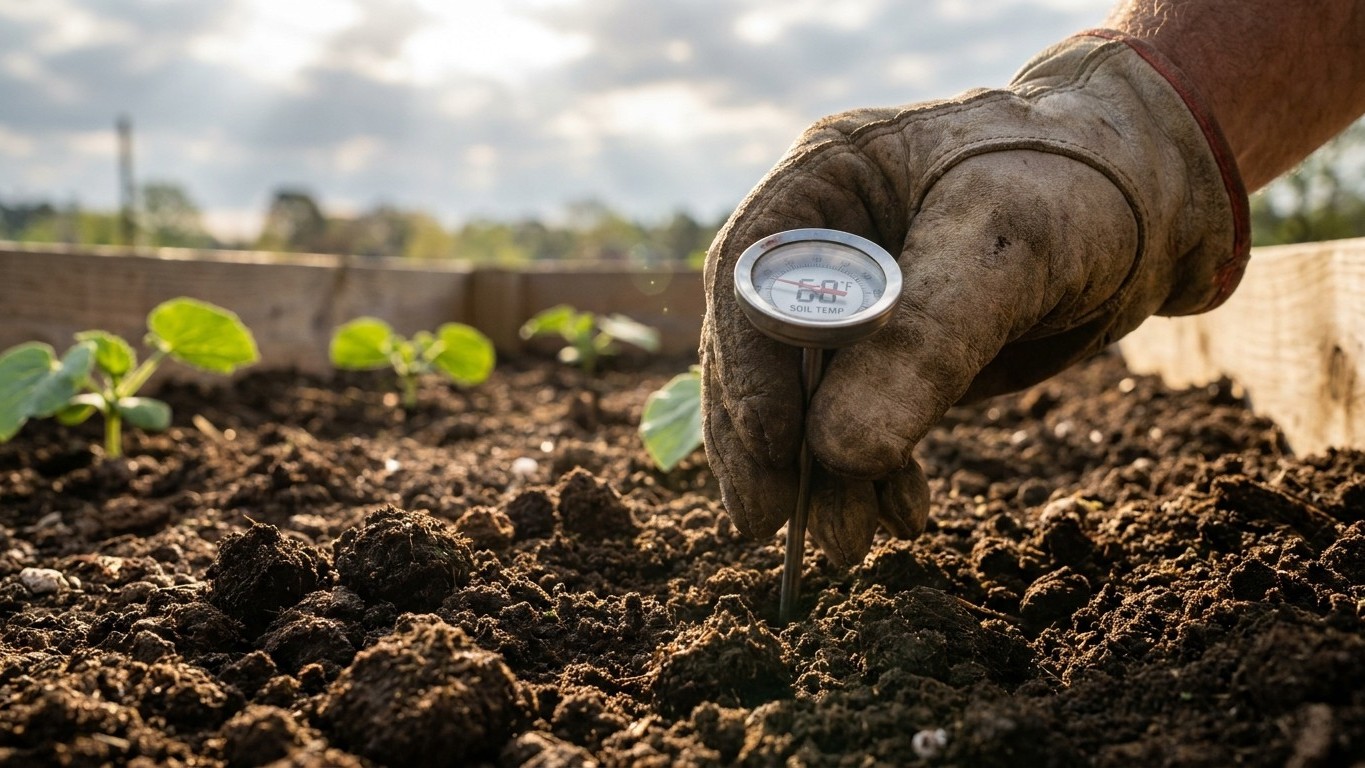

Manitoba gardeners can grow melons, but the province’s short, cool season means success depends on picking early types and warming the soil by hand rather than trusting a calendar date alone. With about four months between frosts and a summer that almost never climbs past 90°F, the window here rewards preparation more than luck. Here’s what actually decides whether a melon vine ripens fruit before the cold comes back.
When the soil is warm enough in Manitoba
The average last spring frost at Winnipeg Richardson International Airport is May 23, according to Environment and Climate Change Canada’s 1981-2010 Climate Normals for that station. That date gets treated as the starting gun for melons across the province, and in a rough sense it is. But it’s worth being precise about what “average” means here: this is a mean date, not a safe one. In one year out of two, frost arrives later than May 23. Planting the moment that date passes on the calendar is a coin flip, not a plan.
The bigger issue for melons isn’t frost risk anyway, it’s soil temperature. Frost is a proxy for a colder problem: melon seed sulks in cold ground, refusing to germinate evenly, and transplants set into chilly soil often just sit there, roots stalled, while the calendar keeps moving. The soil itself warms up on its own schedule, usually weeks after the air stops threatening frost, because bare Manitoba clay and loam hold winter’s chill far longer than the atmosphere does. Waiting for the frost-free date and planting the same afternoon is a common mistake; the ground hasn’t caught up yet.
Working with a short, cold-climate zone
Manitoba’s growing conditions sit within Canadian Plant Hardiness Zone 3b, based on Natural Resources Canada’s 1991-2020 mapping for the reference city. That’s a Canadian zone number, built from seven climate variables, not the single-variable USDA system used elsewhere on this site, and the two don’t convert cleanly. A Canadian zone 4a, for comparison, can overlap nine different USDA zones. What 3b communicates plainly, though, is that this is a genuinely cold growing region, and melons here need help getting a warm start they wouldn’t need further south.
That help comes down to soil-warming technique rather than variety selection alone. Dark mulch laid over the bed a couple of weeks before planting absorbs sun and raises soil temperature faster than bare ground. Raised beds warm quicker than flat rows because they drain and heat from more exposed surface area. Floating row cover over young plants traps daytime heat at ground level on cool nights. None of these techniques require a product name or an application rate to describe, and none of them substitute for checking your own soil with a thermometer before committing seed or transplants to it. The frost date tells you when danger passes; only the soil tells you when it’s ready.
How long the season lasts here
Subtract the average last spring frost (May 23) from the average first fall frost (September 22), both from the same Winnipeg Richardson station and the same 1981-2010 normals, and the frost-free window comes out to about 122 days. That’s the entire growing season available to a melon vine in an average year, from the moment it’s reasonably safe to plant until the moment cold is expected to return and end things.
122 days sounds workable, and for many vegetables it is. For melons, it’s tight rather than generous. A long season, the kind found in warmer US Territories, gives a gardener room to sow a second round of a fast crop after the first finishes, or to experiment with a later planting as insurance against a rough start. Manitoba’s window doesn’t offer that kind of slack. The first sowing, timed carefully around soil warmth rather than the calendar date alone, is effectively the only shot most seasons allow.
Why transplanting becomes worth the trouble
That tightness changes how a Manitoba gardener should think about starting melons at all. Direct-seeding outdoors, once common where the season runs long, eats into a 122-day window fast if the soil takes weeks to warm past the point where seed will germinate. Starting plants indoors and transplanting them out once conditions allow buys back some of that lost time, but only if the root system survives the move intact, since melons resent having their roots disturbed. A gardener working with a short window like this one benefits from checking whether their starts are pot-bound or growing in a container designed to minimize root shock, rather than simply moving the earliest possible transplant outside. For a fuller look at how to plan a second sowing where the season allows it, and how to judge whether transplanting suits a shorter window like Manitoba’s, the succession sowing guide on this site walks through the decision territory by territory.
Heat and water in Manitoba
The reference station at Winnipeg Richardson recorded, on average, 0.0 days a year at or above 90°F over the 1981-2010 normals period. That number isn’t a rounding error or a data gap. It’s the honest measure of how little extreme heat this territory gets in a typical summer, and melons, a crop that ripens on accumulated warmth more than on calendar days, feel the absence of it directly.
Melons don’t need a handful of scorching afternoons so much as a long stretch of warm days adding up, week after week, to enough heat units for sugar to develop in the fruit. A territory with essentially zero days above 90°F is one where that accumulation happens slowly and where the earliness of the type planted, and the soil-warming steps taken at the start of the season, matter more than anything done later. This is not a climate where irrigation timing decides fruit size or where the final two weeks before harvest are a race against heat stress. It’s a climate where the whole season is a slow build toward barely enough warmth, and losing the first few weeks to cold, wet soil can mean the difference between ripe fruit and vines still holding green ones when frost returns.
What a cool, damp summer brings instead
Rainfall reinforces the picture. Manitoba averages about 9.7 inches of rain across June, July and August, per the same Winnipeg station’s 1981-2010 normals, with June the wettest month at 3.54 inches and August the driest at 3.03. That’s a meaningfully wet summer by melon standards, and paired with a summer that rarely gets hot, the combination shifts the main risk away from drought stress and toward moisture-related disease. Powdery mildew and other fungal issues spread readily on melon foliage that stays damp in cool, humid air, and fruit that develops slowly in modest heat is also fruit that sits vulnerable to rot longer. Spacing vines for airflow, watering at the soil rather than overhead, and watching leaves for early mildew matter more here than any irrigation schedule. This is not a hot, dry territory where a gardener worries about the tap; it’s a cool, wet one where a gardener worries about the leaf.
Which melons suit Manitoba
Given a 122-day window, essentially no days above 90°F, and a summer wet enough to invite mildew, the type of melon that suits Manitoba is the earliest-maturing kind available, chosen specifically for disease tolerance rather than for size or sweetness on paper. A short, cool season doesn’t leave room for a melon type built for long, hot summers to catch up partway through; it needs a type built to finish fast on modest accumulated heat, and it needs enough natural resistance to shrug off the mildew pressure that a wet Manitoba summer brings.
This page won’t name a specific variety, and that’s a deliberate choice rather than an oversight. Seed catalogs list dozens of options under each melon type, and which ones actually perform in Manitoba’s specific combination of cold soil, short season and damp air is a question that gets tested locally, not decided by a general reference page. Manitoba Agriculture, reachable at gov.mb.ca/agriculture, publishes variety trial results and current recommendations drawn from actual plantings in the province’s growing conditions, updated as new types are tested and old ones drop out of favor. A cultivar name printed here, without that local trial data behind it, would be a guess dressed up as advice, and a guess is the one thing a gardener trying to beat a 122-day window can’t afford.
What’s worth carrying forward instead is the reasoning: look for the earliest maturity group within whichever melon type interests you, prioritize disease resistance over size or novelty, and let your local extension service’s own trial results, not a province-wide guide, settle the final choice between varieties within that group.