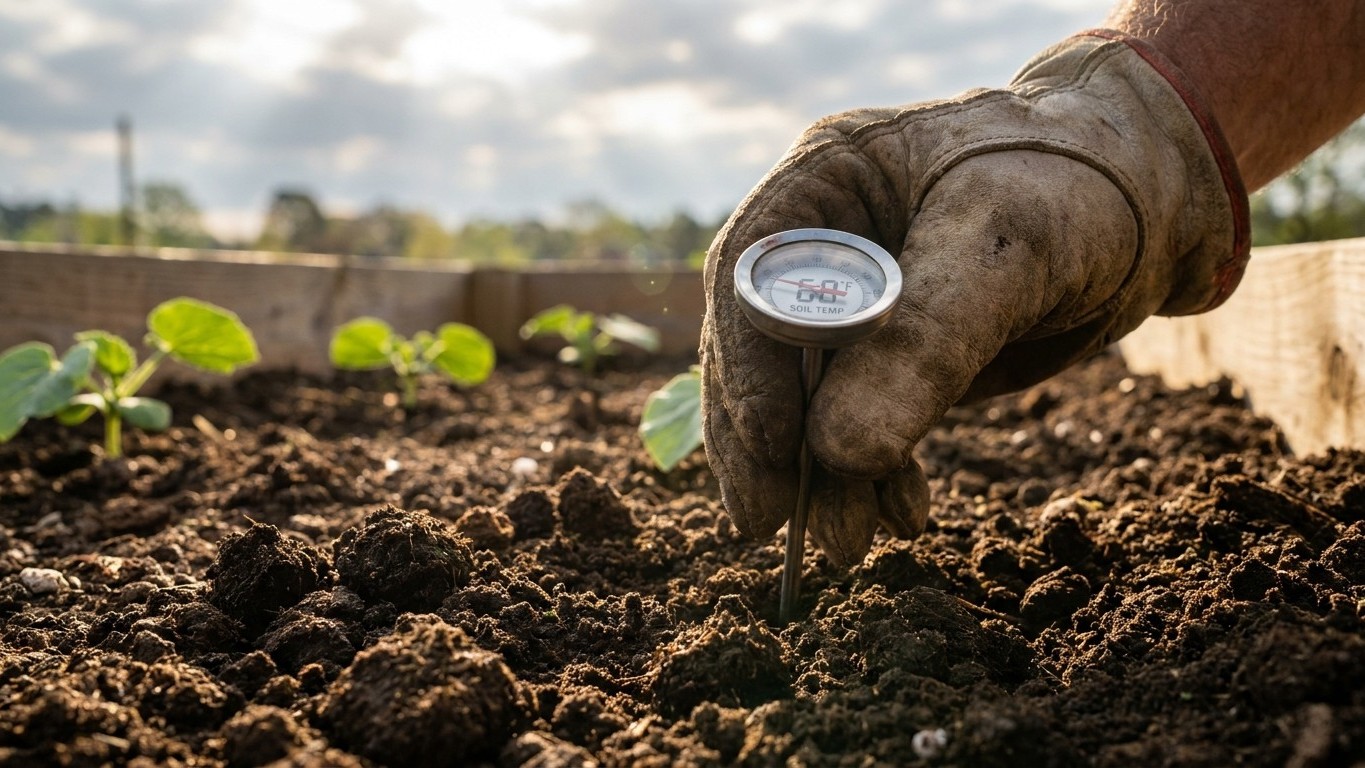

Coastal British Columbia’s soil rarely reaches melon-friendly warmth before late May, sometimes not until June, because the frost calendar around Vancouver only tells half the story. The real trigger is soil temperature, not the calendar date, and that gap is exactly where most home melon crops in this province succeed or stall.
When the soil is warm enough in British Columbia

The average last spring frost at Vancouver Int’l A is March 18, according to Environment and Climate Change Canada’s Canadian Climate Normals for 1981-2010. That date feels early, and it is tempting to treat it as a green light. It isn’t one. A mean frost date is the midpoint of a spread, not a guarantee: in roughly half the years on record, frost has arrived after March 18. Planting melon seed or transplants the week after that date is a bet against the odds this page can’t recommend.
What actually matters for melons is soil temperature, and soil warms weeks after the last frost risk fades. Melon seed germinates poorly in cold, wet soil regardless of air temperature, and transplants set into ground that’s still chilly will simply sit and sulk, sometimes for a month, sometimes permanently. In coastal British Columbia, that soil warm-up lag is longer than in drier interior climates because damp ground holds cold. Gardeners here typically wait well into late May or early June before soil at a few inches’ depth reaches the range melons want to root into.
The reference station behind these normals is Vancouver International Airport, and that matters more here than in most provinces. British Columbia isn’t one climate zone; it’s dozens. The Fraser Valley, Vancouver Island, and the interior Okanagan all warm at different rates, and a province-wide hardiness rating from Natural Resources Canada puts the Vancouver area at Canadian zone 9a, under the seven-variable Canadian system, which does not translate directly to a USDA zone despite the similar-looking number. Gardeners inland or at elevation should expect a slower spring than this station shows.
Warming the ground before you plant
Because the region’s frost date is early but its soil warms slowly, the practical fix is warming the ground itself rather than chasing the calendar. Black plastic mulch laid a couple of weeks ahead of planting, raised beds that drain and heat faster than flat clay ground, and floating row cover over young plants all buy real soil-temperature gains. None of that requires a product recommendation, just a method applied before seed or transplant goes in. For the varieties actually trialled for this climate, the BC Ministry of Agriculture and Food is the source worth checking before buying seed.
How long the season lasts here
Run the two mean dates together and the frost-free window at Vancouver Int’l A comes out to roughly 237 days, from March 18 through November 10. On paper, that’s a long season by Canadian standards, and it’s a real asset for melons, a crop that needs every week it can get. But treat both ends of that window the same way: as averages that can shift by weeks in either direction, not as fixed brackets.
A window this long changes the planting math. In a short-season territory, growers get one shot: seed or transplant goes in as soon as it’s safely possible, and that single sowing has to carry the whole crop. Here, the length of the window opens the door to a second sowing of a fast type in early summer, timed to mature before the mean fall frost in November, or simply held as insurance if the first planting is lost to a slug attack or a cold snap. The general mechanics of staggering plantings for a second harvest are covered in this site’s succession sowing guide, and they apply directly to a coastal BC melon patch with this much season to work with.
The long window also shifts the transplanting decision. Where the season is tight, gardeners often skip transplants because melon roots resent disturbance and the setback can cost a harvest entirely. With close to eight months of theoretical frost-free time, that root check is a smaller risk here: even a transplant that stalls for a couple of weeks after being moved still has time to recover and finish. That’s part of why coastal BC gardeners lean on transplants started indoors, using biodegradable pots to avoid disturbing roots at planting time, rather than direct-seeding and hoping the slow-warming soil cooperates.
None of this erases the frost caution from the first section. A long average window is still an average. The extra weeks are a cushion for a second sowing or a slow start, not a reason to plant earlier than the soil allows.
Heat and water in British Columbia

Vancouver’s reference station records an average of 0.0 days a year above 90°F, per the Canadian Climate Normals for 1981-2010. That number is blunt but honest: heat load, not day length, is the limiting factor for melons on this coast. Melons ripen on accumulated warmth, and a station that essentially never crosses 90°F is telling you the season’s total heat units run low compared with the interior valleys of the province or most of the melon-growing United States.
That reshapes the whole approach. In a hot, dry climate, the story is irrigation and a final few weeks of dry heat to concentrate sugar. That story doesn’t apply here. The coastal BC story is about capturing what heat there is, through black plastic, raised beds, a south-facing wall or slope, and cloches or low tunnels that trap warmth around the plant. Type selection matters more here than sowing date, because a melon bred for a long, hot season simply won’t accumulate enough warmth to finish on this coast, however carefully it’s planted.
Rainfall tells the other half of the story. Summer rain averages about 5.0 inches across June, July and August, against 46.8 inches for the year, meaning the coast’s rain falls mostly outside the growing season.
| Month | Average rainfall |
|---|---|
| June | 2.12 in |
| July | 1.4 in |
| August | 1.45 in |
July, the driest of the three, still isn’t dry by melon standards, and combined with mild temperatures and frequent coastal cloud cover, that dampness is the real hazard here, not drought. Cool, damp summer conditions favor powdery mildew, slow pollination, and fruit that ripens late or not at all. Good airflow between plants, morning watering rather than evening, and keeping foliage dry where possible matter more on this coast than any irrigation schedule.
Which melons suit British Columbia
Reasoning from these three facts, the short heat-accumulation season points toward earlier-maturing melon types generally, rather than the long-season kinds bred for hot interior or southern climates. Muskmelon types bred for shorter, cooler seasons tend to have a better track record on the coast than watermelon types, which typically need more sustained heat than a zero-days-above-90°F climate reliably provides.
The damp summer pattern makes disease resistance the next filter. A type with some tolerance to powdery mildew or downy mildew has a real advantage when July delivers cloud cover and lingering moisture instead of dry heat, and that resistance often matters more to the final harvest than earliness alone.
This page won’t name a specific variety, and that’s a deliberate choice, not an oversight. Seed catalogs change their offerings yearly, and a name that performs well in a trial plot in the Fraser Valley may behave completely differently on a cooler patch of Vancouver Island or an inland Okanagan garden with far more heat to work with. The only recommendation worth following is one grounded in local trial data, and that data lives with the BC Ministry of Agriculture and Food, which tracks what actually performs across the province’s very different growing regions. Checking there before buying seed is the one step that turns this general picture into a planting decision that fits an actual garden.