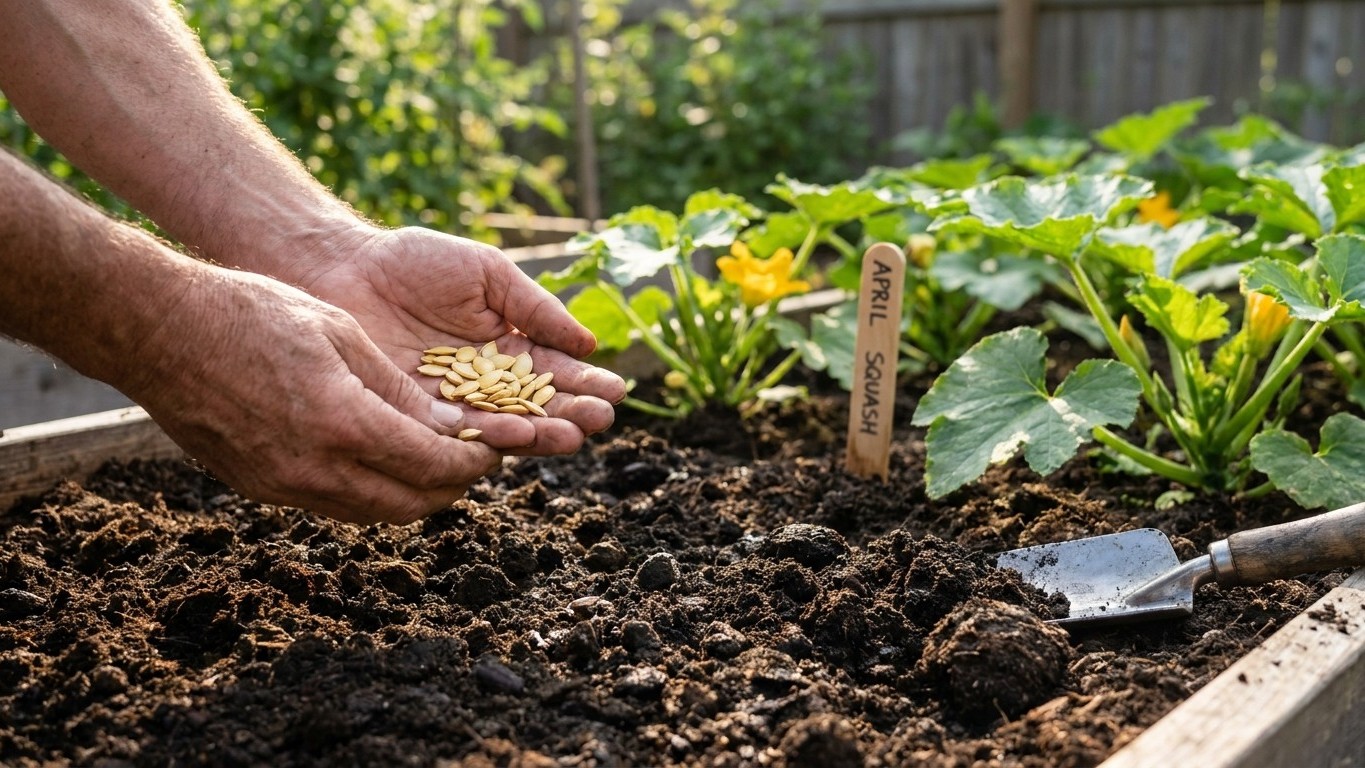

Summer squash goes into the ground in Manitoba between the last week of May and the first week of June, timed to the average last spring frost of May 23. But that date is a coin flip, not a guarantee, and the number that actually caps your season is September 22, the average first fall frost at Winnipeg Richardson International Airport.
The short answer for Manitoba
Environment and Climate Change Canada’s 1981-2010 normals put the average last spring frost at May 23 and the average first fall frost at September 22, both measured at the Winnipeg Richardson Int’l A station. That gives a mean frost-free stretch of roughly 122 days. Summer squash needs somewhere in the neighborhood of 45 to 65 days from transplant to first harvest depending on the variety, so on paper this window has room to spare.
The catch is what “average” actually means here. These are mean dates, not safe dates. In one year out of two, frost arrives later than May 23 in spring, or earlier than September 22 in fall. That’s not a rare edge case, it’s the coin-flip nature of a mean. So the practical answer splits into two moves: direct-seed or set out transplants after May 23 if you’re comfortable with that fifty-fifty odds, or push a week or two later, into the first days of June, if you’d rather not gamble a tray of seedlings on a single date.
Gardeners who want an earlier start without betting the whole crop on the average date typically start seed indoors three to four weeks ahead, then transplant once the soil has warmed, watching the forecast rather than the calendar for the final week before frost risk clears. Direct-seeding outdoors is the simpler route but it only works once the soil itself is warm, which in a Manitoba spring often lags behind the air temperature by a week or more.
On the back end, the September 22 mean fall frost date is the hard stop. Count backward from it, not just forward from spring: a squash sown in early June and needing 55 days to first harvest reaches maturity around July 31, leaving a decent cushion, but a slower 65-day variety sown at the same time is cutting it much closer to that mean fall date, and closer still in the years frost shows up early. This is the calculation that decides everything else on this page.
What will not work here
The single biggest way to lose a summer squash crop in Manitoba is choosing a slow variety and sowing late. If you wait until mid-June to direct-seed a variety that needs 65 days to first harvest, you’re aiming for a mid-to-late August harvest window against a fall frost that averages September 22 but arrives earlier in half of all years. There’s very little slack left for a stretch of cool, cloudy weeks in July that slows fruit set, and that kind of stretch is common at this latitude.
Cold soil at planting time is the second failure point, and it’s easy to underestimate because Manitoba’s zone 3b rating (Canadian system, from Natural Resources Canada’s 1991-2020 hardiness data for the reference station) reflects winter severity across seven climate variables, not spring soil temperature specifically. Squash seed germinates poorly in cold soil, and seedlings set out too early simply sit and sulk rather than growing, which eats into the same days-to-maturity clock you’re trying to protect. Sowing right at the average last frost date without checking the soil itself, not just the air, is a common way to lose a week or two of growing time before the plant even breaks ground.
A watering routine built around a weekly soak will not track reality here either, mainly because of how the summer rain arrives rather than because the total is low. The three summer months average about 9.7 inches combined, with June at 3.54 inches, July at 3.13, and August the driest at 3.03. That’s not a trivial amount of rain, but it rarely arrives evenly. A single heavy thunderstorm can dump much of a month’s total in an afternoon and then leave the garden dry for two or three weeks, which a rigid weekly schedule won’t catch. August, the driest month on average and also the stretch when fruit is setting hardest, is exactly when a squash plant is least forgiving of a missed watering.
One thing that is not a major threat here, worth naming because it trips people up in other regions: extreme heat stress. Manitoba averages 0.0 days a year at or above 90°F at the reference station, so the failure mode of wilting, blossom drop, and scorched leaves from a heat wave is essentially absent from this climate. Don’t import a heat-avoidance strategy from a hotter territory; it solves a problem Manitoba doesn’t have while distracting from the ones it does.
What changes across Manitoba
The 3b hardiness rating quoted above belongs to the reference station used for these normals, and Manitoba is not one climate zoned uniformly from that single point. The Canadian hardiness system builds its rating from seven separate climate variables, not just winter minimum temperature, and Natural Resources Canada is explicit that its zones don’t line up on a simple scale with the U.S. system many gardeners are more used to seeing. A Canadian zone rating a province over can span several USDA-equivalent zones at once, which is a reminder that “zone 3b” describes conditions at one weather station, not a province-wide guarantee.
In practice this means a garden well north of Winnipeg, or one sitting at higher elevation, should expect both a later average last spring frost and an earlier average first fall frost than the dates given above, which shortens the whole window this page is built around. A garden in a warmer southern pocket of the province may see the reverse: an earlier effective start and a later fall cutoff. Neither adjustment is something this page can calculate for you, because the underlying frost and hardiness data here comes from one specific station, not a province-wide average.
The honest position is that there is no single Manitoba planting date, only a reference point and a direction to adjust it. If your garden sits north or upland of Winnipeg, shift both the spring start and the fall harvest deadline earlier in your own planning. If it sits in a milder southern pocket, you likely have a bit more room on both ends than the numbers above suggest. Rather than guess at which side of that line your own plot falls on, use Natural Resources Canada’s hardiness zone map for the actual rating tied to your specific location, since a province-level page can’t responsibly assign you a zone it wasn’t built to know.
Where to check this for your own county
This page gives you the Manitoba-wide reference numbers: one frost pair, one rainfall pattern, one hardiness rating, all tied to the Winnipeg Richardson Int’l A station. That’s useful as a starting point, but it is not a substitute for a local recommendation, and a county or municipal-level source will beat it every time.
Manitoba Agriculture, the province’s own agricultural extension service, is at gov.mb.ca/agriculture. What’s worth pulling from there specifically is a local planting calendar built for your municipality’s actual frost pattern rather than the airport-station average used here, and any list of vegetable varieties that have been trialled under Manitoba growing conditions rather than a generic seed-catalog description. Provincial extension staff and demonstration plots exist precisely to catch the local variation that a single-station climate normal can’t, whether that’s an earlier frost pocket in a low-lying field or a warmer microclimate against a south-facing wall.
Treat the numbers on this page as the province-wide baseline, useful for understanding the general shape of a Manitoba growing season, and treat anything you find through Manitoba Agriculture as the correction layer on top of it. If the two disagree, on planting week or on which squash variety handles the local season best, the county-level or extension-verified answer is the one to follow. This page was built to explain the mechanism behind the dates, not to override a recommendation tuned to your specific soil and latitude.
Checking this against your own garden
Every date in this article is a station average from a single airport, and your own garden will tell you more than any of them once the season actually starts. Three signs are worth tracking by hand, with no equipment beyond your own attention.
Soil warmth by feel is the first and most direct check. Push a finger a couple of inches into the planting bed on a morning in late May; if it still feels cold and damp rather than merely cool, the soil hasn’t caught up to the calendar yet, regardless of what the average last frost date says, and seed sown into it will simply stall rather than germinate.
The first flush of male flowers is the second marker, and it tells you the plant has shifted from vegetative growth into reproductive mode. Male flowers typically appear before the female flowers that actually set fruit, so their arrival is an early signal, not the harvest itself, but a plant that’s slow to throw any flowers at all in the weeks after transplant is a sign the local season is running cooler or slower than the regional average would suggest.
The appearance of the first true leaves, the serrated set that follows the plant’s initial round seed leaves, marks the point where a seedling has moved past its most vulnerable stage. A quick pace to true leaves after sowing suggests your particular plot is running warm relative to the provincial average used on this page; a sluggish pace suggests the opposite, and either way it’s a better guide to your own microclimate than any single station’s mean frost date.