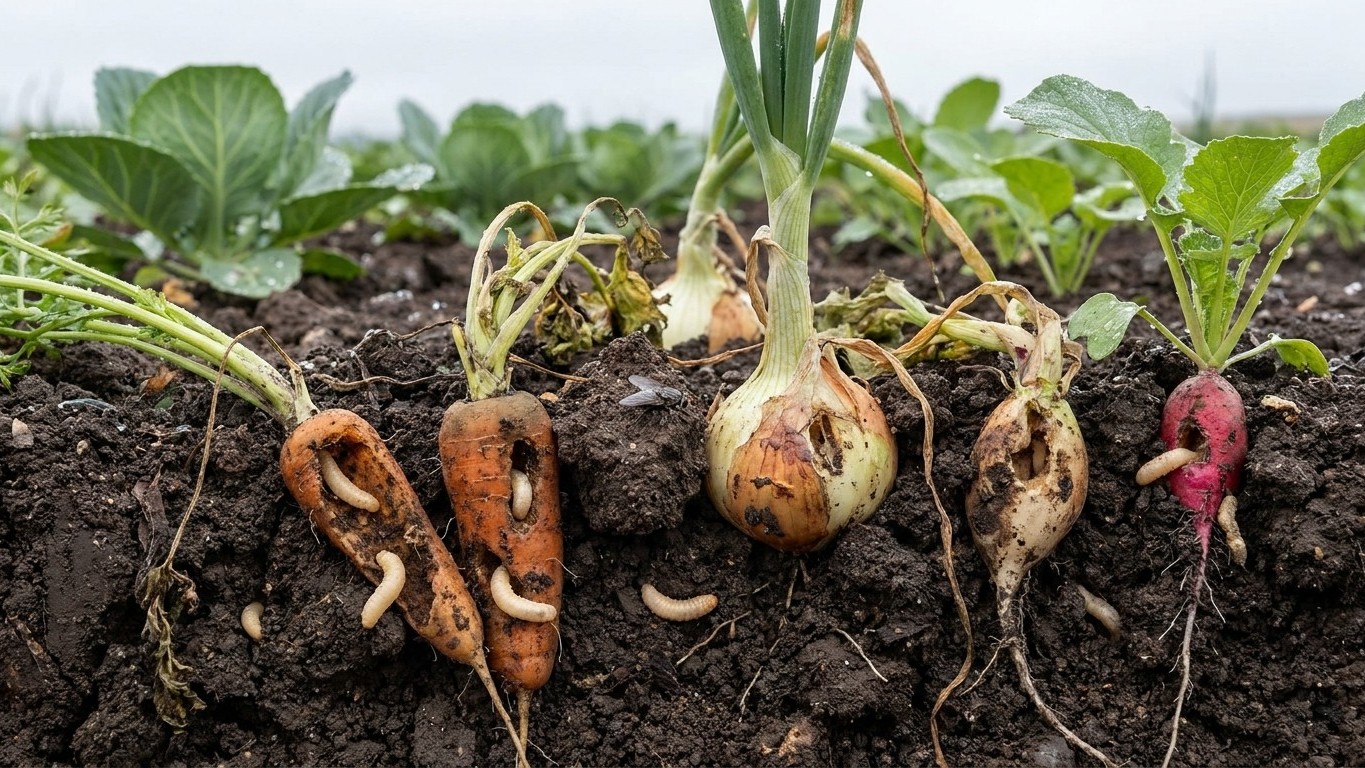

Sow hardy unusual roots such as parsnips and salsify in spring as soon as the soil can be worked, ahead of Winnipeg’s average last frost of May 23. Start celeriac indoors and set it out once frost danger has passed. Fast fall roots go in during midsummer. Every date here is an average from one weather station, so treat it as the middle of a window, never as a promise.
The short answer for Manitoba
What the frost dates actually measure
Environment and Climate Change Canada’s 1981-2010 climate normals for the Winnipeg Richardson International Airport station put the last spring frost on average May 23 and the first fall frost on average September 22. Both are mean dates. They are not safe dates, and they are not probability bands. A mean is the midpoint: in roughly one spring out of two, frost still turns up after May 23, and in roughly one fall out of two, it arrives before September 22.
Between the two averages sit about 122 days. That is the frame for everything below, and it is smaller than it looks. Subtract a week of cold soil at each end and a slow root crop has little slack.
One more caveat on the numbers. Canadian normals cover 1981-2010, while the US figures elsewhere on this site cover 1991-2020, so don’t line the two up as if they were the same yardstick. And the station is in Winnipeg. It describes the south of the province better than it describes anywhere else.
A sowing window by root type
Roots don’t all react to frost the same way, so the calendar splits by type. The table gives the logic; the dates anchor to the May 23 and September 22 averages above. For the full list of what to grow, see The Best Unusual Roots to Grow in Manitoba.
| Type | Examples | When it goes in |
|---|---|---|
| Hardy, slow, direct-seeded | Parsnip, salsify, scorzonera, Hamburg parsley | Early spring, as soon as the soil can be worked, before May 23 |
| Slow, started indoors | Celeriac | Seeded inside, transplanted after frost danger has passed, which means after May 23, not on it |
| Fast, cool-season | Daikon and other winter radishes | Midsummer sowing, so they size up in cool fall weather |
| Perennial | Jerusalem artichoke, horseradish | Early spring, once the ground thaws |
The pattern is simple. Anything that tolerates a frost goes in early and takes the long season. Anything that doesn’t waits until the May 23 coin flip has been decided in your favor. The wider picture is in Growing Unusual Root Crops in Manitoba.
What will not work here
Start with the tropical roots. Yacon, oca and sweet potatoes want a long, warm growing season, and Manitoba offers about 122 days between average frosts, with a late-spring frost still possible after the first date. A tender transplant set out on May 23 faces roughly even odds of meeting frost. Gardeners who grow these here rely on early indoor starts, black plastic and row cover, and even then the harvest is small. For most home gardens the effort buys little.
Late sowing sinks the slow hardy roots too. A parsnip seeded in mid-June has fewer than 100 days before the average first frost, and parsnips are slow to germinate and slow to size up. Hardy roots do survive fall frost, and a few cold nights can improve their flavor, so the September 22 average is a looser deadline for them than for tender crops. The deadline that matters is the ground freezing solid. Miss the spring window and the root goes into winter at half size.
Winter itself is the next limit. At the Winnipeg reference station, the mean daily minimum of the coldest month is -21.4 °C. That is the average, not the record low, so the cold snaps run well below it. Frost drives deep into unprotected soil. Roots left in the ground for a spring harvest need a thick mulch, and even then results vary from winter to winter. Planning to dig everything in the fall is the safer default.
Cold wet soil in April is a quieter failure. Slow seed such as salsify or parsnip, sown into soil that is still chilled, can sit for weeks and rot or come up patchy. Much of southern Manitoba’s cropland is heavy clay, which warms slowly and crusts over, and clay also tends to produce forked, stunted roots on any long taproot. Raised beds or loosened, amended rows fix most of this before it starts.
Then there is the problem of copying calendars from elsewhere. A planting guide written for a milder region puts parsnips in the ground weeks before Manitoba’s soil is workable, and sets out transplants in a week when frost here is still likely. The dates on this page start from Winnipeg’s frost record for exactly that reason.
What changes across Manitoba
A province is not one garden. The hardiness zone this page carries is 3b in the Canadian system, from Natural Resources Canada’s Plant Hardiness Site, and it belongs to the reference city, Winnipeg, not to the province. The Canadian system is built on seven climate variables, while the USDA map uses one, and NRCan itself says there is no simple conversion between them. So 3b here is not a USDA zone, and nothing on this page should be read on the US scale.
How far the zone moves inside Manitoba is not something this page has a figure for, so there is no single answer to give. What the data does say is that northern and upland districts run weeks behind the Winnipeg station: later last frost in spring, earlier first frost in fall. For these places the 122-day frame shrinks from both ends.
For a reader in the north or on higher ground, a few shifts follow:
- Move every spring date later and every fall deadline earlier than the Winnipeg figures suggest, by the number of weeks your local record shows.
- Drop the slowest crops first. Celeriac and scorzonera are the ones to question, while parsnips and the quick winter radishes keep a better chance.
- Start transplants indoors and use raised beds or dark mulch to get the soil moving sooner.
- Choose perennial roots like Jerusalem artichoke and horseradish, which don’t depend on the calendar the way an annual does.
To find your own zone, don’t guess and don’t borrow Winnipeg’s. Look up your municipality on Canada’s Plant Hardiness Site, which lists zones by place, and read the result as a rough guide to winter cold, not as a planting date.
Where to check this for your own county
Your provincial agriculture office is the next stop. Manitoba Agriculture is the provincial source, and it is where local growing guidance gets published. Two things are worth looking for there: a planting calendar written for your part of the province, and any list of varieties trialled where you live.
Be clear about what this page is. It carries one station’s frost averages and one reference-city zone, and it does not reproduce a Manitoba root-crop calendar from the department, because the sources behind it don’t include one. It is the provincial overview. A recommendation for your own area beats it every time, because it rests on local frost records and on varieties that have actually been grown in your soil and wind.
Manitoba runs on rural municipalities rather than counties, so if the word “county” turns up in a US-style guide, read it as your municipality or the nearest district. When you find a local calendar, check the years its frost data covers. A guide built on older normals will sit a few days off a more recent one, and that gap matters most for tender transplants.
Variety trials deserve a second look. A root that does well in a trial plot near Winnipeg may not reach size in a cooler district, and a short-season type that looks modest in a catalogue can be the only one that finishes. If a local trial lists days to maturity, set it against your own frost-to-frost window and drop anything that doesn’t leave a margin. If there is no trial for your district, ask the department directly, and plant two or three kinds side by side in your first year.
Checking this against your own garden
Your own observations outrank every date above, since they describe the exact spot where the seed goes in. Three are worth watching, and none needs equipment.
Soil warmth by feel. Push a bare hand into the bed, up to the wrist. If the soil feels cold enough to ache, it is too early for slow seed such as salsify or celeriac transplants. A bed that warms days before the neighbor’s is a south-facing, well-drained spot. A bed that stays cold has clay, shade or standing water.
First true leaves. Seedlings first show a pair of seed leaves, then the first true leaves, which look like the adult plant. Note how many days a sowing takes to get there. A slow, uneven row points to cold soil or a crust the seedlings struggled through. A fast one tells you the spot is a good early planting site for next year.
Where frost lands. On a clear, still night in spring or fall, check the lawn and the beds at dawn. White grass in one corner and green in another shows you the cold pockets, usually the low ground where cold air settles. Keep tender transplants out of those, and put hardy roots there if you have to use them at all.
Write the dates down for a couple of seasons. A garden log of when the soil turned workable, when seedlings emerged and when frost first showed is the most accurate calendar you will have, and it improves every year you keep it.
Common questions
Is May 23 a safe date to plant tender roots in Manitoba?
No. May 23 is the average last spring frost at the Winnipeg Richardson International Airport station, which means frost still arrives after that date in roughly one year out of two. Treat it as the midpoint of a risky stretch and hold tender transplants a week or two later, or be ready with covers.
Do hardy roots have to come out before September 22?
Not necessarily. September 22 is the average first fall frost, and parsnips and similar hardy roots tolerate frost. The real deadline is the ground freezing. Lift the crop before then, or protect it with a thick mulch if you plan to leave some in the ground.
Is zone 3b the same as USDA zone 3b?
No. The 3b on this page is from the Canadian system, which uses seven climate variables, while the USDA system uses one. NRCan notes that there are no simple conversions between them, so never read a Canadian zone on the US map.
Do these dates work for northern Manitoba?
Not as they stand. They come from a Winnipeg station, and northern and upland districts run weeks behind it. Use them as a starting point, shift both ends of the window to match your local frost record, and check with Manitoba Agriculture for guidance closer to home.