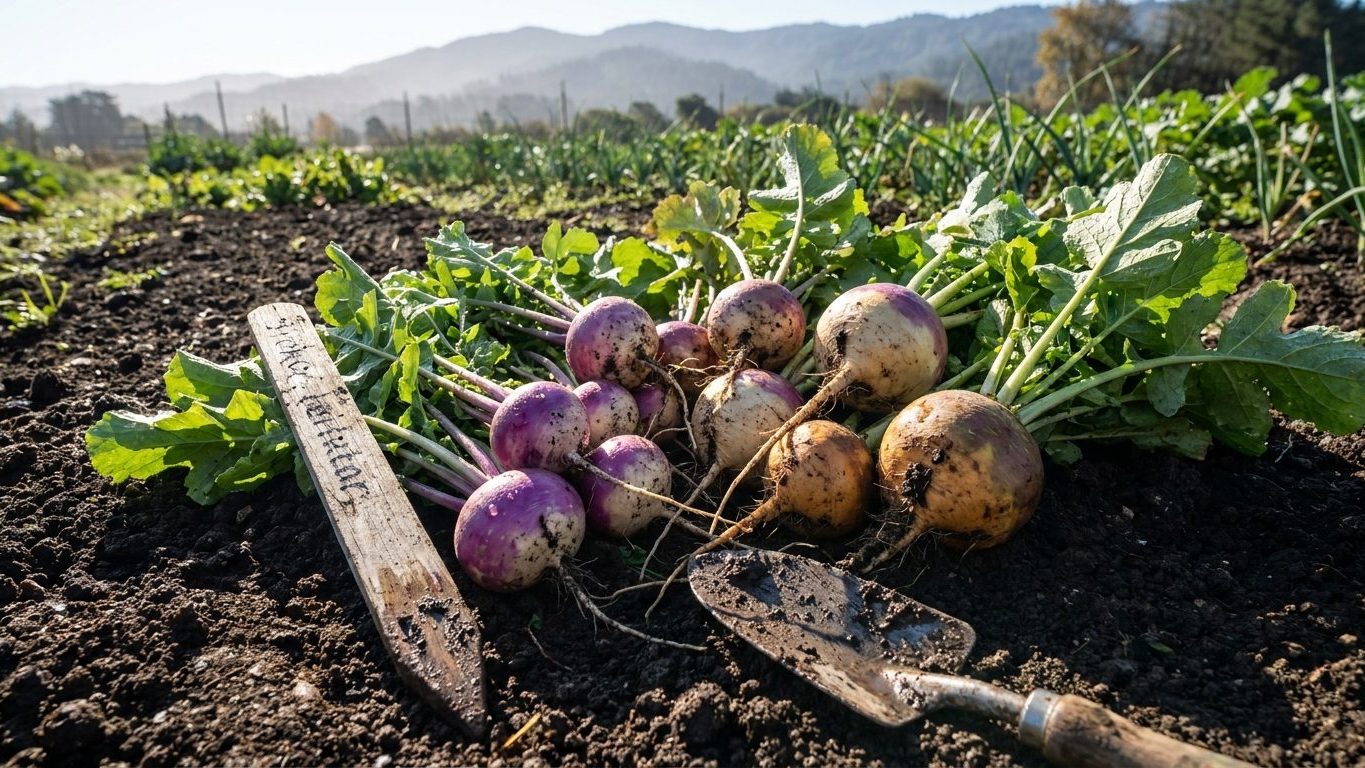

Maryland gardeners get the best results from fast-maturing turnip varieties for a spring crop and heat-tolerant, longer-season rutabaga varieties timed to mature after the first frosts of fall. The state’s frost dates and its short spring window before summer heat arrives are what push that decision, not personal preference.
The short answer for Maryland
Turnips are flexible enough to work in two windows here: a quick spring sowing right around the last frost, and a fall sowing that almost always outperforms it. Rutabaga is a one-shot crop in this state, and it only really works as a fall crop. That distinction matters because Maryland’s last spring frost falls between April 3 and April 16, and the first fall frost arrives between October 26 and November 5 (NOAA NCEI 1991-2020 Climate Normals, reference station USW00093721). That’s the frame everything else fits into.
For turnips, look for 50-to-55 day types in spring, since anything slower runs into early summer heat and turns pithy or bolts. For a fall turnip crop, you can afford a slightly slower variety, because cool weather in September and October concentrates sugars instead of stress hormones, and the roots hold in the ground longer without going woody.
Rutabaga needs 90 to 100 days from seed to a full-sized root, and it actually improves with a touch of frost, the cold converts starches to sugar and takes the edge off the flavor. Working backward from Maryland’s first fall frost window, that means sowing rutabaga in late July to early August for most of the state, so the roots are sizing up as the weather cools and are ready to pull, or at least mulch in place, before repeated hard freezes set in.
The reason spring rutabaga rarely works here is math, not bad luck: by the time soil is reliably workable after an April 3-16 last frost, you’re already racing a summer that arrives fast, and a 90-day crop sown in April is finishing in July, in the middle of Maryland’s hottest, muggiest stretch. Turnips can sometimes squeeze through that gap. Rutabaga almost never does.
What will not work here

Slow-maturing rutabaga varieties sown in spring are the most common failure in Maryland gardens, and it’s almost always a timing problem rather than a soil or seed problem. A 100-day rutabaga sown right after the last frost date is trying to bulk up a root through the hottest six weeks of the year, and heat during root formation produces cracked, woody, bitter rutabaga more often than not. If you want rutabaga here, fall sowing is not a suggestion, it’s close to the only path that works.
Northern-bred turnip varieties selected for slow spring warm-ups also underperform. Maryland’s spring compresses fast between the last frost and full summer heat, and turnips bred for regions where spring lingers into June will bolt to seed here before the root ever fills out, because the temperature swing that normally signals “still early season” to the plant happens in a matter of weeks, not months.
Weekly watering schedules borrowed from cooler, wetter climates also fall short. Maryland summers regularly deliver stretches of heat and humidity that dry out the top few inches of soil well before a week is up, and turnip and rutabaga roots that experience a dry-wet-dry cycle tend to split or grow woody rings. Consistent, more frequent moisture, not a fixed weekly schedule, is what these roots actually need through a Maryland summer.
Leaving mature roots in the ground uncovered through the coldest stretch of winter is another common misstep, especially for gardeners used to genuinely cold climates where snow cover insulates the soil. Maryland’s coldest month averages a nightly low near 25.4°F, cold enough to injure exposed roots, but without the reliable insulating snow cover that protects roots at similar temperatures farther north. Roots left unprotected here go through more freeze-thaw cycles than they would under snow, and that repeated cracking speeds up rot. A layer of straw mulch, or simply harvesting before the hardest freezes, avoids the problem entirely.
Finally, tight spacing recommendations printed on seed packets bred for drier climates can backfire in Maryland’s more humid summers, particularly on the Eastern Shore, where crowded foliage traps moisture and invites downy mildew. Extra air movement between plants matters more here than the package suggests.
What changes across Maryland
Maryland is not one garden, and the state’s official hardiness range reflects that: it spans 5b to 8a on the USDA Plant Hardiness Zone Map, a range built on one measurement, the average annual extreme minimum temperature. That’s a wide spread for a state this size, and it means a planting date that works in one county can be two or three weeks off in another.
Western Maryland, in Garrett and Allegany counties, is mountainous and runs weeks later on both ends of the season: spring frost lingers well past the statewide April window, and fall frost arrives earlier than the statewide average. A rutabaga sowing date calculated from the statewide first fall frost window needs to move earlier for gardeners at elevation, or the crop risks running out of season before the roots size up.
The Eastern Shore sits at the opposite end of that spread. Milder winters and a longer stretch of workable fall weather mean gardeners there can often sow both Turnips and Rutabaga later than the statewide dates suggest, and stretch the fall harvest window closer to Thanksgiving in a mild year.
This page can’t tell you which zone your own yard falls into, that depends on elevation, slope, and how close you are to open water, all of which shift temperatures on a scale smaller than county lines. What it can do is flag that the spread exists. Check the official USDA Plant Hardiness Zone Map for your specific address before locking in a sowing date, and treat the statewide frost window here as a starting point to adjust from, not a fixed rule.
Where to check this for your own county
Everything above is built from statewide climate normals, and Maryland’s actual growing conditions vary enough county to county that a county-level recommendation will beat this page every time. The right next stop is the University of Maryland Extension, the land-grant extension service for the state.
Once there, look specifically for two things: a local vegetable planting calendar for your county or region, and any variety trial results for turnips or rutabaga run through the local extension office or a nearby demonstration garden. Extension offices frequently track which specific varieties held up in local trial plots against the exact soil and pest pressure of that county, information that a statewide climate normal simply can’t capture.
It’s also worth asking, by phone or through the extension website’s contact form, whether your county office has a master gardener program or a current fact sheet on cole and root crop scheduling. Many county offices publish their own adjusted frost-date guidance built from local station data rather than the single reference station used for statewide averages, and that local adjustment is exactly what a gardener in Garrett County or on the lower Eastern Shore needs, since both sit well outside the statewide middle ground.
Treat this article as the broad, state-level frame: it tells you what type of turnip or rutabaga fits Maryland’s overall season length and heat pattern. Your county extension office fills in the specific dates and the specific varieties that have actually performed well on soil like yours. When the two disagree, follow the county-level source, it starts closer to your own dirt.
Checking this against your own garden
Every date on this page is a statewide average, and your own garden will tell you more than any calendar once you know what to watch for. Three simple checks, all doable without a single tool, will tell you more about your own microclimate than a frost-date range ever will.
First, check soil warmth by feel before sowing. Push your hand a couple inches into the bed in early spring: soil that feels cool but crumbles easily, rather than clumping cold and wet, is workable for an early turnip sowing regardless of what the calendar says. If it still feels cold and sticky, wait, even if the date on this page has already passed.
Second, watch for the first true leaves on seedlings, the second set that emerges after the small rounded seed leaves. That’s the point where a turnip crop has actually taken hold, and how quickly it happens after sowing tells you whether your particular bed is running warm or cool compared to the statewide average this page is built from.
Third, watch for early flower buds forming at the center of the plant before the root has sized up, a clear bolt signal that means the plant sensed heat or day-length stress earlier than expected. Seeing that in a spring crop is a strong hint that your yard warms faster than the statewide window suggests, and it’s worth shifting your spring sowing a bit earlier, or leaning more heavily on the fall crop, the following year. Seeing it in a fall crop, on the other hand, usually points back to a sowing date that ran too early for that season, worth pushing back by one to two weeks next time.