
Maryland beds sown in late October give you seedlings the size of a thumbnail by Thanksgiving, and they sit there barely growing until March. Sown too early, in the heat of August, the same seed sprouts thin, bolts, or never comes up at all. The workable window is narrower than the seed rack suggests. Before you open a packet, mark your fall frost range on the calendar and sow so the seedlings have real leaves well ahead of it.
When the soil is warm enough in Maryland

NOAA’s 1991-2020 climate normals, measured at the Baltimore station, put the last spring freeze between April 3 and April 16. NCEI derives that from its 32 F freeze probabilities, in the band where a freeze is still 30 to 70 percent likely. Western Maryland (Garrett and Allegany counties) is mountainous and runs weeks later. The Eastern Shore runs milder. Use the Baltimore band as a reference point, not as your county’s date. A frost date is a probability, not a promise, and a freeze after the band has closed is always possible.
Frost is a proxy, soil is the test
The frost date tells you when the air stops threatening seedlings. It says little about the ground. Soil warms after the freeze risk ends, and it lags the air by days or weeks depending on drainage, slope, and whether the bed was mulched over winter. Winter salad crops are cool-season plants, so in spring they do not need warm soil. They need soil that has thawed and drains well enough that a handful does not smear when you squeeze it.
A cheap soil thermometer pushed to seed depth in the morning gives you a reading to compare against the minimum printed on the seed packet. That reading beats any date on any calendar, including the one above.
The soil problem that bites in Maryland
Salad for cold-season harvest goes in during late summer, when Maryland ground is at its warmest. That is where most failures begin. Spinach, lettuce and mâche seed can sit dormant in hot soil or come up in patches. Four habits fix most of it:
- Sow in the evening, and water the row before and after.
- Lay a board or a sheet of burlap over the row until the first seedlings show, and lift it daily to check.
- Choose a bed that gets afternoon shade from a fence, a trellis, or a tall row of tomatoes.
- Resow at once if the stand comes up thin.
Spring sowing runs the other way. Hardy types can go in as soon as the bed is workable, well before the frost band closes, and they finish before summer heat turns them bitter. The crop as a whole, and the basics this page assumes you have already done, are covered in Winter Salads: What Grows When Lettuce Will Not.
This page talks in types, not cultivars, for a reason. The varieties that have been trialled in Maryland soils are a question for your local extension office, and section four explains where to find them.
How long the season lasts here
NOAA’s 1991-2020 normals for Baltimore put the first fall freeze between October 26 and November 5. Set that against the last spring freeze of April 3 to April 16 and the arithmetic is simple. From April 16 to October 26 is 193 days. From April 3 to November 5 is 216 days. So the frost-free stretch at the Baltimore station runs from a little over six months to about seven, depending on which ends of the two bands you land on. Both figures come from the same NCEI freeze-probability method, and both describe Baltimore. Western Maryland’s window is shorter, sometimes by weeks, and the Eastern Shore’s is longer.
What a window that long allows
It allows a spring sowing and a second, separate late-summer sowing, with room to spare. That is unusual for a salad crop. In a shorter climate the first sowing is the only one, and every week lost to a late start comes off the harvest. Here you can afford to fail once. If August heat wrecks the first late-summer sowing, a second one a couple of weeks later still has time to reach cutting size before the fall band arrives.
The window also changes how you plant. In a short season, transplanting is a way to buy back weeks, and it is worth the root check that comes with it. Maryland’s season gives you the time to direct sow most of the crop, which avoids the check entirely. That matters most for spinach, mâche and claytonia, which are the types that resent being moved. Transplants still earn their place for lettuce and kale, and for anyone whose late-summer bed is not free until the tomatoes come out.
The window is not the harvest
The frost-free stretch measures the season for tender crops. Winter salad types keep growing, slowly, after the first freeze, and that is the point of growing them. The fall band is best read as a deadline for establishment, not for harvest. A plant with several true leaves by then can hold and be cut through winter under cover. A plant that has only sprouted will stall.
Staggering your sowings a couple of weeks apart spreads that risk across the window. The succession sowing guide on this site turns the frost bands into a sowing calendar you can print. For a neighboring take on the same crop, Winter Salads for Tennessee Gardens shows how the window shifts one state south, and it is a useful comparison if you garden near the Virginia line.
Heat and water in Maryland

This page does not carry a count of days above 90 F or a summer rainfall total for Baltimore, and it will not guess at one. NOAA publishes both in its climate normals for the nearest station, and it is worth looking them up. What you can say without the figures is that Maryland summers are warm and humid. That has two consequences for a winter salad grower. Seed sown in late summer meets hot soil, as described above. Crowded seedlings in still, humid air are prone to fungal problems such as downy mildew, which is why spacing and airflow matter as much here as they do anywhere.
Water is the easier half. Summer storms come in bursts and dry spells follow them, so a late-summer seedbed can go from waterlogged to baked in a week. Water the row shallowly every day until seedlings are up, then move to a deeper soak twice a week. A layer of straw or shredded leaves between rows holds moisture, but keep it off the seedlings themselves. Water in the morning so leaves dry before evening, and do not overhead-water once nights turn cold.
The cold decides what stands uncovered
The number that governs the crop is the winter low. NOAA’s 1991-2020 normals give a mean daily minimum of 25.4 F in the coldest month at Baltimore. That is a mean, not a record, so many nights run colder. The USDA Plant Hardiness Map 2023 puts Maryland at zones 5b to 8a, a wide range built on the average annual extreme minimum. Baltimore sits in the middle of it, and the mountains and the Eastern Shore sit at the two ends.
A mean minimum below freezing sorts the crops into three groups:
- Stand uncovered in most winters: spinach, kale, mâche, claytonia.
- Need a cover to stay clean and edible: lettuce, mizuna, tatsoi, endive, escarole.
- Cannot manage at all: tender summer heading lettuce left in the open, and basil.
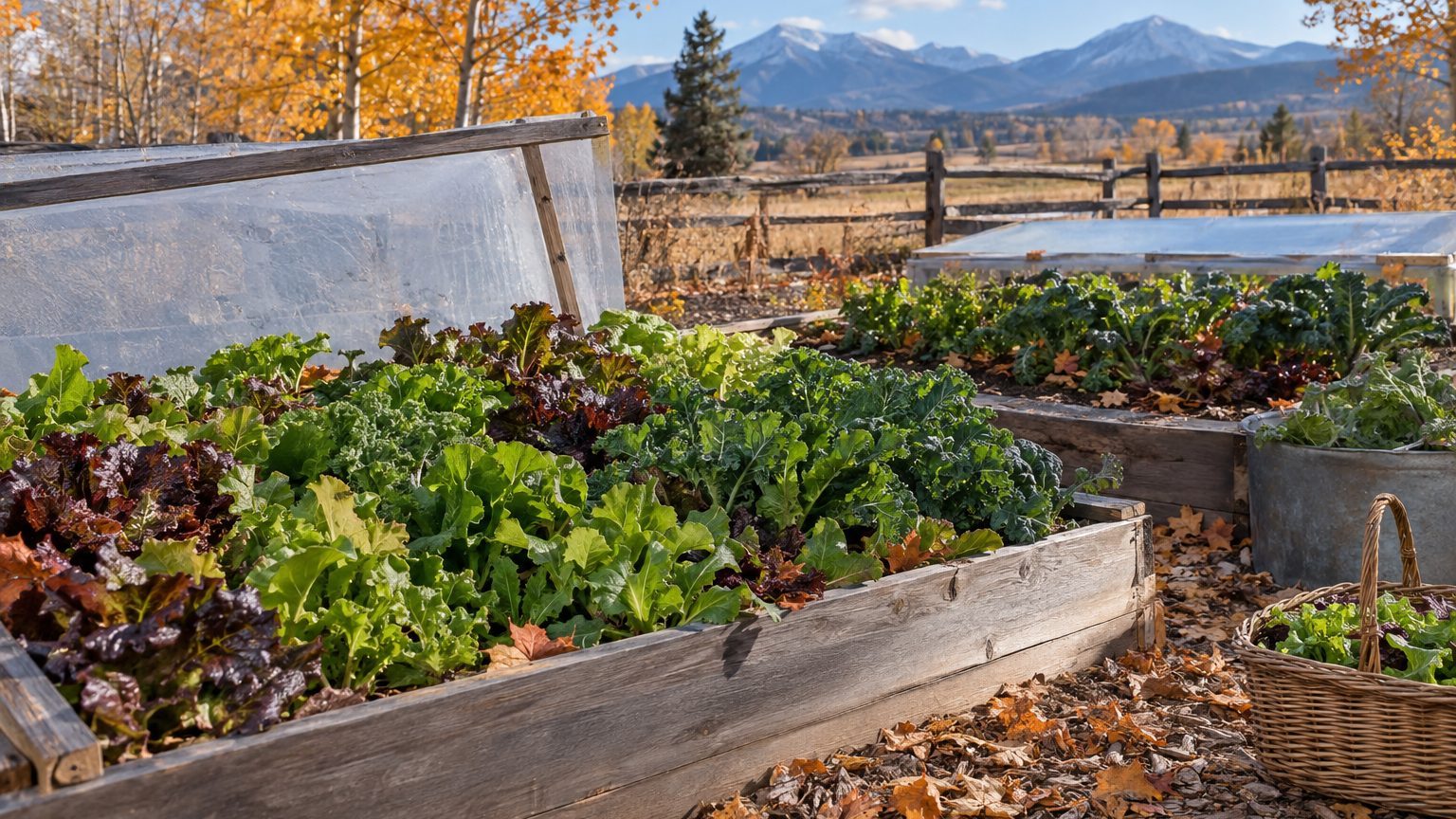
Cover means a low tunnel of hoops and row cover fabric, or a cold frame with a glass or polycarbonate lid. Both keep frost off the leaf surface and keep rain from splashing soil onto it. Vent a cold frame on sunny days. A sealed frame in winter sun overheats quickly and invites mildew.
Light runs out before cold does
The first fall freeze sets a second limit. In late fall the days shorten to the point where plants barely grow, whatever the temperature. Growth after the fall band is mostly holding. That means anything you want to harvest through winter has to be near cutting size before the light fails, and once it is holding, you are cutting from a stock, not from a growing crop. Take a few outer leaves from each plant and leave the center alone. Neighbors to the west can compare their own timing in Winter Salads for Missouri Gardens, where the winter cold behaves differently.
Which winter salads suit Maryland
Choose by type, and let the local facts rank your criteria. Maryland has a long window, so you do not need the very earliest types, and speed is not the deciding factor. The hot, humid summer means germination in warm soil and airflow at the root matter more, so favor types that sprout reliably in late summer and give them space. The humid air makes disease resistance the first criterion when you read a seed packet, and downy mildew resistance on a lettuce packet is worth choosing over any other selling point. The cold then sorts what needs cover, as the table shows.
| Type | Uncovered through a Baltimore-type winter | Late-summer sowing concern |
|---|---|---|
| Spinach | Usually holds | Patchy germination in hot soil |
| Mâche (corn salad) | Holds well | Slow to sprout, keep the seedbed cool |
| Claytonia | Holds well | Dislikes heat, sow in shade |
| Kale (baby leaf) | Usually holds | Few problems, watch for caterpillars |
| Mizuna and tatsoi | Better with a cover | Bolt if sown too early |
| Endive and escarole | Better with a cover in hard freezes | Heat can turn leaves bitter |
| Lettuce | Wants a tunnel or frame | Seed may not sprout in hot soil |
Why this page names no cultivars
Refusing to name a variety is the correct answer here. Cultivar performance depends on the soil, the elevation, and the disease pressure where you garden, and Maryland spans mountain, piedmont, and coast. The only recommendation that means anything is one from a trial run in your conditions, and this page does not have that list. The University of Maryland Extension is where to find what has been grown and tested in the state. Ask them about your county specifically, since Garrett County and the Eastern Shore need very different answers.
Seed packets carry a fact worth knowing. Days to maturity are counted under summer light, and fall crops take longer because the days are shorter. When you work backward from the fall freeze band, add a margin to the packet figure instead of trusting it to the day.
Common questions
Can I grow winter salads in Western Maryland?
Yes, but on a different calendar. Garrett and Allegany counties run weeks later on both ends of the season by NOAA’s reckoning, and the figures on this page describe Baltimore. Count back from your own first fall freeze, use a tunnel or cold frame for everything except the hardiest types, and expect slower growth once the light drops.
Is row cover enough, or do I need a cold frame?
Row cover on hoops handles most Maryland winters for spinach, kale, mâche and mizuna. A cold frame is worth building for lettuce and endive, which fare worse in the coldest weeks. Either one also keeps rain from splashing soil onto the leaves, which helps cleanliness at harvest.
Why did my spinach never come up in September?
The soil was probably too warm. Spinach seed often refuses to sprout in hot ground, and dry spells make it worse. Shade the row, water daily until it sprouts, and if the stand is thin, sow again rather than waiting.
Can I keep cutting the same plants all winter?
You can, but take less than you would in September. Cut a few outer leaves per plant and leave the growing center. Wait until frozen leaves have thawed before you pick, because leaves frozen stiff snap and bruise, and they turn slimy soon after.