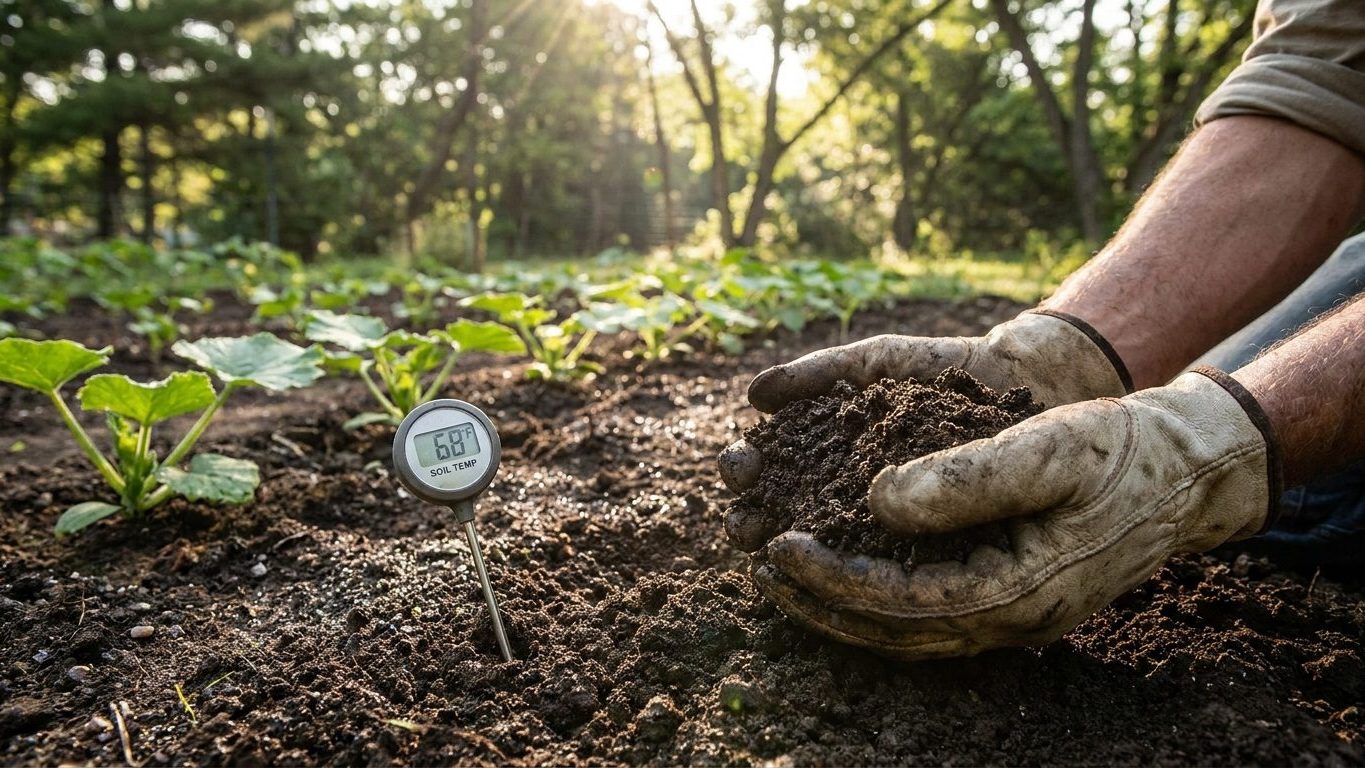

Direct-seed winter squash in Maryland once the last spring frost has passed, generally from late April through May depending on where you garden. Count backward from your first fall frost using each variety’s days-to-maturity, and you’ll find most windows close by mid to late July. That’s the calendar in short.
The short answer for Maryland
Maryland’s last spring frost falls somewhere between April 3 and April 16, based on NOAA’s 1991-2020 climate normals for the 30-70% freeze probability band. That’s not a hard cutoff. It means that on April 3, there’s roughly a 30% chance of a 32°F freeze still happening, and by April 16 that risk has dropped to around 30% from the other direction, having peaked and declined through the window. Winter squash seedlings can’t handle any frost at all, so most gardeners wait until the tail end of that window, or a week or two past it, before setting seed or transplants outside.
The fall side of the calendar is just as important and often ignored. Maryland’s first fall frost arrives between October 26 and November 5, again per the same NOAA station data. Winter squash needs a long run of warm days to actually finish, not just sprout. Acorn and delicata varieties typically need 80 to 90 days from seed to harvest. Butternut runs closer to 100 to 110 days. Hubbard, one of the slowest common types, can push past 110. Working backward from an October 26 frost, a 110-day Hubbard needs to be in the ground by roughly early July at the very latest, and that’s cutting it close with no room for a cool, slow spring.
In practice, that means most Maryland gardeners aiming for a full-size winter squash harvest are sowing in the second half of April through May, not waiting until early summer. Direct-seeding after the soil has warmed, rather than right on the calendar date of last frost, tends to produce faster germination and stronger early growth, since squash seed rots in cold, wet soil more often than it survives it.
- Acorn, delicata: 80-90 days, most forgiving of a late start
- Butternut: around 100 days, the middle ground
- Hubbard and other large storage types: 100-110+ days, the least room for error
If your seed packet doesn’t list a maturity window, that’s the first thing to track down before picking a sowing date, since the frost dates above only tell half the story.
What will not work here
A once-a-week watering habit is the most common way winter squash struggles in Maryland. The region averages about 24.6 days a year at or above 90°F, concentrated right in the middle of squash season, and summer rainfall runs about 12.6 inches across June, July, and August combined. June, the driest of the three at just 3.98 inches, is also the month squash seedlings are establishing roots and setting their first flowers. A single deep watering every seven days doesn’t come close to covering that gap when heat is pulling moisture out of the soil faster than a weekly slug of water can replace it. The result shows up as stalled vines, dropped blossoms, and fruit that sets small and stops growing.
The flip side causes a different failure. July and August bring 4.48 and 4.09 inches respectively, often arriving as heavy thunderstorms rather than steady rain, and that combination of humidity and sudden downpour is exactly what powdery mildew and other fungal problems need. Gardeners who Plant Winter Squash on tight spacing, thinking they’re saving space, end up with vines that can’t dry out between rain events. Leaves yellow, mildew coats the foliage by August, and plants that looked healthy in July collapse before the fruit has finished sizing up. Wider spacing and rows oriented to catch prevailing wind matter more here than in a drier climate.
Timing failures are the third pattern, and they’re tied directly to the maturity numbers above. A Hubbard or other 110-day variety sown in June, whether from a late start or a second planting attempt after a failed first one, is racing a first fall frost that could land as early as October 26. Miss that window and the plant gets caught mid-fruit, with squash that never cures properly and won’t store. This isn’t a risk that applies evenly across the state either, which is the next thing worth sorting out before you commit to a variety.
What changes across Maryland
Maryland’s hardiness zone range, 5b to 8a on the USDA Plant Hardiness Zone Map, is wide enough that there’s no single frost calendar that fits the whole state. The USDA zone system is built on one measurement, average annual extreme minimum temperature, so it’s a rough proxy for cold exposure rather than a precise planting guide, but the spread from 5b to 8a still signals real differences in how long the growing season runs from one county to the next.
Western Maryland, Garrett and Allegany counties in particular, sits in the mountainous end of that range. Higher elevation means a later last spring frost and an earlier first fall frost than the statewide dates suggest, which squeezes the growing season from both ends. A Hubbard variety that’s already a tight fit statewide becomes a genuine gamble there. The Eastern Shore runs the opposite direction: milder, closer to the water, with a longer effective season that gives more room for slow-maturing types and forgives a later sowing date.
Central Maryland, including the Baltimore area used as the reference station for the frost and heat normals cited above, sits in the middle of that spread. Gardeners there are working closer to the statewide averages than either edge of the state.
The USDA hardiness zone map is the tool for that, and it’s worth five minutes to look up a specific address rather than assume based on county name alone. What matters for planning purposes is the direction of the shift: gardeners at higher elevation or farther inland in Western Maryland should lean toward shorter-maturity varieties and sow a bit earlier where soil allows, while Eastern Shore gardeners have more slack on both ends of the calendar.
Where to check this for your own county
The University of Maryland Extension, at extension.umd.edu, is the source built for exactly this problem. State-level frost dates and hardiness zones are a starting point. A county-level recommendation from the extension service accounts for local soil, elevation, and microclimate in a way a statewide page can’t, and it will almost always beat what’s written here.
Two things are worth looking for specifically once there. First, a local or regional planting calendar, if the county office publishes one, since that will reflect the actual frost pattern for that specific area rather than the statewide 30-70% probability band used above. Second, any list of winter squash varieties that have been trialled by extension staff or master gardener programs in that county. Varieties that have been tested locally, for disease resistance to the powdery mildew pressure common in Maryland’s humid summers or for their fit with a shorter mountain season in the west, carry more weight than a seed catalog description written for a national audience.
The state-level picture is useful for understanding the overall shape of the season and why the dates aren’t fixed. It is not a substitute for a county-specific recommendation, and readers gardening in Garrett County or on the Eastern Shore in particular should treat the extension office as the next stop rather than the last word.
If you follow the almanac, here is when to plant winter squash by the moon. It is a tradition, not a proven method.
Checking this against your own garden
Every date here is a normal, an average drawn from three decades of weather. A reader’s own garden runs on its own schedule, and three simple observations will tell you more than any calendar.
Soil warmth by feel comes first. Winter squash seed germinates poorly in soil that still feels cold or stays soggy after rain. Push a finger a few inches down; if it feels cool and damp rather than warming toward room temperature, the soil isn’t ready yet regardless of what the frost date suggests. This matters more on heavy clay soil, which holds cold and moisture longer than sandy ground, and it explains why two gardens ten miles apart can be ready weeks apart.
The first flush of male flowers is the second signal. Squash plants produce male flowers well before female ones, and a strong early flush is a sign the plant has settled in and is putting on steady growth rather than sitting stalled from cold shock or drought stress. If male flowers show up but stall out with no follow-up growth for weeks, that’s usually a heat or moisture problem worth addressing before blaming the calendar.
First true leaves, the second set that appears after the initial seed leaves, mark the point where a plant has moved past its most vulnerable stage. Watching how many days that takes from sowing, compared to the seed packet’s stated germination window, gives a rough read on how a particular spot’s soil temperature and drainage compare to the regional average, which is the most useful microclimate check a home gardener can run without any equipment beyond a hand and a bit of patience.