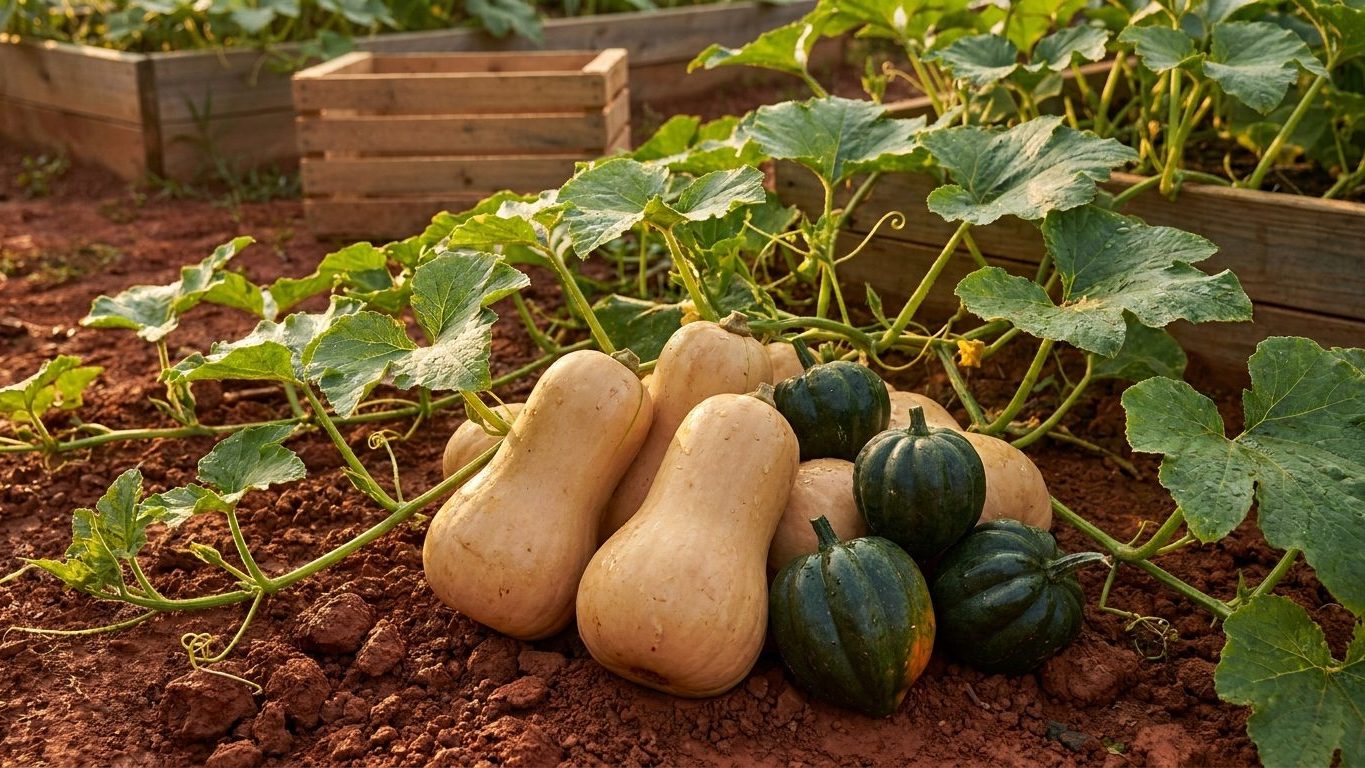

Maryland’s frost-free season, roughly six and a half months across most of the state, comfortably fits nearly every winter squash type. The real filter here is summer humidity and heat, not the calendar. Butternut, acorn, and delicata handle the Mid-Atlantic’s wet spring and sticky summer better than giant storage types like hubbard or banana squash, which need more room, more airflow, and a longer run of dry heat than this climate reliably offers.
The short answer for Maryland
Start with the calendar math, because it settles more than people expect. The last spring frost across the state’s reference station falls somewhere between April 3 and April 16, and the first fall frost lands between October 26 and November 5. Stretch those two windows to their widest, and a Maryland garden gets somewhere between 193 and 216 frost-free days, depending on where in that band the season actually falls. That is a long growing window by national standards. Nearly every winter squash on the market, from a 90-day acorn to a 110-day hubbard, fits inside it with room to spare.
So the decision in Maryland is not about running out of time. It is about which types tolerate 24.6 days a year at 90°F or hotter (the Baltimore-area normal) combined with a summer that delivers about 12.6 inches of rain across June, July, and August, unevenly, with June running driest at 3.98 inches. That combination, heat load plus humid but inconsistent rain, favors compact, disease-resistant types over sprawling ones that need constant airflow and steady moisture to avoid mildew.
| Type | Typical days to maturity | Fit for Maryland |
|---|---|---|
| Butternut | 90 to 100 days | Strong. Thick stems resist vine borers, tolerates heat well. |
| Acorn | 80 to 95 days | Strong. Fast enough to dodge late-summer disease pressure. |
| Delicata | 90 to 100 days | Good, but thin vines need watching for borers. |
| Kabocha | 95 to 110 days | Workable in most of the state, tight on the shortest seasons. |
| Spaghetti | 85 to 100 days | Good, sets fruit reliably in the heat. |
| Hubbard / banana | 100 to 120 days | Risky. Needs the longest, driest stretch Maryland rarely guarantees. |
Butternut earns its reputation here for a reason beyond taste. Its solid stem resists the squash vine borer that thrives in the Mid-Atlantic’s warm, humid summers, a pest that hits acorn and delicata harder because their stems are hollow and thinner. If a Maryland garden has struggled with vines collapsing in August, that is very often the culprit, not the weather itself.
What will not work here

Giant, slow-maturing storage squash are the first to struggle. A 115-to-120-day banana squash or a large hubbard variety needs every one of Maryland’s frost-free days to size up and cure properly, and that only works reliably in the milder stretch of the state’s window. In a year where frost arrives on the early side of the October 26 to November 5 range, or in a garden where planting got delayed past the last frost date, those slow types run out of runway before the fruit fully matures and the rind hardens for storage.
A weekly watering habit fails just as predictably. June is the driest summer month at 3.98 inches, and that shortfall lands right when squash plants are setting their heaviest vine growth and pushing out first fruit. Combine that with 24.6 days a year above 90°F, mostly clustered in July and August, and a plant on a once-a-week schedule goes through real drought stress between waterings, especially on sandy soil where rain and irrigation both drain through fast. The result is blossom drop, small fruit, and vines that stall out right when they should be filling in.
Crowding invites the disease this climate favors
Tight spacing is the third failure point, and it is specific to Maryland’s humidity, not a generic gardening rule. With roughly 12.6 inches of rain spread across June through August and heat that keeps foliage wet longer after each rain, powdery and downy mildew spread fast through crowded plantings. Vines packed in without airflow hold moisture on their leaves overnight, and a mildew outbreak in a humid August can defoliate a planting before the fruit even finishes sizing. Wide spacing and pruning back excess foliage matter more here than in a drier climate, where the same crowding would barely register as a problem.
None of this rules out the slower types entirely. It just means they carry more risk, and that risk is not evenly spread across the state.
What changes across Maryland
The USDA Plant Hardiness Zone Map places Maryland across a wide band, from 5b to 8a. That is not a small spread. A garden at the cold end of that range and one at the warm end are working with a meaningfully different climate, even though both sit inside the same state’s borders. There is no single frost date, no single season length, and no single squash recommendation that applies evenly from one end of Maryland to the other.
Western Maryland, the mountainous counties like Garrett and Allegany, runs weeks later on both ends of the frost calendar than the reference station the statewide dates above are drawn from. Spring frost lingers longer there, and fall frost arrives sooner, which trims real days off the 193-to-216-day window calculated earlier. A gardener in that part of the state working with a hubbard or banana squash is taking on more risk than the statewide numbers suggest, simply because the local season is shorter than the state average implies.
The Eastern Shore sits at the other end of that spread. Milder winters and a longer frost-free stretch there give slower-maturing types more of the runway they need, and push the practical planting window earlier in spring than it would be inland or at elevation.
No statewide figure tells an individual reader which zone their own garden sits in. The USDA hardiness zone map is built for exactly that lookup, using average annual extreme minimum temperatures as its single variable. What matters here is recognizing that “Maryland” is not one growing climate, and that a variety choice that works well on the Eastern Shore may be the wrong bet in Garrett County, and the reverse.
Where to check this for your own county
The state-level picture covers season length, heat load, humidity, and the general range of hardiness zones Maryland spans. A county recommendation will always beat a state one, because it accounts for the local frost dates, local soil, and the varieties that have actually been trialled in that specific area rather than averaged across the whole state.
The University of Maryland Extension, at extension.umd.edu, is the source built to close that gap. Two things are worth looking for there specifically. First, a local planting calendar for the reader’s own county, which will translate the statewide frost-date range into a more precise local window, particularly useful for anyone gardening in the western mountains or on the milder Eastern Shore where the statewide numbers understate the local difference. Second, variety trial results or recommended-variety lists for vegetable gardens in Maryland, which reflect what has actually performed well against local pest and disease pressure, including the vine borer and mildew issues discussed above.
Extension offices also field direct questions from home gardeners, often through a county-specific hotline or master gardener program, which is a faster path to a locally-tested answer than trying to extrapolate one from statewide climate normals. The dates and figures above are a solid starting point for narrowing down squash types by category. They are not a substitute for the county-level detail that decides the final variety choice.
Checking this against your own garden
Every date and figure above describes an average built from three decades of climate records at a reference station. A garden’s own microclimate, shaped by slope, soil type, nearby structures, and tree cover, can run days or even weeks ahead of or behind those averages. Three simple observations, none requiring anything beyond a hand and a bit of patience, settle that gap better than any calendar date.
Soil warmth by feel comes first. Winter squash seed germinates poorly in cold soil, and a gardener who pushes a hand a few inches into the bed and finds it still cool and damp, even after the calendar says the last frost has passed, is looking at soil that has not caught up to the season yet. Warm, slightly dry-feeling soil is the better signal to plant, regardless of what the date says.
The first flush of male flowers is the second marker. Squash plants typically produce male blossoms before female ones, and a garden that is running warm for its microclimate will show that first flush earlier than a garden running cool, even if both were planted the same week. It is an early read on how the season is actually unfolding on that specific plot.
The appearance of true leaves, the second set that emerges after the rounded seed leaves, marks the point where a seedling has enough root and leaf structure to handle transplant stress or a light cold snap. A patch that is slow to reach that stage is signaling a cooler, slower microclimate than the county average, and that is worth factoring into how much risk to take on a longer-season variety.