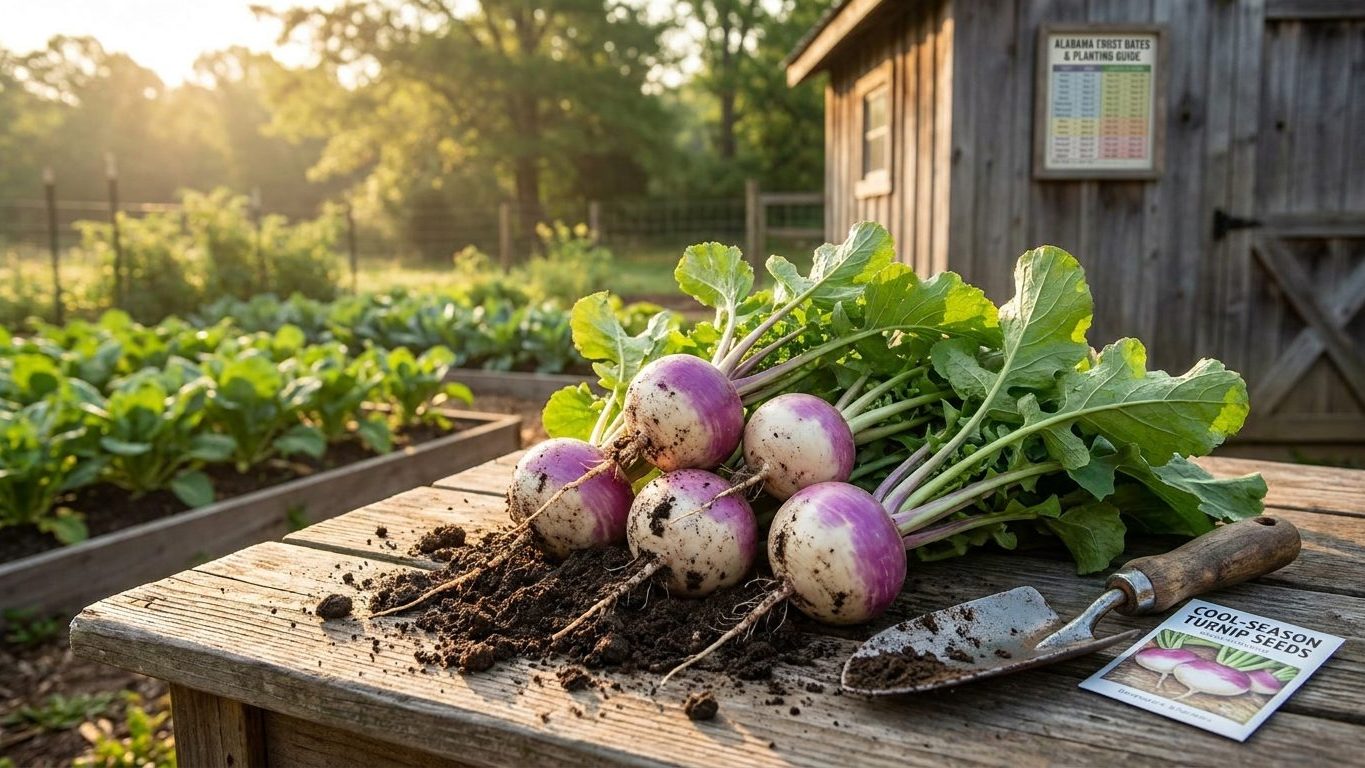

Two windows work for turnips in Massachusetts: a spring sowing once the soil dries out after the last frost, and a fall sowing timed backward from the first freeze. The spring crop is riskier here because summer heat arrives fast and turns roots bitter and woody, so most Massachusetts gardeners lean on the fall window instead.
The short answer for Massachusetts
Turnips are a cool-weather root crop, and Massachusetts gives you two narrow slots to work with rather than one long season. The state’s frost data, drawn from the Boston/Logan station, puts the last spring freeze between April 1 and April 8 and the first fall freeze between November 3 and November 14. Those dates mark the 30-70% probability band for a 32°F freeze, meaning there’s still a real chance of frost on either side of them, not a hard line.
For a spring crop, that means getting seed in the ground as soon as the soil can be worked, generally in the two to three weeks bracketing that early-April frost window. Turnip seedlings shrug off a light frost, so gardeners don’t need to wait for the freeze risk to disappear entirely. The catch is that a spring-sown crop is racing the calendar toward the season’s heat, and turnips sown in April are often bulking up right when June temperatures climb, which pushes flavor toward sharp and fibrous.
The fall window is the one most Massachusetts growers actually rely on. Counting backward from the earliest end of the fall frost band (November 3) gives sowing dates that land in late July through mid-August, depending on how fast a given variety matures and how much cold-tolerance the gardener wants to bank into the schedule. Turnips are a fast crop by garden standards, so a late-July sowing has real margin to finish before the ground freezes, and a light frost after that point actually sweetens the roots rather than damaging them.
There’s no single “best day” this page can hand you, because the frost dates themselves are a probability range, not a fixed switch. What the state’s own numbers support is a sowing strategy built around two anchor points: soil workable in early April for a spring crop, and a countdown from early-to-mid November for the fall crop, with the fall option carrying less risk of bitter, stressed roots.
What will not work here

The most common mistake is treating Massachusetts like a single, forgiving season and sowing a slow-maturing turnip or rutabaga too late in summer, expecting it to finish before the first freeze. Rutabagas in particular need considerably longer than standard turnips to bulk up, and a sowing in mid-August is cutting it close against a fall frost that can arrive as early as November 3 in some parts of the state. Anyone growing rutabaga here needs to sow noticeably earlier than they would a quick salad turnip, not on the same date.
Watering on a weekly schedule is another failure point, and it’s less about drought than about the state’s summer heat spikes. The coldest-month mean minimum in Boston sits at 23.1°F, which tells you winter here is genuinely cold, but that same climate swings hard the other direction in July and August. A turnip patch that dries out between infrequent waterings during a hot stretch responds by going woody and pungent, or by bolting to flower early, especially in a spring-sown crop already under heat stress. Consistent moisture through summer heat matters more than the total volume of water applied.
Tight spacing is a third trap, and it’s specific to a humid state like Massachusetts rather than a universal turnip problem. Turnip greens sown too close together trap moisture between leaves, and in a humid coastal or valley summer that creates ideal conditions for foliar disease to move through a bed fast. Growers in drier inland climates can sometimes get away with crowding; growers here generally can’t.
Finally, sowing a full-season turnip in the same window as a quick 40-something-day variety and expecting both to hit the same fall harvest date is a scheduling error that shows up every year. The frost window here is real but narrow, and mismatching a variety’s maturity time to that window is the single most avoidable way to lose a fall crop to an early freeze.
What changes across Massachusetts
Massachusetts is not one climate, and the USDA Plant Hardiness Zone Map makes that plain: the state spans zone 5a to zone 7b, built on the average annual extreme minimum temperature. That’s a wide spread for a state this size, and it means a sowing date pulled from Boston-area frost data will not hold everywhere.
The reference frost dates in this article come from the Logan Airport station, a waterfront, urban site that is consistently the mildest spot in the state. Coastal and Greater Boston gardens tend to track close to those numbers. Inland suburbs, the Connecticut River Valley, and especially the Berkshires in the western part of the state sit in the colder end of that zone range, and they see frost arrive earlier in fall and linger later in spring than the Boston data suggests.
What that means practically: a gardener in a colder inland or higher-elevation part of the state should treat the fall sowing window as starting earlier, not later, since their effective first frost may land well before November 3. On the spring side, the same colder pocket likely needs to wait longer past April 8 before soil is workable and frost risk has genuinely passed, even though the statewide band suggests early April.
This page can’t tell an individual reader which zone their own yard falls into. That’s exactly what the USDA hardiness zone map is for, and it’s worth checking directly rather than assuming the coastal dates apply to a colder inland garden. The zone spread here, 5a to 7b, is large enough that “Massachusetts” alone is not a precise enough answer for a sowing date near either edge of the season.
Where to check this for your own county
This page gives a state-level answer, and a state-level answer is a starting point, not a final one. The next step is the University of Massachusetts Amherst’s extension service, available at ag.umass.edu, which is the state’s designated land-grant extension program under the USDA NIFA system.
Once there, look specifically for two things. First, a local or regional planting calendar that breaks the state down further than a single statewide frost window, since county-level guidance accounts for the kind of inland-versus-coastal spread described above. Second, look for any variety trial results or recommended cultivar lists specific to Massachusetts growing conditions. Extension services often test turnip and rutabaga varieties against local pest pressure, disease, and the state’s actual frost timing, and that trial data is more useful than a generic seed packet date.
A county-specific recommendation will always beat a state-level one, for the simple reason that it’s built on the actual microclimate a gardener is working with, not an average across a state that spans two-plus hardiness zones. Checking the county-level calendar before finalizing a sowing date is the single most useful action a Massachusetts gardener can take beyond reading this page.
Treat this article as the broad framework, the two-window logic and the reasoning behind it, and treat the extension service as the fine-tuning layer that adjusts those windows to a specific piece of ground.
If you follow the almanac, here is when to plant turnips by the moon. It is a tradition, not a proven method.
Checking this against your own garden
Every date on this page is built from averages and probability bands, and a gardener’s own observations will outrank all of it. Three signs are worth watching before trusting a calendar date over what’s actually happening in the soil.
Soil feel comes first. Workable spring soil should crumble loosely in the hand rather than clump into a dense, wet ball. Turnip seed sown into cold, sticky soil germinates poorly and slowly, regardless of what the calendar says about the date having arrived. Waiting for that crumbly texture, even if it means sowing a few days later than the state’s early-April window suggests, generally beats forcing seed into soil that isn’t ready.
Germination speed is the second signal. Turnip seed sown into properly warmed soil typically pushes up its first true leaves within roughly a week to ten days. A much slower emergence than that is a sign the soil is still too cold, even if the frost-date calendar suggests conditions should be fine, and it’s worth noting for next season’s timing on that same bed.
Finally, watch for any premature flower stalk shooting up from a young plant, a sign of bolting brought on by heat or moisture stress rather than the plant reaching normal maturity. A spring-sown crop that bolts early in a hot June is telling a gardener something specific about that microclimate: the fall window is likely the more reliable bet for that exact garden going forward, regardless of what the statewide dates recommend.