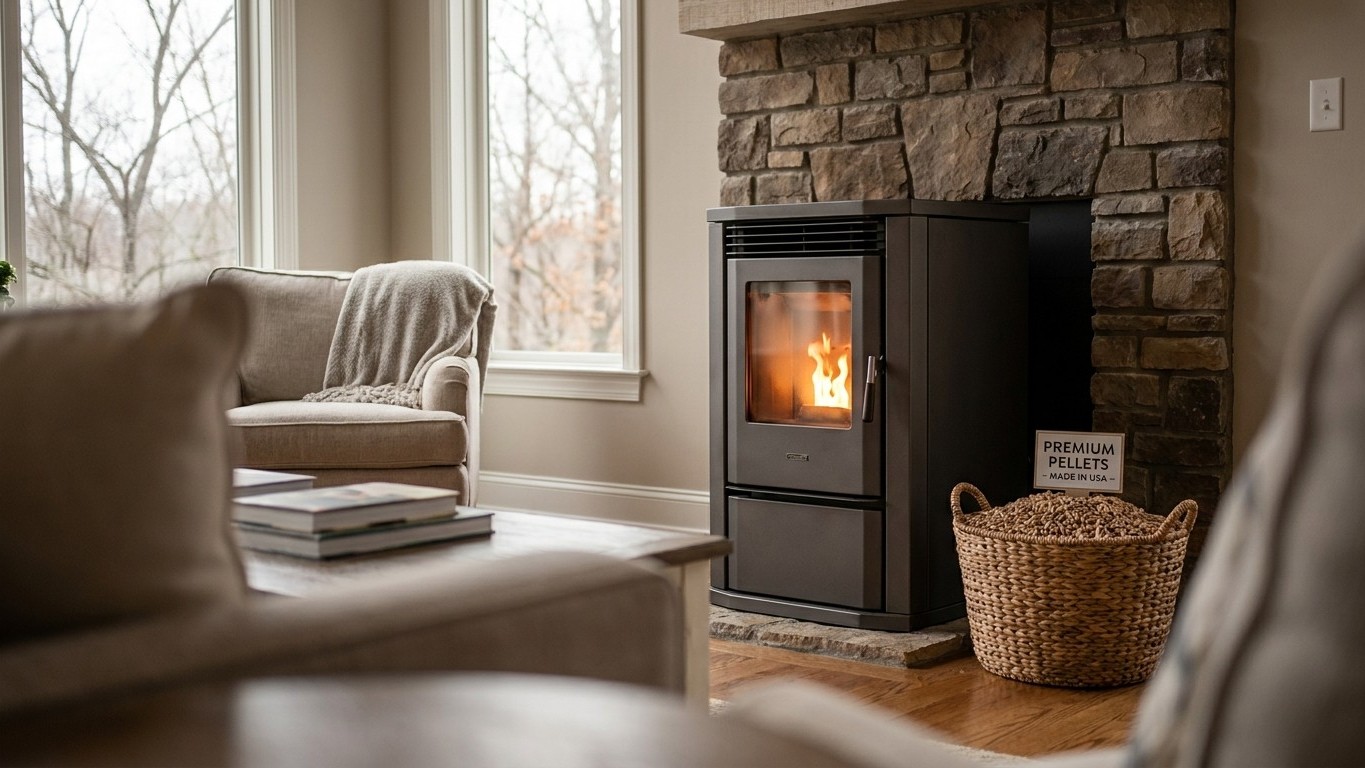

A pellet stove in Michigan works for its keep. Between the first cool nights of September and the last chilly mornings of May, the state’s furnaces and boilers run for the better part of nine months, and a stove asked to help carry that load burns through real tonnage before spring arrives. Whether it ends up as your main heat source or a supplement running alongside a furnace depends on your house, but the climate itself isn’t in question. Here’s what the numbers actually say about depth, length, cost, storage, and what happens when the power goes out in the middle of January.
How hard the winter works here

Detroit Metro AP logs about 6,067 heating degree days a year, measured against the 65 F base that NOAA uses to define a “normal” day requiring heat. That figure is the whole story in one number: it’s the sum, across every day of the year, of how far the average temperature falls short of 65 F. A house in a place with 3,000 heating degree days needs roughly half the fuel of a house sitting at 6,067, all else being equal. Michigan, at this reference station, sits well above the national middle. This is not a state where a pellet stove is optional atmosphere in a mild fall and forgotten by December. It’s a climate that asks a stove to work.
Depth is one thing. Length is another, and Michigan has both. Heating demand at Detroit Metro AP starts in September, the first month whose average temperature (64.9 F) dips below that 65 F threshold, and it doesn’t let go until June, when the mean finally climbs back over the line. That’s a nine-month heating season. January carries the heaviest load, with 1,216 degree days on its own, roughly a fifth of the entire year’s total packed into one month. February isn’t far behind at 1,036. A stove here isn’t lighting a few cozy fires in November and calling it done. It’s expected to show up in September, work hardest in the dead of winter, and still be relevant in April, when 488 degree days are still on the books.
None of this applies evenly across the state, and that matters more in Michigan than in most places. Detroit Metro AP sits in the southeast, in the state’s mildest corner. A house in the Upper Peninsula, or even in the snowbelt counties along Lake Michigan’s eastern shore, faces a longer season and higher totals than the number above. If you’re heating in Marquette or Houghton, treat 6,067 as a floor, not your actual number, and expect the season to start earlier and end later than it does near Detroit.
How many tons a winter takes here
Nobody can hand you a tons-per-winter figure and have it mean anything, because no source publishes one by state or county, and two houses on the same street can burn twice as much as each other depending on how they’re built. What you can do is work the math that actually governs it. A bag of pellets weighs 40 pounds. Fifty bags make a ton. How many tons you burn is a direct function of how much heat your house demands, which is exactly what the degree-day figure above is measuring. More degree days, more fuel, for a given house and a given heating strategy.
Three things move that number more than anything else:
- How well the house holds heat. A tight, well-insulated 2010s build in Grand Rapids can burn noticeably less than a drafty older farmhouse in the same county, even with identical degree days.
- Whether the stove is the only heat or a supplement. A stove asked to carry the whole nine-month season burns far more than one running a few hours in the evening alongside a furnace that’s doing most of the work.
- The setting it runs at. A stove left on a low or medium setting through the mild shoulder months of September, October, and April sips fuel compared to the same stove cranked through January’s 1,216-degree-day peak.
Given all that, the honest method isn’t a formula, it’s a measurement. Buy pellets in reasonable batches through your first winter, keep the receipts or just count the bags as you burn through them, and add it up in April. That single measured season, tied to your actual house and your actual habits, beats every estimate anyone can offer you from a chart. It also gives you a number you can trust for planning the second winter, which is the whole point. For the national math behind bag counts and seasonal ranges, see our guide on how many pellets a winter takes.
Buying and storing them in this climate
Michigan’s heating season starts in September, which means the window for buying ahead closes earlier than a lot of people assume. Pellets are typically cheapest in the off-season, before the first real cold snap sends everyone to the same dealers at once. Since demand here starts building as early as September and the season doesn’t fully release its grip until June, waiting until October or November to stock up means competing with every other household in the state doing the same thing, right as a cold snap or a supply hiccup can empty shelves fast. Buying before the season starts, not during it, is the difference between a calm purchase and a scramble.
Storage matters just as much as timing, and Michigan’s climate cuts both ways here. Pellets are compressed sawdust held together by nothing but pressure and the wood’s own natural lignin, no glue involved, which means moisture is the enemy in either direction. Michigan summers along the Great Lakes run humid, and that humidity finds its way into garages and sheds where a lot of households stash their pellet supply. A garage floor that sweats in July, especially one with a slab poured close to grade or near an unvented crawlspace, will pull moisture up into stacked bags sitting directly on the concrete. Winters bring their own version of the problem: wet snow tracked in, roof leaks, or a shed that isn’t quite sealed against wind-driven rain off Lake Michigan or Lake Erie. Either way, pellets that absorb moisture swell, lose their shape, and crumble into sawdust that won’t feed properly through an auger.
The fix is the same one that applies everywhere, just more urgent given the local humidity: keep bags off bare concrete on pallets or boards, keep them under a roof, and don’t buy more than you can store dry. When comparing options, compare price per ton rather than per bag, since that’s the only figure that actually lines up across different package sizes and sellers. For the full rundown on protecting pellets from moisture and judging quality before you buy, our national storage and quality guides go deeper than a state page can.
What a winter outage means here
A pellet stove needs electricity to function, full stop. The auger that feeds pellets into the firebox, the fans that circulate heat into the room, and the control board that runs the whole thing all draw power from a wall outlet. Unlike a wood stove, which will keep radiating heat through a blackout as long as someone’s willing to feed it logs by hand, a pellet stove with no power is just a cold metal box. No auger, no fire, no heat, regardless of how much fuel sits in the hopper.
That fact means something different depending on how hard the winter is pressing, and in Michigan it presses hard. At 6,067 heating degree days a year, with January alone carrying 1,216 of them, a power outage in the depths of winter isn’t an inconvenience, it’s a heating emergency for any household leaning on that stove as a primary source. The same outage in September or April, sitting in the mild shoulder months where degree-day totals barely register, is closer to an evening without a fire in the living room. The stakes rise and fall with the calendar, not just the forecast.
Most Michigan households aren’t actually staking their winter on the stove alone, which is worth knowing before an outage hits. State data shows 83% of homes run a furnace as their main heating equipment, and 77% heat primarily with natural gas. A smaller share, 9%, rely on a steam or hot-water boiler, and another 9% run on propane. Electricity as a main heat source sits at 10% statewide. What that mix tells you is that for most households, the pellet stove is layered on top of a furnace system, and that furnace, if it’s gas-fired, may keep running through a power outage depending on how it’s wired, though many modern gas furnaces still need electricity for the igniter and blower. Rather than guess at your own setup, check the label on your furnace and your stove, and see our national guide on power cuts and heating for how to plan around either one going dark at the same time.