
Collards grow reliably across most of Utah, but the state’s climate is anything but uniform, and that changes the answer more than most guides admit. In the Salt Lake Valley, plant after the region’s variable spring frost risk fades; at higher elevation, wait longer. Whether the crop becomes a fall-only planting or a standing winter green depends on how cold that specific location’s coldest month runs, not on a statewide average.
When the soil is warm enough in Utah

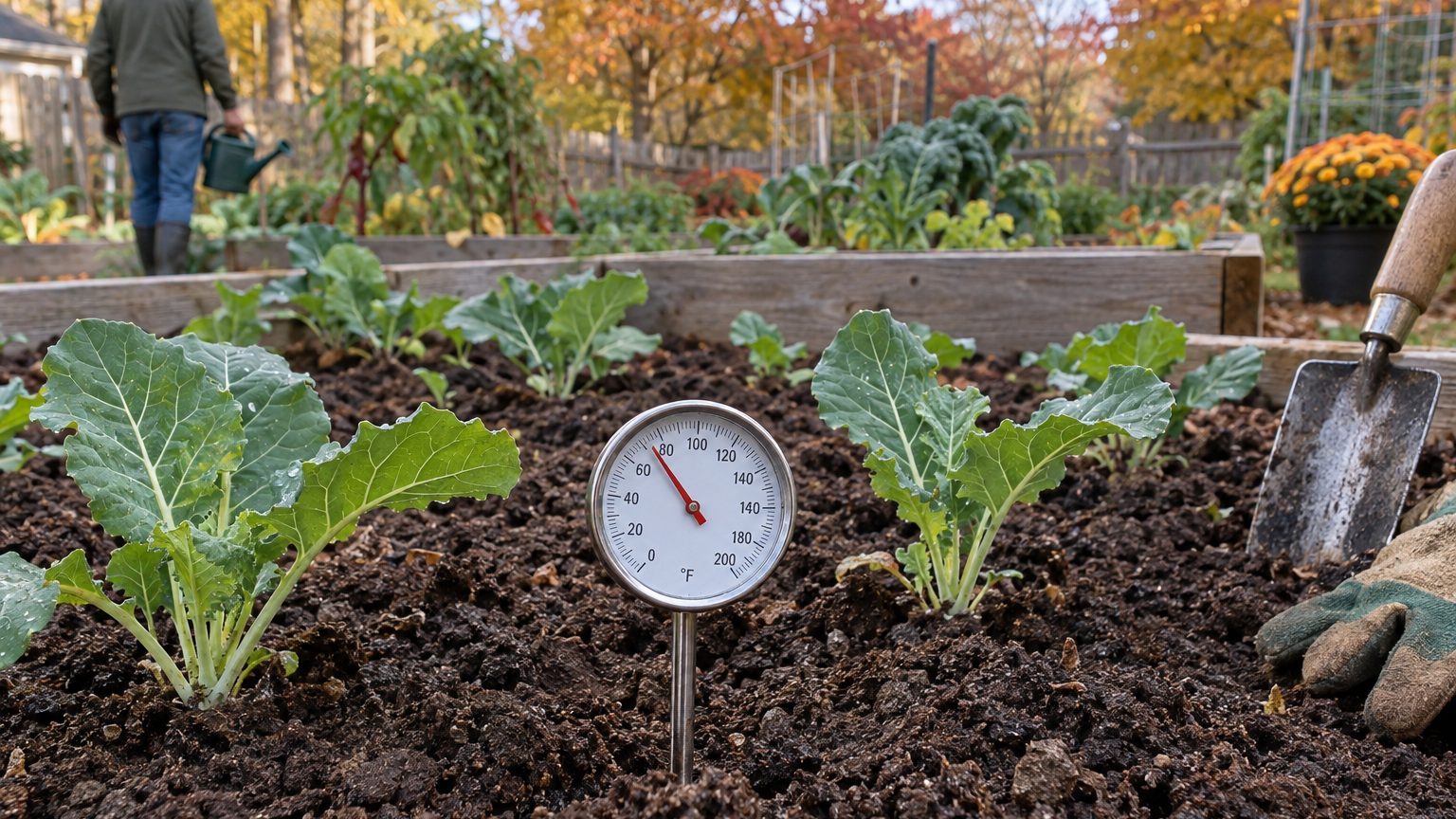
Frost dates get quoted constantly, and they’re useful, but they answer the wrong question if taken literally. A frost date tells you when the air stopped freezing on a given probability basis. It does not tell you when the soil, several inches down, has warmed enough for collard roots to actually start working. Those two events are related but not identical, and the gap between them is where a lot of transplant shock happens.
The number itself, and its limits
For the Salt Lake City reference station (NOAA station USW00024127), the last spring freeze at 32°F falls somewhere in the window of April 12 to April 29, based on 1991-2020 Climate Normals. That’s a 30-70% probability band, not a fixed calendar date. It means frost has already retreated in roughly a third to two-thirds of years by the early end of that range, and hasn’t fully cleared out in the rest. Treat it as a planning tool, not a guarantee written into the ground.
The valley itself is the mildest slice of the state. Utah runs from roughly 2,200 feet to over 13,000 feet in elevation, and most of the state sits higher and colder than Salt Lake City. Southern Utah’s low-elevation basins run warmer than this reference point; mountain valleys and benches run considerably colder, sometimes by several weeks on either end of the frost calendar. Anyone gardening outside the Wasatch Front should treat the Salt Lake figure as a starting reference, not a local forecast, and check their own county’s frost data before committing seedlings to open ground.
What actually decides transplant timing
Soil temperature is the practical trigger for collards, which germinate and root reliably once the ground has shed its early-spring chill, typically a week or two after the local last-frost window closes. Direct-seeded collards can go in slightly earlier than transplants, since seed sitting in cool soil simply waits rather than suffering the shock a set of leaves would. Raised beds and south-facing plots warm faster than open flat ground, which matters more in Utah’s higher valleys than it does near the lake.
One more thing worth flagging early: collards are brassicas, in the same family as cabbage, kale, mustard, turnip and rutabaga, and they share pest and disease pressure with all of them. A gardener rotating collards into a bed that grew any of those crops the year before hasn’t rotated anything. That single fact shapes bed planning more than most people expect, and it’s worth checking a dedicated brassica rotation guide before laying out next year’s plot.
How long the season lasts here
Pairing both frost windows gives a real sense of what’s workable. The first fall freeze at the Salt Lake City station lands between October 18 and October 29, again a 30-70% probability band from the same 1991-2020 Climate Normals. Stack that against the spring window of April 12 to April 29, and the open growing season along the Wasatch Front runs somewhere around 170 to 200 days, depending on which end of each range actually plays out in a given year.
What that window allows
That’s a genuinely long season by collard standards, long enough to support a spring sowing and a second one in late summer aimed at a fall harvest, rather than treating the crop as a single-shot planting. Collards handle a second sowing well because they tolerate light frost once established, which stretches the harvest window on the back end further than most warm-season crops could manage. Anyone planning that second round should look at a succession sowing guide before committing a whole bed to one planting date, since timing the second sowing against the fall frost window matters as much as the spring one did.
Higher, colder parts of the state won’t get this same math. Where the season runs shorter, that first sowing effectively becomes the only one, and it raises the stakes on transplanting rather than direct seeding, since a transplant buys back weeks that a short season doesn’t have to spare. It also changes whether starting seedlings indoors is worth the extra step at all, given how much less room there is to recover from a slow or failed first attempt.
The valley’s long window is the exception here, not the rule for the state as a whole. Anyone gardening at elevation should expect both frost dates to shift, usually compressing the season from both ends at once rather than just one.
Heat and water in Utah

Summer heat isn’t really the variable that decides how a Utah collard patch gets planned. The winter is. That single distinction splits this crop into two entirely different management styles depending on where in the state a garden sits.
The winter low is the deciding number
At the Salt Lake City reference point, the coldest month’s average daily minimum runs 24.2°F, based on 1991-2020 Climate Normals. That’s cold enough that collards there behave as an autumn crop: sown for a fall harvest, picked through the first hard freezes, and finished once sustained hard cold sets in, rather than kept going leaf by leaf through the winter months. In warmer, lower-elevation pockets of southern Utah, where winter minimums run milder, the same plant can behave as a standing crop, harvested a few leaves at a time from November into March. The USDA hardiness zone range for the state, 4a-9a on the 2023 Plant Hardiness Zone Map, reflects exactly this spread: a single state number would flatten a real difference between a Salt Lake City winter and a St. George winter.
Water in an arid state
Utah is one of the driest states in the country, and collards don’t tolerate a dry stretch the way some root crops do. Their leaves respond fast to inconsistent moisture, going bitter or slowing growth when a bed dries out between waterings. That makes irrigation scheduling, not summer heat itself, the practical daily concern for most Utah gardeners growing this crop, particularly through the hottest stretch of midsummer when soil moisture disappears quickly even under mulch. A steady watering routine matters more here than chasing an exact temperature threshold, since the crop’s real vulnerability is moisture swings rather than heat alone.
Where a garden sits in a cooler, damper mountain valley, the risk flips: slower ripening and a higher chance of leaf mildew in still, humid air, which points toward wider plant spacing and better airflow rather than anything to do with drought.
Which collards suit Utah
The honest answer here is a type, not a name. This page can’t source a specific cultivar responsibly, because the varieties that actually perform well shift by elevation, soil and local disease pressure in ways only a state trial program tracks with any accuracy. Utah State University Extension runs exactly that kind of local variety testing, and its extension service is the right place to get a name that’s actually been proven in-state rather than guessed at from outside it.
Matching type to conditions
What can be said reliably is how to reason through the choice by type, based on the same facts already laid out above.
| Utah condition | Type to favor | Why |
|---|---|---|
| Shorter season at elevation | Earliest-maturing types | Less time between sowing and harvest before hard frost |
| Hot, dry lower valleys | Types tolerant of heat, given airflow and root shade | Reduces stress during peak summer irrigation demand |
| Cool, damp mountain valleys | Disease-resistant types | Lowers mildew risk in still, humid air |
Beyond the choice of type, bed placement does real work here. Rotating collards away from any bed that grew cabbage, kale, mustard, turnip or rutabaga in the past few seasons matters because all of them are brassicas sharing the same pest and disease pressures, a point worth checking against a dedicated rotation guide before the bed gets set for next year. Skipping that step tends to matter more in Utah’s drier soils than gardeners expect, since stressed plants in marginal moisture recover from disease pressure more slowly than well-watered ones do.
Whatever type gets chosen, the extension service’s own trial data will name the specific variety that’s actually earned its place in a given county, and that’s a stronger recommendation than any general guide can offer.