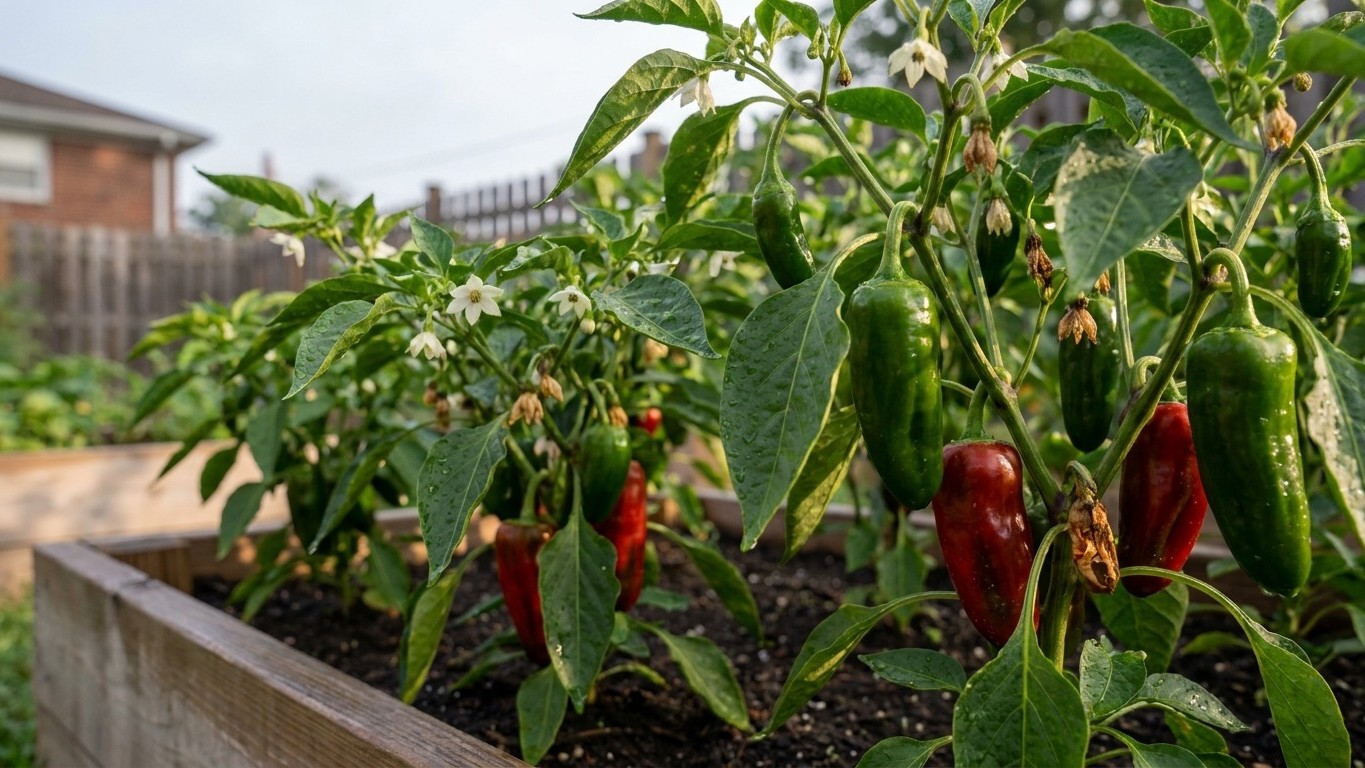

Michigan’s growing season decides pest pressure on peppers more than any single insect does. This page’s sourced data centers on the climate windows that make peppers vulnerable in the first place: frost timing, the number of days that cross 90°F, and the narrow band in which fruit actually sets. Pest identification for your county runs through Michigan State University Extension, which is also the source for the frost data below.
Which pests attack pepper in Michigan
Here’s the honest starting point: the verified facts behind this page don’t carry a species-by-species pest list for Michigan pepper crops. What they do carry is the climate mechanics that decide when a pest problem even gets a foothold, and the authority that documents actual pest activity county by county is Michigan State University Extension, the same source this page uses for frost-free dates. That’s the right place to confirm exactly what’s chewing, sucking, or boring in a specific garden, because pest presence shifts from one part of the state to another.
What can be said with confidence is what doesn’t belong on a pepper damage page. Wood-boring beetles that hollow out tree trunks, grubs that live under turfgrass, and moths that target orchard fruit all show up in general Michigan pest conversations, but none of them touch an annual vegetable grown from a spring transplant. If a neighbor mentions a borer or a grub in the same breath as pepper trouble, that’s a sign the diagnosis has wandered off the actual crop.
Peppers instead attract three broad categories of feeding pressure, and each one lines up with a different stage of the plant’s life. Early on, right after transplant, soft young stems and tender leaves draw insects that feed at the soil line or on new growth. Mid-season, once the canopy fills in, sap-feeding insects colonize the undersides of leaves where they’re hard to spot. Later, once fruit forms, feeding damage can move to the fruit itself, especially where it touches soil or sits in dense foliage with poor airflow.
The single most useful number for judging how much pressure a Michigan pepper patch will face is the count of days that reach 90°F or hotter: 10.3 per year on average at the Detroit reference station, per NOAA NCEI Climate Normals covering 1991 to 2020. That’s not a huge number, and it matters because heat stress on the plant itself, not just insect activity, is often the bigger threat to fruit set in a Michigan summer.
Because this page can’t attach names to a list that doesn’t exist in the sourced data, the more useful move is tracking the conditions that invite feeding damage and pairing that with a call to the local extension office once a specific symptom shows up. That’s covered next.
When each one shows up, and what it does first
Timing on a pepper plant runs off the frost-free window, not off a calendar month, because that window itself moves across the state. Frost-free dates land around April 30 in the Detroit area and shift to early or mid-May across most of the Lower Peninsula, according to MSU Extension. Transplants shouldn’t go in the ground before then, and pest pressure on young plants doesn’t really start until the plants themselves are in the ground and growing.
In the first two to three weeks after transplant, watch the base of the stem and the newest leaves. Feeding at the soil line shows up as a plant that looks fine one evening and is toppled or missing entirely the next morning, cut clean rather than wilted. Feeding on the newest leaves shows up as small ragged holes or a stippled, silvery look across the leaf surface, usually worse on plants that are already stressed from a cold snap or uneven watering.
Once the plant is established and putting on size, usually several weeks into the season, sap-feeding damage tends to concentrate on leaf undersides. The tell is a leaf that curls or yellows from the inside out, sometimes with a fine webbing or a sticky residue on the leaves below it. This kind of damage rarely kills a plant outright, but it slows growth right when the plant needs energy for flowering.
Flowering is where the climate math becomes the bigger story. Fruit set fails at both ends of the temperature scale: nights below 55°F or days above 90°F, per Utah State University Extension. Michigan’s 10.3 average days above 90°F means the hot-end failure is a real but limited risk most seasons, concentrated in the hottest stretch of summer. The cool end depends on nighttime lows specific to a given garden and season, which this page doesn’t track, so that’s one to watch directly rather than assume from the calendar.
Once fruit is forming, any feeding damage that shows up on the fruit itself, small punctures, sunken spots, or chewed patches near the stem end, deserves a same-week look rather than a wait-and-see approach, since fruit damage doesn’t heal the way leaf damage can.
Telling the damage apart from everything else
Pepper plants get blamed for insect damage constantly when the real cause is heat, water, or a nutrient gap. Sorting these out before reaching for any treatment saves both time and the plant.
| What you see | Likely cause | What tells them apart |
|---|---|---|
| Leaves curling and yellowing from the inside | Sap-feeding insects or uneven watering | Check leaf undersides for insects or fine webbing before assuming a water problem |
| Ragged holes in leaves | Chewing insects | Chewing leaves clean edges of leaf tissue; disease spots leave a discolored ring instead |
| Plant cut off at the soil line overnight | Soil-line feeding | A clean, sharp cut through the stem points to feeding, not wilt or disease |
| Blossoms dropping before fruit forms | Temperature stress | Nights under 55°F or days over 90°F cause blossom drop with no insect involved at all |
| Fruit soft and pitted after storage | Chilling injury, not pest damage | Storage below about 45°F causes this; it shows up days after harvest, never in the garden |
That last row catches more gardeners than any insect does. Clemson Cooperative Extension notes that peppers store best at 45 to 50°F and 80 to 90 percent relative humidity for two to three weeks, which is warmer and more humid than a standard refrigerator. A home fridge running colder than that will pit and soften pepper fruit within days, and it’s easy to mistake that damage for something that happened in the garden.
None of this replaces a direct look at the plant. When a symptom doesn’t match anything on this list, or when it’s spreading across a bed rather than staying isolated to one plant, that’s exactly the case for a call to the county extension office rather than a guess based on a photo search.
What actually works here, and what is a waste of time
On a Michigan-length growing season, timing beats intervention almost every time. A physical barrier placed over young transplants right after they go in the ground, during that first two to three weeks when soil-line feeding is most likely, does more good than any treatment applied after the damage shows up. Once a stem is cut through, nothing brings that plant back.
Transplanting only after soil reaches 60°F and frost has passed, per Utah State University Extension, also cuts pest pressure indirectly. A plant that isn’t cold-stressed grows faster through its most vulnerable early stage and spends less time as an easy target.
Row covers and floating barriers work because they block access physically, not because of any active ingredient, and they need to come off before flowering so pollinators can reach the blossoms. Leaving cover on too long trades one problem for another.
What tends to waste time: treating for insect damage that turns out to be heat stress or blossom drop from a cool night, since no pest control addresses a temperature problem. Spraying on a fixed schedule instead of in response to an actual symptom also wastes effort and money, especially given how limited the true hot-stress window is in a typical Michigan summer.
This page doesn’t name products, active ingredients, or rates, because that call belongs to MSU Extension, which tracks what’s currently labeled and approved for use in Michigan. That’s the right source once a specific pest is confirmed rather than suspected.
Where to check this for your own county
Michigan State University Extension is the named authority behind the frost data on this page, and it’s also the right first call for pest documentation specific to a county rather than the state as a whole. Pest presence isn’t uniform across Michigan; a problem common in one county can be rare two counties over, shaped by local weather, soil, and what’s growing nearby.
The frost-free window itself runs from around April 30 in the Detroit area to early or mid-May across most of the Lower Peninsula, which means a pest calendar built for one part of the state can be off by a couple of weeks somewhere else. That gap matters more than it sounds like it should, since a treatment or barrier timed to the wrong week does very little good.
The most useful next step for anyone seeing actual damage right now is a call or a visit to the local MSU Extension county office, ideally with a photo or, better, the affected plant part in hand. County offices track what’s active locally in a way that no statewide page can match, and they can confirm whether a symptom is a pest, a temperature problem, or something else entirely.
Common questions
Do I need to cover pepper transplants against frost?
Peppers shouldn’t go in the ground before the local frost-free date, which lands around April 30 in the Detroit area and early to mid-May across most of the Lower Peninsula, per MSU Extension. Covering an already-transplanted pepper during a late cold snap can buy a little protection, but the better fix is simply waiting for the window to open.
Why are my pepper blossoms dropping with no visible pest?
Temperature is the likely answer before any insect. Fruit set fails when nights drop below 55°F or days climb above 90°F, according to Utah State University Extension, and neither end of that involves a pest at all.
Can I store harvested peppers in the refrigerator?
A standard fridge usually runs colder than the 45 to 50°F peppers need, and that extra cold causes pitting and softening within days. Clemson Cooperative Extension notes the better range is 45 to 50°F with 80 to 90 percent humidity, holding fruit for two to three weeks at most.
How long after transplanting should I expect pepper fruit?
Clemson Cooperative Extension puts harvest at roughly 70 to 85 days after transplanting, which is a helpful marker for deciding when to start checking fruit closely for any late-season feeding damage.