
Most pepper varieties can ripen fully in a Michigan garden if the plant goes into the ground already several weeks old and the grower manages both ends of the temperature scale, not just the cold snaps everyone worries about in spring. The season is workable, but it isn’t forgiving of a late start or a plant left to sit in a cold night.
The short answer

Start with the heat side of the equation, because that’s the number this territory actually carries. The reference station in Detroit averages 10.3 days a year at or above 90 F. That’s not a heat wave here and there, it’s a real stretch of high-heat days spread across a typical summer, and it matters because pepper fruit set collapses once daytime temperatures push past 90 F. Flowers drop instead of turning into fruit. Ten days sounds small next to a Southern summer, but it’s enough to stall a plant for a week or two right in the middle of the season if those hot stretches land during peak bloom.
Now the other end, and this is the one growers underestimate. Pepper fruit set also fails when nights drop below 55 F, according to Utah State University Extension. A stretch of cool nights in early summer, the kind that can show up even after the last frost has passed, will stall flowering just as effectively as a heat spike does. The plant doesn’t die, it just refuses to set fruit until conditions swing back into range.
This is the part where a broad climate summary can’t do the job for you. This site tracks days at or above 90 F for Michigan, but it does not carry summer night minimum temperatures for the state, and that figure varies by county, by proximity to the Great Lakes, by elevation, even by which side of a valley a garden sits on. A yard two miles from Lake Michigan can run several degrees warmer at night than a field twenty miles inland, and no statewide average captures that. Don’t guess at your nighttime lows based on how far north or south you are on a map, and don’t assume the coldest month of the year tells you anything about a July or August night. Those are two different questions with two different answers. If cool nights are a real concern in your area, the only reliable move is to actually watch your own overnight lows during bloom season, using a simple outdoor thermometer or a local weather station reading, rather than relying on regional assumptions.
Put those two thresholds together and the practical takeaway is straightforward: Michigan’s season has enough heat days to occasionally stall fruit set from the top end, and possibly enough cool nights early and late in the season to stall it from the bottom end too. Neither one is severe enough to rule out peppers. Both are real enough to plan around.
When to start seed here
The timing question is really just subtraction, and it’s worth doing the arithmetic yourself rather than trusting a generic seed-packet date, because the two numbers that matter both shift by county.
- Find your last spring frost date. MSU Extension puts this around April 30 in the Detroit area, and early to mid May across most of the Lower Peninsula. If you garden further north, or inland away from lake influence, lean toward the later end of that range rather than the earlier one.
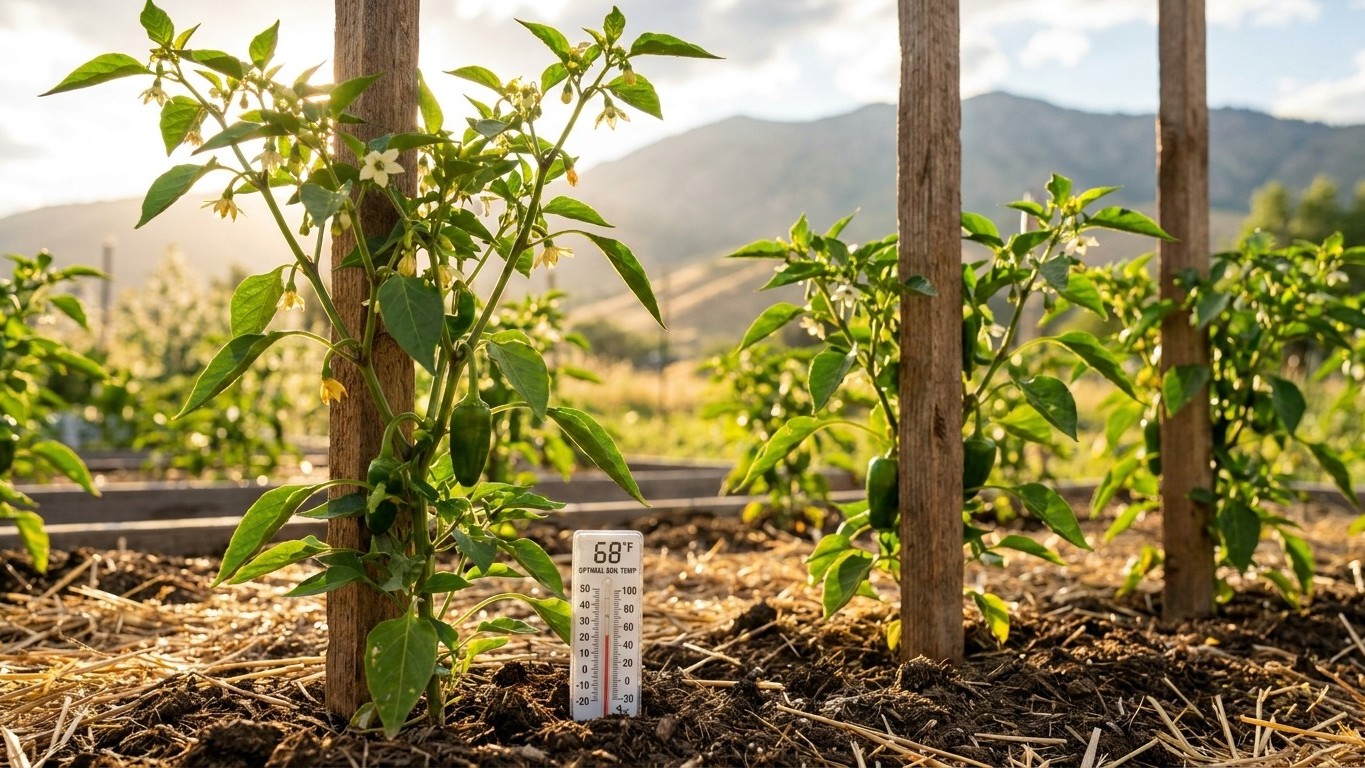
- Add the soil warm-up. Frost passing doesn’t mean the soil is ready. Pepper transplants need soil at 60 F before they go in the ground, per Utah State University Extension, and soil temperature typically lags behind air temperature by a couple of weeks in spring. That pushes your actual transplant date past the frost date itself, sometimes by ten days to two weeks depending on how quickly your particular soil warms.
- Count backward 8 to 10 weeks for indoor seeding. This is the range Utah State University Extension gives for how long pepper seedlings need indoors before they’re ready to go outside. If your soil hits 60 F around the third week of May, for example, counting back 8 to 10 weeks lands your seed-starting date in the second or third week of March.
- Build in a buffer week. Pepper seed germinates slowly compared to most vegetable seed, and a cool spring can push soil warm-up later than expected. Starting a week earlier than the strict calculation costs nothing; starting a week late can mean a shorter fruiting window at the back end of summer.
Redo this math for your own county rather than borrowing a date from a neighboring state or a seed catalog written for a milder region. A grower near Detroit working off the April 30 frost date will land on a different indoor seeding week than someone in a colder pocket of the northern Lower Peninsula working off a mid-May frost date. The gap between those two areas can run two to three weeks, which is exactly the margin that separates a pepper plant that sets fruit in July from one still building its root system when the first hot stretch hits.
What goes wrong here
- Blossom drop during a hot spell. When daytime highs climb into the 90s, which this territory sees an average of 10.3 days a year, flowers can abort before setting fruit. There’s no way to cool the air, but shade cloth over the plants during the worst afternoon hours reduces the stress, and keeping soil consistently moist (not soggy) during a heat stretch helps the plant keep flowering instead of shutting down entirely.
- Blossom drop during a cool night. The flip side: a run of nights below 55 F, whether in early June or a cool snap in August, stalls fruit set the same way heat does. Since this site doesn’t track nightly lows for Michigan, the fix starts with watching your own thermometer during bloom weeks. If a cool stretch is forecast, row cover pulled over the plants at night traps a few extra degrees and can be enough to keep flowers setting.
- Sunscald on exposed fruit. Michigan summers deliver enough strong, direct sun that a pepper suddenly exposed by a broken branch or over-pruned foliage can develop a pale, papery patch on the side facing the sun. Keep the plant’s natural leaf cover intact rather than stripping leaves to “let more light in,” which is a common overcorrection that does more harm than good.
- Blossom-end rot. A dark, sunken spot on the bottom of the fruit, usually tied to uneven watering rather than a soil problem alone. Inconsistent moisture, heavy rain followed by a dry stretch, is common in a Michigan summer and interferes with how the plant moves calcium to the fruit. Even, regular watering, especially during the same hot spells that trigger blossom drop, is the most direct fix.
Utah State University Extension names six pepper varieties suited to home gardens but doesn’t attach a heat tolerance rating, a days-to-maturity figure, or a mature size to any of them in that source. Rather than guessing at numbers that aren’t published, the safer approach is to choose based on your own transplant timing and expected first-fall-frost date, and to treat variety selection as secondary to getting the start date and watering right.
Common questions
Can peppers still ripen if a hot spell hits during flowering?
Flowers that abort during a stretch of 90 F-plus days won’t come back, but a healthy plant will push out new blooms once temperatures ease, so a mid-summer heat spell delays the harvest rather than ending it, provided the plant still has enough season left afterward.
Do I need to worry about cool nights if I planted after the last frost?
Yes. Frost and the 55 F night threshold for fruit set are two separate issues. A night can sit comfortably above freezing and still be too cool for pepper flowers to set fruit, so watching overnight lows through the bloom period matters even weeks after frost risk has passed.
Is 8 weeks or 10 weeks better for starting seed indoors?
Utah State University Extension gives the range as 8 to 10 weeks without specifying which end suits which conditions, so the choice comes down to your own transplant date: if your soil is slow to warm and your frost date is later, lean toward 10 weeks for a sturdier transplant.
Why does soil temperature matter more than air temperature for transplanting?
Roots sit in soil, not air, and a pepper transplant set into soil below 60 F stalls its root growth even if daytime air feels warm enough. That stall shows up later as a slow, unproductive plant, which is why soil temperature, not the calendar date, should decide when transplants go in.