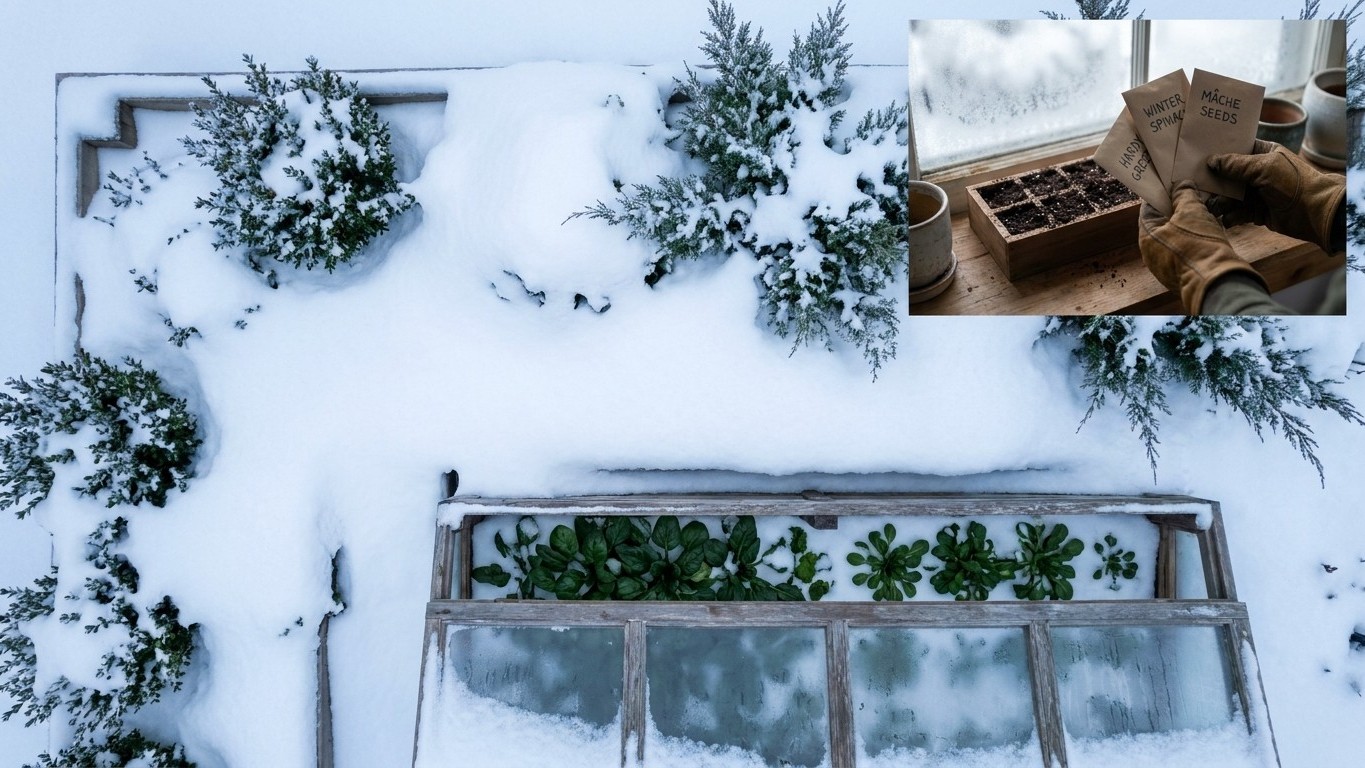

February in Michigan is not a month for the open garden. Statewide, soil sits frozen or waterlogged, and the last spring frost is still eight to twelve weeks away depending on where you live. What actually happens this month is indoors and under cover: seed-starting for onions and peppers, dormant pruning, seed ordering, and the occasional cold-frame harvest of greens that never stopped growing under the snow.
What goes in the ground in February

The decision here isn’t the calendar, it’s the soil. A garden bed is workable when it crumbles instead of clumping into mud, and in most of Michigan that condition simply doesn’t exist in February. With the last spring frost running around April 30 in the Detroit area and early to mid May across most of the Lower Peninsula (MSU Extension, Frost-Free Dates), the frost window itself is still two to three months out. That gap matters more than any date on a seed packet.
For most of the state, the honest answer is that nothing goes into open ground this month. The exception, and it’s a narrow one, is garlic or shallots you didn’t get planted in fall: if a thaw leaves the ground workable in the milder pockets of zone 6b, in Michigan’s southern tier, a late planting can still root before hard freeze returns. It’s a gamble, not a plan, and it will lag well behind a fall-planted crop.
Cold frames and low tunnels are where real February activity happens outdoors. Hardy greens sown the previous fall, spinach, mâche, claytonia, keep producing under cover through winter as long as snow load doesn’t collapse the structure. Bare-root fruit trees and cane fruit can be ordered now for planting once the ground opens, but the planting itself waits. Indoors, forcing rhubarb crowns or Belgian endive (witloof chicory) roots in a dark, cool space gives a genuine February harvest without touching frozen soil at all.
Nothing here should be padded with crops that can’t survive a Michigan February. If a seed catalog or a neighbor suggests direct-sowing peas or lettuce outdoors this month, the soil temperature and the frost window both say otherwise for the vast majority of the state.
What to start under cover
Indoor seed-starting in February is arithmetic, not tradition. Count backward from the local last-frost date, then back further by however many weeks a given crop needs before it’s ready to transplant. Because that last-frost date shifts from around April 30 near Detroit to early or mid May farther north and inland, every gardener needs to run this math for their own county rather than copy a fixed date off a chart.
Counting backward from the frost window
Onions and leeks grown from seed need roughly ten to twelve weeks of indoor growth before they go outside, which puts a Detroit-area start in early to mid February and a start farther north closer to late February. Peppers run eight to ten weeks, landing in the same general window. Both are slow starters, and starting them late means small, underdeveloped transplants come spring.
| Crop | Weeks before last frost | Typical indoor start (Detroit-area timing) |
|---|---|---|
| Onions, leeks (seed) | 10-12 weeks | Early-mid February |
| Peppers | 8-10 weeks | Mid-late February |
| Cabbage, broccoli | 6-8 weeks | Late February-early March |
The two failure modes are opposite but equally common. Start too early and the seedlings outgrow their pots weeks before it’s safe to transplant, ending up rootbound, stretched, and stressed before they ever see the garden. Start too late, especially with slow crops like onions or leeks, and there isn’t enough season left for them to size up properly once transplanted. A bright south-facing window rarely supplies enough light for either group; without supplemental grow lights, expect leggy stems even on a well-timed start.
What is ready to pick
Outdoors, there’s little to gather in February, and that’s worth saying plainly rather than stretching a short list. What’s available comes from crops planted and protected months earlier. Kale and leeks left in the ground under a thick mulch or snow cover can still be dug or cut when the soil around them isn’t frozen solid; snow itself acts as insulation, and a kale plant that looks collapsed under it often perks back up within an hour of being brought inside.
Cold frames extend this further. Spinach, mâche, and other cold-hardy greens sown the previous fall keep producing slowly through winter, growth nearly stalled but not stopped, and a frame can yield a modest salad every week or two even in the coldest stretch.
Indoors, sprouts and microgreens fill the gap with almost no setup: a tray of pea shoots or radish microgreens on a windowsill goes from seed to harvest in one to two weeks, giving fresh greens with none of the wait a garden demands.
This is also the month to walk the root cellar or basement storage shelves. Squash with a soft spot near the stem, potatoes that have started sprouting or gone soft, onions with a moldy neck all need pulling and using before they spread rot to the rest of the batch. A single soft squash left in a bin can take out its neighbors within a week or two.
The jobs that matter this month
February carries real deadlines even without a single seed going into open ground. Dormant pruning of apple, pear, and cane fruit is best done now, while the plant is fully dormant and the branch structure is visible without leaves in the way. Prune too late, after buds start swelling, and the plant wastes energy on growth that then gets cut away; prune correctly now and the tree channels that energy into the branches left behind.
Seed ordering belongs on this month’s list too, and not as a formality. Popular varieties of tomatoes, peppers, and onions sell out of seed companies’ stock by late winter most years, so ordering in February rather than March is the difference between getting a preferred variety and settling for whatever’s left.
Soil testing fits here as well: samples sent to a lab now come back with results in time to amend beds before the spring planting rush, rather than guessing at pH and nutrient levels under time pressure in April. Turning the compost pile, even a half-frozen one, keeps decomposition moving and prevents it from going anaerobic and sour by spring.
Tool maintenance is unglamorous but pays off directly: a sharpened pruning saw or hoe blade cuts cleanly and reduces plant stress, where a dull one tears and invites disease. Checking raised beds, trellises, and fencing for winter damage now means repairs happen before soil work and planting compete for the same hours. And a second pass through stored crops, squash, potatoes, onions, catching rot before it spreads, protects food that’s already been grown rather than food that’s still months away.
What not to do in February
The most common mistake is trusting a warm afternoon over the actual soil and frost data. A 55-degree day in February doesn’t mean the ground has warmed or that frost risk has passed; the last spring frost is still weeks to months out depending on location, and a single mild stretch changes none of that math.
Uncovering cold frames, pulling back mulch, or hardening off seedlings outdoors after a warm spell is a related trap. Michigan’s February thaws are notoriously followed by hard refreezes, and plants exposed too early can be damaged or killed by the cold snap that follows just days later. Keep protective covers in place until the pattern, not just one warm afternoon, actually shifts.
Starting warm-season crops like tomatoes indoors this early is another frequent error. Tomatoes need only six to eight weeks before transplanting, which lands in March for most of the state; a February start means leggy, stressed plants sitting in pots for weeks longer than necessary before it’s ever safe to move them outside.
Fertilizing dormant plants, especially with nitrogen, wastes the input and can even harm root health. Dormant trees, shrubs, and perennials aren’t actively taking up nutrients, so applied nitrogen either leaches away with snowmelt or sits unused in the soil. Save feeding for when growth actually resumes.
Checking this against your own county
Everything above is a statewide starting point, not a set of instructions for a specific yard. Elevation, distance from Lake Michigan or Lake Huron, and simple north-south position across the Lower and Upper Peninsulas can shift frost windows by several weeks in either direction. A garden near the shoreline benefiting from lake-effect warmth behaves differently than one forty miles inland at higher elevation, even at the same latitude.
For a planting calendar built around a specific location, MSU Extension‘s outreach resources are the reliable next stop. County-level frost data and local planting guidance there will narrow these ranges down to something a specific garden can actually use.
Common questions
Can I plant anything directly outdoors in Michigan in February?
For nearly all of the state, no. Soil is frozen or too wet to work, and the last spring frost is still weeks to months away. The rare exception is a late garlic or shallot planting during an unusual thaw in the mildest southern pockets, and even that lags behind a fall-planted crop.
Is it too early to start tomato seeds indoors in February?
Generally yes. Tomatoes need only six to eight weeks before transplanting outdoors, which lines up with a March start for most of Michigan given the April 30 to mid-May frost window. A February start risks leggy, rootbound seedlings.
What can I harvest from a Michigan garden in February?
Very little outdoors beyond kale or leeks protected under mulch or snow, plus whatever a cold frame is still producing. Indoors, sprouts and microgreens can be ready within one to two weeks of sowing, and stored squash, potatoes, and onions should be checked regularly for spoilage.
Why does my Michigan frost date differ from what I’ve read elsewhere?
The Detroit area’s last spring frost runs around April 30, but much of the Lower Peninsula sees it early to mid May, and local factors like elevation and lake effect shift it further. Checking county-level data through MSU Extension gives a more accurate window than a single statewide figure.