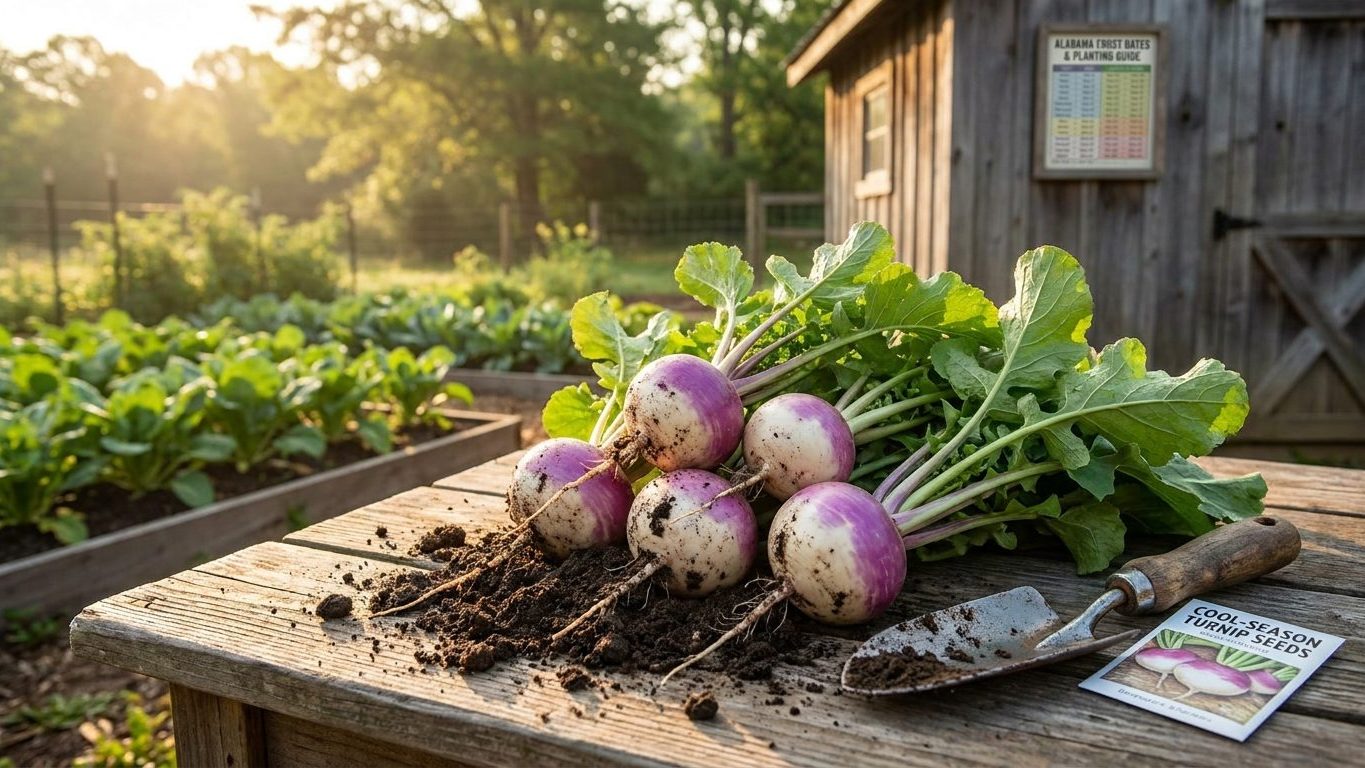

In most of Michigan, turnips go in the ground twice a year: right after the last spring frost for an early crop, and again in mid-to-late summer for the fall crop most gardeners actually prefer, since cool weather sweetens the roots instead of turning them woody.
The short answer for Michigan
Turnips work Michigan’s calendar from both ends. The spring sowing follows the last spring frost, which lands around April 30 in the Detroit area and early to mid May across most of the Lower Peninsula, according to MSU Extension’s frost-free date records. That date isn’t a guarantee. It’s calculated as the point where the odds of another freeze drop below half, so a gardener who sows right on that date is still gambling on the slower half of the bell curve. Waiting a few extra days after the date costs almost nothing; sowing two weeks early can cost the whole planting to a late cold snap.
The fall sowing is the one experienced Michigan gardeners lean on, because turnip roots that finish in cool weather stay crisp instead of going pithy in August heat. Here the anchor point is the other end of the season: MSU Extension’s Michigan Garden Calendar puts the first fall frost at October 6 to October 21 for zone 6a, which covers a meaningful share of the state’s most productive growing counties. Counting backward from that window, and given that most turnip varieties reach harvestable root size well within eight or nine weeks, a late-July to mid-August sowing generally has enough runway to finish before the ground freezes.
That’s the whole mechanism: two windows, bookended by two averaged frost dates, and both dates are probabilities rather than promises. The spring window rewards patience. The fall window rewards counting backward from the first frost date rather than forward from summer’s start, because it’s the frost, not the calendar month, that ends the growing season for turnip roots left in the ground.
Neither number above is a fixed rule for every county. They’re the reference figures MSU Extension publishes for its benchmark stations, and Michigan’s geography stretches wide enough that a gardener two hundred miles north of Detroit is working with a genuinely different season, which the next sections cover directly.
What will not work here

The most common failure with Michigan turnips isn’t a bad variety choice, it’s timing that ignores how tight the fall window actually is. Take the earliest of the zone 6a fall frost range: October 6. Count backward from there, and a turnip sown in early August has roughly nine weeks before frost. A turnip sown in late August has closer to five. Most turnip varieties can still finish in that shorter stretch, but rutabaga, which shares a spot on Michigan seed racks and looks like an oversized turnip, needs a longer season to bulk up. Sow rutabaga on the same late-August schedule as a turnip planting and it typically won’t have sized up before the ground turns cold. The safer rule of thumb is to sow rutabaga no later than early July in most Michigan counties, giving it the extra weeks turnips don’t need.
The other failure runs in the opposite direction: sowing too early in spring because the calendar says it’s April. Michigan’s coldest month averages a daily minimum of 19.2°F at the Detroit reference station, and soil doesn’t shed that kind of winter cold the moment air temperatures climb. Seed dropped into soil that’s still cold and wet from snowmelt doesn’t die from frost, it simply sits, doesn’t germinate, and often rots before conditions improve. That’s a separate problem from the frost date itself. Passing the last spring frost date tells a gardener the air is unlikely to freeze again; it says nothing about whether the soil a few inches down has actually warmed enough for turnip seed to sprout.
A third mismatch shows up with spacing and humidity rather than timing. Michigan summers bring enough rainfall and humid stretches that turnip greens planted too close together stay damp between waterings, inviting the leaf spot and rot issues that thin, airy plantings mostly avoid. None of this is exotic advice specific to some other climate. It’s what Michigan’s own frost dates and winter cold data point to directly: a fall crop with a real deadline, a spring crop that shouldn’t jump the gun on soil temperature, and a humid growing season that punishes crowding.
What changes across Michigan
Michigan is not one climate wearing a single state name. The USDA Plant Hardiness Zone Map, built from 1991-2020 average extreme winter minimum temperatures, places the state anywhere from 4a to 6b, and that spread is wide enough that there’s no single sowing date that fits the whole map. Zone 4a conditions, typical of parts of the Upper Peninsula and higher, colder pockets of the northern Lower Peninsula, mean a shorter frost-free season on both ends: the last spring frost tends to linger later into May than the Detroit-area date already cited, and the first fall frost can arrive well ahead of the October 6-21 window that applies to zone 6a counties farther south.
A gardener working in one of those colder zones should treat the fall sowing window as earlier, not later, than the state’s general guidance suggests, since the frost that ends the season simply shows up sooner on the calendar. Practically, that means shifting fall sowing earlier by a couple of weeks as insurance, and treating any rutabaga planting even more conservatively than the early-July mark that already applies farther south. Elevation compounds this in the same direction: higher ground, even within the same general latitude, tends to run colder at night and collects frost first, since cold air settles into low spots and drains away from high ones.
None of this can be resolved from a state-level article, and that’s the honest limit of what a page like this one can tell a reader. The hardiness zone map exists precisely because “Michigan” spans that 4a-6b range, and the only way to know which end of it applies to a specific address is to check the map directly rather than guess from a regional reputation.
Where to check this for your own county
MSU Extension is Michigan’s land-grant extension service, and it’s the source both frost-date figures in this article come from. Its outreach and county office directory is the right next stop for anyone who wants a number sharper than the state-wide figures used here.
Two things are worth looking for specifically once there. First, a local or regional planting calendar, since MSU Extension publishes guidance that accounts for county-level frost timing rather than the single reference-station dates cited above. Second, any list of turnip and rutabaga varieties that have actually been trialled by county extension offices or Master Gardener programs in that part of the state. Varieties that perform well in a longer-season southern Michigan county don’t necessarily hold up the same way in a shorter-season northern one, and county-level trial notes catch that gap in a way a general state overview can’t.
A county recommendation beats a state one every time, for the simple reason that it’s built on local weather station data rather than a statewide average that has to stretch across a 4a-6b range. This page can give the mechanism and the reference figures; it can’t tell a reader in Marquette the same thing it tells a reader in Ann Arbor, because those two counties sit in genuinely different parts of the map. Contact the local MSU Extension county office directly and ask for their turnip and rutabaga planting notes before finalizing a sowing date off any general calendar, including this one.
The Moon calendar is a separate, older custom: see when to plant turnips by the moon, written as tradition rather than fact.
Checking this against your own garden
Frost dates and hardiness zones describe averages. A garden is one specific patch of ground, and it can run warmer or colder than the reference station by more than either figure accounts for. Three simple checks, all doable without a single tool, tell a gardener more about their own microclimate than any published date.
First, soil feel. Grab a handful from where the turnips will go. Soil that’s still cold enough to feel damp and clay-like, clumping into a solid ball, hasn’t warmed enough yet regardless of what the spring frost date says. Soil that crumbles apart easily in the hand has usually warmed past the point where turnip seed germinates reliably. Second, watch how fast seedlings move from cotyledons to their first true leaves. A quick turnaround, often just a matter of days once true leaves start pushing, suggests the soil is running warm for the season; a long stall suggests it’s running cool, and the next sowing should be pushed a few days later.
Third, watch a spring-sown planting for early flowering stalks. Turnips that bolt to flower before the roots have sized up are reading the season as hotter or longer-daylight than expected, usually a sign that spring sowing happened too late relative to that particular garden’s own warm-up. Note the date the first true leaves appear each season and compare it year to year; that single observation, tracked over a few seasons, ends up telling a gardener more about their own soil than any state-wide frost date ever will.