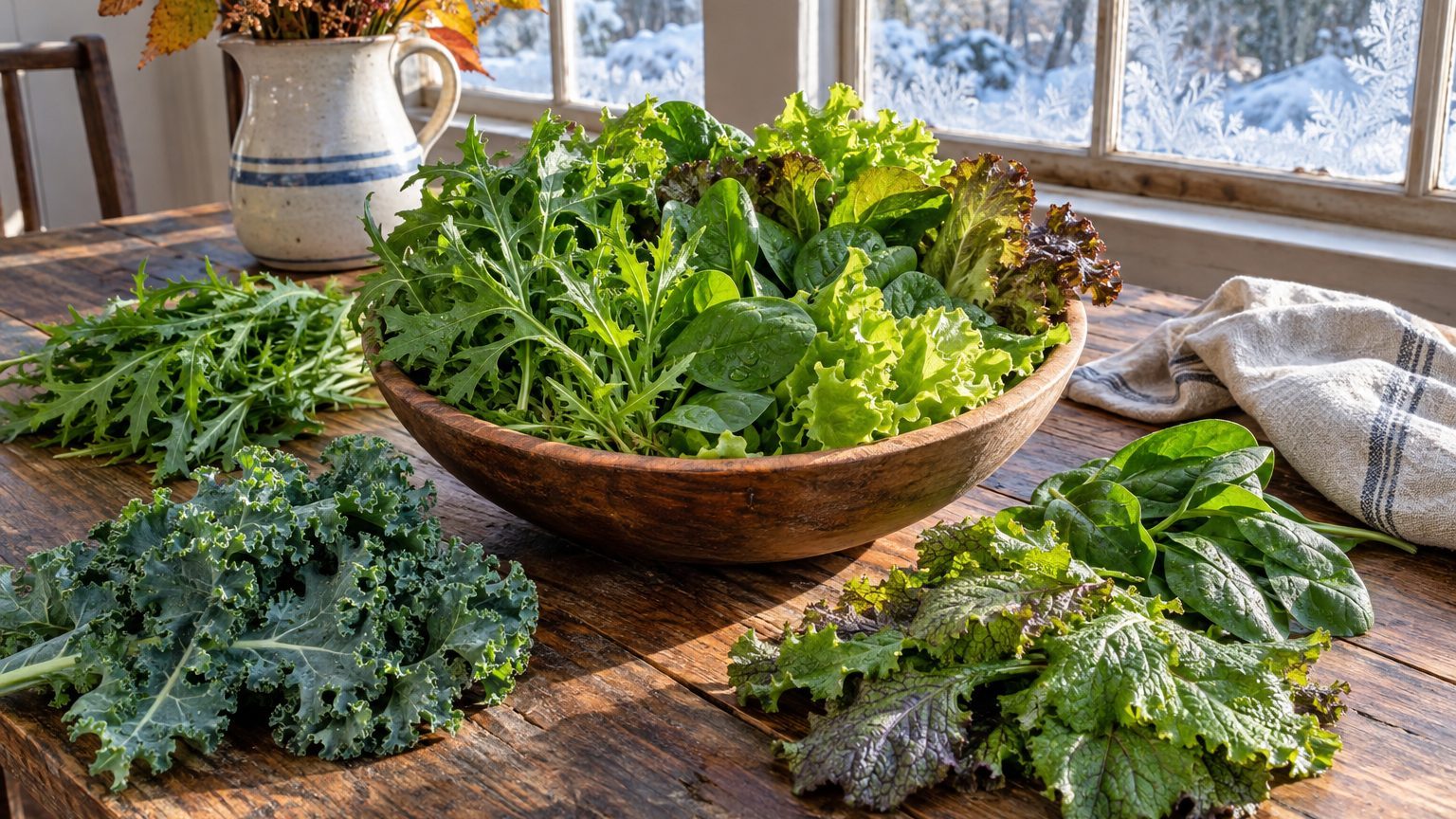

The first fall frost in Michigan’s zone 6a arrives between October 6 and October 21, and that date shapes everything about winter salads here. The best performers are hardy leafy greens, grown under cover, with tender lettuce as a bonus rather than the backbone. Which greens suit which garden depends on where in the state you live.
The short answer for Michigan
Build your winter salad bed around cold-hardy greens such as spinach, mâche, claytonia, kale and mizuna, and treat tender lettuces as a protected extra. That choice follows from two numbers. The mean daily minimum of Michigan’s coldest month is 19.2°F (NOAA 1991-2020 normals, Detroit reference station). Last spring frost falls around April 30 in the Detroit area and early to mid May across most of the Lower Peninsula.
That 19.2°F is an average of nightly lows, so some nights run colder. A leaf that shrugs off an average night in the teens will do better on the bad ones. This is why the hardy types lead and the soft ones follow.
| Type | Examples | Role in a Michigan winter bed |
|---|---|---|
| Very hardy leaves | Spinach, mâche, claytonia | The core crop; the best bet to hold through the cold months under a cover |
| Hardy brassicas | Kale, mizuna, arugula | Reliable cut-and-come-again greens, good for flavor variety |
| Tender lettuce | Loose-leaf and head types | Fall harvest, or a bonus under a well-managed cover |
Season length sets the rest. With the first frost window opening October 6 (as of today, it opens tomorrow), anything you sow outdoors in autumn has a short runway before growth slows. Fast, small-leaved crops make the most of it. Our guide on when to sow winter salads in Michigan turns those dates into a sowing schedule, and the broader overview in Winter Salads for Michigan Gardens covers the setup.
Heat is not the problem in this state’s winter garden, so you do not need to hunt for heat-tolerant selections. Choose for cold tolerance and speed, then for flavor. Mâche’s nutty, mild leaves and claytonia’s succulent, spoon-shaped ones both turn up in winter markets for exactly this reason.
What will not work here
Late sowing is the usual failure. Frost arrives between October 6 and October 21 in zone 6a, and a seed sown after that has too little growth ahead of it. Seedlings that are still tiny when the cold sets in tend to sit there, barely moving, until the days lengthen again. You end up with a bed that looks planted and yields nothing for months.
Slow, large-headed crops fail for the same reason. Full-size heading lettuce, and anything that needs a long stretch of steady growth to form a head, is the wrong bet. A mean coldest-month low of 19.2°F is an average, and the colder nights below it stall growth completely. Pick small leaves you can cut young.
Going unprotected is the second big mistake. Hardy spinach and mâche can come through cold nights in the open, but a single exposed row of tender lettuce has little chance against a Michigan January. The cheap fix is a low hoop or a cold frame, and even a layer of row cover helps. Without some cover, plan on a fall harvest only.
Cover can also backfire. A closed frame on a bright, mild day can trap heat and humidity, and damp, stagnant air invites rot on a crowded bed of leaves. Vent it on mild days and close it again for the night. Spacing matters here too. Greens packed tight under plastic stay wet longer than the same plants given room.
Spring has its own trap. The last frost falls around April 30 in the Detroit area and early to mid May across most of the Lower Peninsula, so tender transplants set out in early April are a gamble. And an overwintered crop will bolt once the days warm and lengthen, ending your harvest on the plant’s schedule, not yours. Sow a fresh round for spring instead of expecting the winter bed to keep going.
One thing this page does not have is Michigan-specific snow cover or winter sunshine totals. Both affect how much a cover helps, and your county extension office is the place to ask.
What changes across Michigan
Michigan is not one garden. The USDA Plant Hardiness Zone Map (2023, built on 1991-2020 normals) places the state anywhere from zone 4a to 6b, and that spread is a big one. The zone is built on a single variable, the average annual extreme minimum temperature, so it tells you about the coldest nights, not about how long your fall lasts or how bright your January is.
The dated figures in this article, including the October 6 to October 21 frost window, are tied to zone 6a, and the winter low comes from the Detroit reference station. Treat them as a southern reference point, not a statewide rule. A gardener farther north, or on higher, more exposed ground, should expect colder winters and a shorter fall.
In practice, northern readers should shift in a few directions. Sow earlier than a southern calendar suggests. Lean harder on the very hardy types, spinach, mâche and claytonia, and give them a sturdier cover than a bare row cover. Expect the harvest to pause for longer in the darkest, coldest weeks. Someone in a milder southern spot, or near a Great Lakes shoreline where the water can soften the cold, has more room to try tender lettuce under cover.
Which zone applies to you is a question for the USDA map, not for this page. Look up your own ZIP code there, and note that a zone describes cold only. Then compare what you find with the Detroit-based numbers here and adjust.
Where to check this for your own county
The next stop is your state extension service. MSU Extension runs county-level outreach across Michigan, and it is the source for frost-free dates, garden calendars and local advice. This page is the state-level view, and a county recommendation beats a state one every time, because a county knows its own soils, lake influence and typical frost dates.
Once you are there, look for two things. The first is a local planting calendar, ideally with fall sowing dates for your county, which should be tighter than the broad windows here. The second is a list of varieties trialled locally. A variety that performed well in a regional trial has proved itself in conditions close to yours, and that is worth more than any national catalog description.
Many county offices also run a gardening help line or a Master Gardener program, and those volunteers know what failed last winter in your area. Ask about season-extension methods, such as hoops and cold frames, and which crops people near you actually harvest in January.
When a county number and a number on this page disagree, go with the county. The frost dates here (around April 30 in Detroit, early to mid May across most of the Lower Peninsula) are a sensible starting estimate. They are not a promise for your yard.
Checking this against your own garden
Your own observations outrank every date here. Three are worth watching, and none needs equipment.
- Soil warmth by feel. Push your hand into the bed in the morning. Soil that feels cold and heavy means slow germination, and a bed that warms earlier than your neighbor’s has a milder microclimate, perhaps from a wall or a sunny slope.
- First true leaves. After the seed leaves come the first true leaves, and their timing shows whether a sowing is keeping pace. If seedlings reach that stage well before the first frost, they have a head start. If not, add cover or accept a smaller harvest.
- Where frost shows first. On the first frosty morning, walk the yard. White grass in a low corner and bare grass beside the house shows you where cold pools and where it doesn’t. Put the tender plants in the spot that stays green.
Keep a note of the date each time. After a winter or two you will have a calendar that is more accurate for your yard than any state-level one.
Common questions
Can I grow winter salads outdoors all winter in Michigan?
Hardy greens like spinach, mâche and claytonia are the best bets, but they do better under a hoop, cold frame or row cover. With a 19.2°F average coldest-month low, bare ground is risky for anything tender.
When is the first fall frost in Michigan?
For zone 6a, it falls between October 6 and October 21. Colder parts of the state, in zones down to 4a, can see it earlier, so check with your county extension office.
Is lettuce worth growing in a Michigan winter?
As a fall crop, yes. Under a well-ventilated cover it can carry on for a while, but it is the first thing to struggle when the cold deepens. Hardy greens are the safer core of the bed.
Do the dates on this page apply to my county?
They are a state-level starting point. The last spring frost is around April 30 in the Detroit area and early to mid May across most of the Lower Peninsula. Your county’s extension calendar should take precedence.