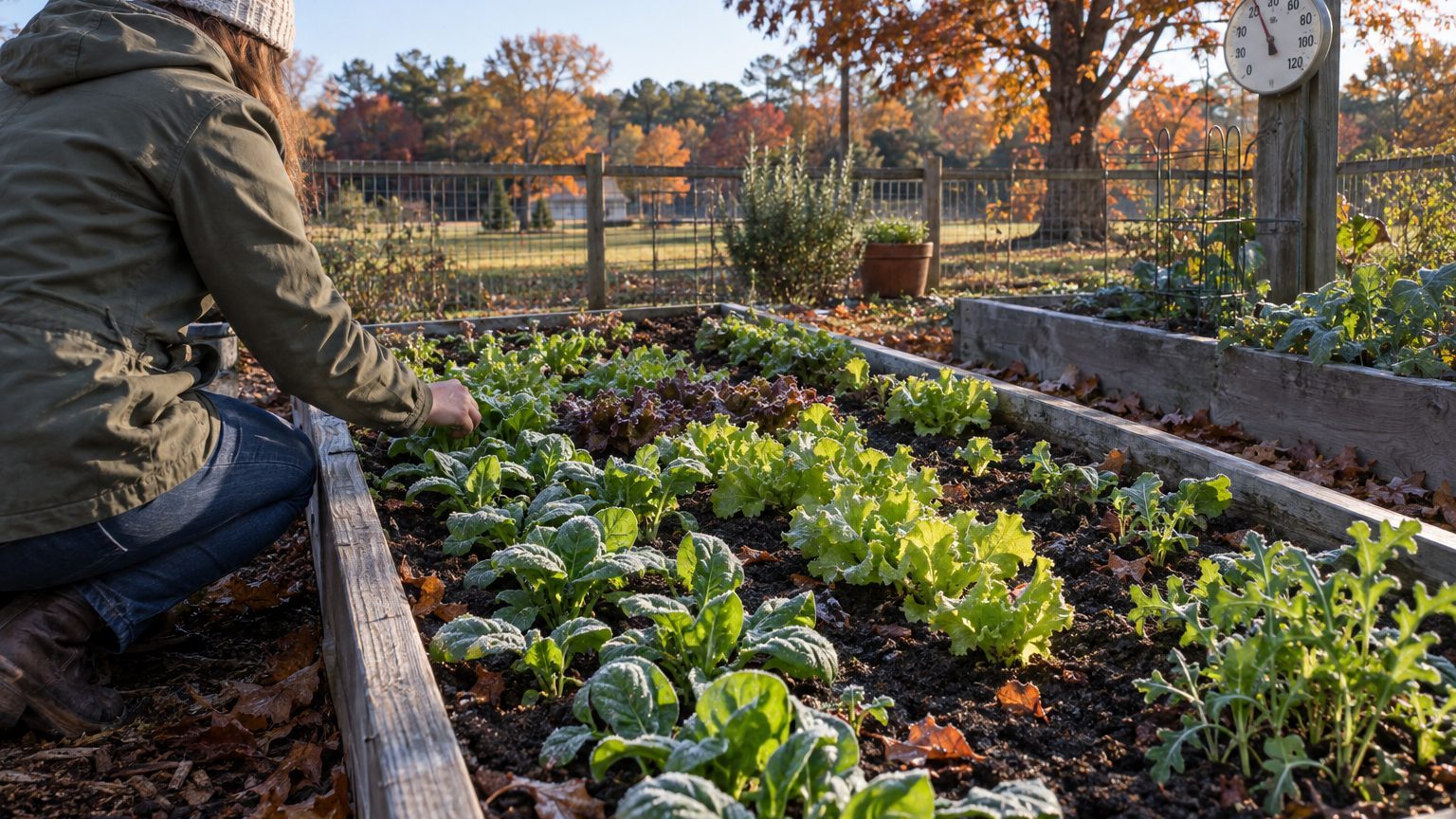

Michigan winter salads go in the ground in the weeks before the first fall frost. In zone 6a, MSU Extension’s Michigan Garden Calendar puts that frost between October 6 and October 21. Count backward from that window rather than forward from the first cool morning. Farther north the clock runs earlier, and this page can’t give you your county’s date, but it can show you how to find it. For the full picture, start with Winter Salads for Michigan Gardens.
The short answer for Michigan
Take the first fall frost range, October 6 to October 21 for zone 6a, and subtract the days to maturity printed on the seed packet. The result is your latest sensible sowing date. Winter salads work on a simple principle: the plant should be close to harvest size when frost arrives, because growth slows to a crawl as daylight shrinks. What you cut in December is mostly what grew in October.
A frost date is a statement about probability. It describes when the first frost has historically tended to arrive, built from decades of records. It does not say when frost will arrive this year. Some autumns bring it early, some hold off, and a calendar built on the average will be wrong in both directions.
Spring has its own pair of dates. These matter for winter salads less as sowing cues than as the end of the season, when you pull covers and turn the bed over to warm crops.
| Frost event | Date | Source |
|---|---|---|
| First fall frost (zone 6a) | October 6 to October 21 | MSU Extension, Michigan Garden Calendar |
| Last spring frost, Detroit area | Around April 30 | MSU Extension, Frost-Free Dates |
| Last spring frost, most of the Lower Peninsula | Early to mid May | MSU Extension, Frost-Free Dates |
Today is October 5, 2026, one day before the earliest date in the fall range. For open-ground sowing this season, the window has largely passed across the Lower Peninsula. What remains is sowing under a cover, or planning for 2027 while the dates are fresh. Late summer is when the real work happens.
Which salads you sow matters as much as when. Hardy types tolerate a late start far better than tender lettuces do, and the choice by type is laid out in The Best Winter Salads for Michigan.
What will not work here
Sowing in October and hoping. A bed seeded the week the first frost arrives produces seedlings too small to carry through winter. They sit at a few leaves, neither growing nor dying, and by February most of them are mush or gone. The frost range of October 6 to October 21 is short, and anything that needs the whole stretch to size up is out unless it has protection.
Tender lettuce in an unprotected bed fails for a different reason. Detroit’s coldest month has a mean daily minimum of 19.2°F (NOAA NCEI Climate Normals, 1991-2020). That figure is an average of the nightly lows, so plenty of January nights fall below it. Soft, thin-leaved heads that shrug off a light October frost won’t survive repeated nights in the teens without a tunnel or frame over them. Only the hardiest greens hold in the open, and even they do better with cover.
Copying the Detroit spring date statewide is another trap. Around April 30 is the Detroit-area figure. Across most of the Lower Peninsula, MSU Extension gives early to mid May, so a gardener a couple of hours inland who lifts covers on April 30 is gambling. This page also has no frost-free dates for the Upper Peninsula, and it won’t borrow numbers from elsewhere to fill the gap. If you garden up there, the local source is the only honest one.
Treating any frost date as a guarantee is the quieter mistake. The dates are averages, so a gardener who sows on the last safe day of the range every year is betting on an average autumn every year. Sow earlier than the arithmetic says and the downside is small. Sow later and you lose the crop.
A calendar from another state fails here for the same reason. Dates tuned to a longer, milder season will leave a Michigan bed half-grown when the cold arrives. Use Michigan numbers or Michigan-specific advice, and be wary of anything that doesn’t say where it was written.
What changes across Michigan
Michigan doesn’t have one growing season. The USDA Plant Hardiness Zone Map (2023 edition, based on 1991-2020 normals) runs the state from zone 4a to zone 6b. That’s six half-zone steps, from the coldest northern pockets to the warmest southern spots. There is no single answer for the state, and any page that gives one is rounding off the problem.
The USDA system rests on one variable: the average annual extreme minimum temperature. It tells you how cold the worst nights get, not how long the season is. Two gardens in the same zone can have different first-frost dates, and neither the zone nor the frost date captures snow cover, which insulates a bed in a way a thermometer reading doesn’t. Treat the zone as one input among several.
For dated recommendations this page leans on Detroit as its reference city, and the dates above describe the southeast. The further you are from that corner, the less they apply directly.
If you garden in the north
Shift everything earlier. Your first fall frost arrives sooner than the October 6 to 21 range given for zone 6a, so your sowing window closes sooner. Protection also becomes a given rather than a bonus. A low tunnel or cold frame that is optional in the south is the normal way to hold a winter salad bed in the north. This page doesn’t have a dated first-frost range for the colder zones, so use the local sources in the next section for that.
If you garden in the south
The window runs later, and the margin for error is wider. But the Detroit minimum of 19.2°F is a reminder that a mild-sounding zone still produces nights hard enough to kill unprotected tender greens.
To find your own zone, look up your ZIP code on the USDA Plant Hardiness Zone Map. Don’t guess from a neighbor’s or a relative’s garden two counties away.
Where to check this for your own county
Your state extension service is the next stop. MSU Extension runs county offices across Michigan, staffed by people who know what actually survives in local soil and local weather. Two things are worth looking for. The first is the local planting calendar, ideally one built on frost dates for your county or the nearest weather station. The second is the list of varieties trialled in your county, which tells you what has been grown there, not just what a seed catalog promises.
MSU Extension also publishes the Frost-Free Dates page and the Michigan Garden Calendar, the two sources behind the frost ranges above. They’re a good place to see how the dates shift from one part of the state to another.
This page can’t confirm that a salad-specific calendar exists for every county. If the website doesn’t turn one up, call or email your county office and ask three questions. When does the first fall frost typically arrive near you? Which hardy salad greens have done well locally? Does anyone there use low tunnels or frames for winter harvests?
A county recommendation beats a state one. The state view has to cover places hundreds of miles apart with different growing seasons, and this page is the state view. Use it to understand the logic and the range, then let your county office narrow it down.
Checking this against your own garden
Your own observations outrank every date here. Three are worth tracking, and none needs equipment.
Soil warmth by feel. In late summer, push a bare hand a few inches into the bed. Soil that feels hot, even at dusk, is a poor place to start cool-season seed, and soil that feels cool and damp is welcoming. Try it in an open bed and beside a south-facing wall. The difference between the two spots is your microclimate at work, and it can be bigger than the gap between neighboring zones.
The first male flowers. On squash and cucumber vines, male blooms open before female ones. Write down the date they appear each year. It becomes a rough local clock, and if yours opens consistently earlier or later than a friend’s across town, that’s a sign your site runs warmer or cooler than the state averages suggest.
The first true leaves. After the seed leaves, the first true leaves mark a seedling that has taken hold. If your fall sowings reach this stage well before the frost window opens, your timing was right. If they’re still bare when October arrives, you started too late, and next year’s sowing date should move earlier by that margin.
Common questions
Can I still sow winter salads in Michigan in early October?
The first fall frost range for zone 6a begins October 6, so the open-ground window has largely passed in the Lower Peninsula. Sowing under a tunnel or frame is still possible, but this page has no firm cutoff date for it. Your county extension office is the better source.
What is the last spring frost date in Michigan?
MSU Extension lists around April 30 for the Detroit area and early to mid May across most of the Lower Peninsula. This page doesn’t have figures for the Upper Peninsula.
How cold do Michigan winters get for salad crops?
At the Detroit reference station, the mean daily minimum of the coldest month is 19.2°F (NOAA, 1991-2020). That’s an average of nightly lows, so many nights run colder, and northern Michigan is colder still.
Does my hardiness zone tell me when to sow?
No. The USDA zone rests on the average annual extreme minimum temperature. It tells you how cold winters get, not when frost arrives. Use frost dates for timing and the zone for survival, and check both locally.