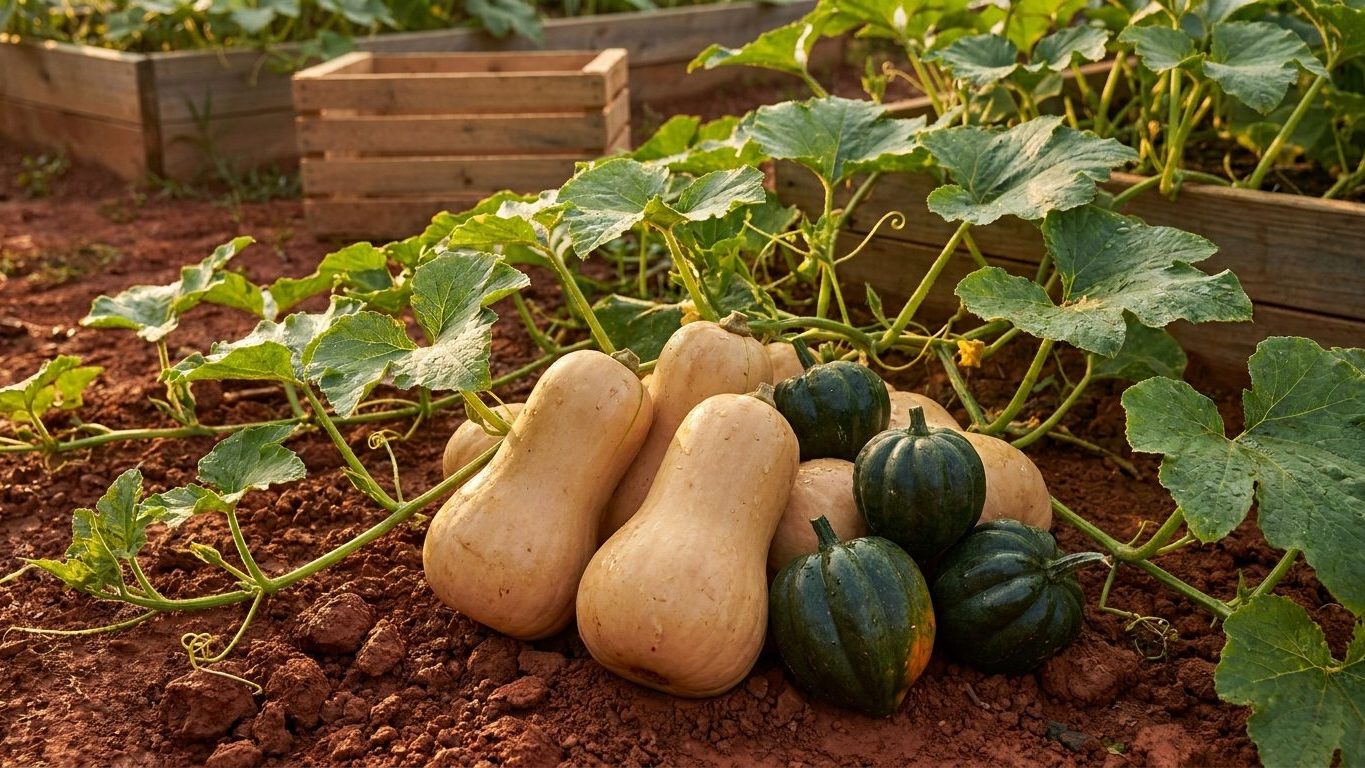

Michigan’s frost-free window runs from late April in the Detroit area to sometime between October 6 and October 21 farther inland, giving most gardeners a season long enough for butternut, acorn, delicata and spaghetti squash, but tight for the slowest hubbard and giant types. Pick by days to maturity, not by what looked good on a seed rack in another state.
The short answer for Michigan
Start with the number that matters most: the gap between April 30 (the last spring frost around Detroit) and October 6 to October 21 (the first fall frost in zone 6a). That’s roughly 160 to 175 days in the warmest part of the Lower Peninsula, and it shrinks fast the farther north or the higher up you go. Winter squash varieties are sold by days to maturity, and that number is your filter. Anything that needs 100 days or fewer from transplant is a safe bet almost anywhere in the state. Anything past 110 days is a gamble outside the warmest counties.
Heat is the second filter, and Michigan’s numbers here are modest. The reference station near Detroit averages just 10.3 days a year at 90°F or hotter. That’s a mild heat load compared to the Corn Belt states winter squash catalogs are often written for. Types bred to sweeten under sustained summer heat, like some kabocha and long-season hubbard lines, can size up here but may not develop full flavor in a cool, cloudy August. Types that mature reliably in moderate heat, butternut and acorn chief among them, are the safer default.
By type, for this state
| Type | Typical days to maturity | Fit for Michigan’s season |
|---|---|---|
| Acorn | 80-100 | Reliable statewide |
| Delicata | 80-100 | Reliable statewide |
| Spaghetti | 90-100 | Reliable in most of the Lower Peninsula |
| Butternut | 100-115 | Fine near Detroit; tight farther north |
| Kabocha | 90-110 | Workable but wants a warm, sunny spot |
| Hubbard / giant types | 110-120+ | Risky outside the warmest counties |
That table is the entire decision for most Michigan gardens: shorter-maturing types first, longer ones only where the season and the site both cooperate.
What will not work here

The slowest winter squash on the market, the 120-day-plus hubbard and banana types, are the first thing to cross off outside a handful of warm counties. Direct-seed one of these in mid-May after a cool spring and you’re pushing maturity into the second or third week of October, right when frost is arriving in zone 6a territory and likely earlier farther north. A late-June transplant of the same variety has almost no margin left. This isn’t a soil or fertilizer problem. It’s arithmetic: the plant needs more days than the season reliably gives it.
Squash bred for hot, dry growing regions run into a different failure here. With only 10.3 days a year above 90°F at the Detroit reference station, Michigan’s summer heat load is genuinely mild. Varieties selected to concentrate sugars under intense, sustained heat can come out bland or watery in a cool, overcast August, even if the fruit sizes up fine. This is a flavor failure, not a yield failure, and it’s easy to blame on the wrong thing (soil, water, timing) when the real cause is a climate mismatch.
Watering on a weekly schedule is the third trap. Summer rainfall averages about 10 inches across June, July and August, with August the driest month at 3.26 inches. That sounds like enough, but it rarely falls evenly. A single thunderstorm can drop half a month’s rain in an hour, most of which runs off rather than soaking into the root zone, especially on the sandy soils common across much of the Lower Peninsula. A sandy garden watered once a week on a fixed schedule can still be running dry between storms during a hot stretch, and winter squash sulks fast once it dries out during fruit set.
Close spacing is the last one, and it’s a humidity problem more than a rainfall problem. Michigan summers carry enough ambient moisture off the Great Lakes that powdery mildew shows up on squash foliage most years regardless of how much rain falls. Varieties or spacing charts written for drier western states routinely underestimate the airflow winter squash needs here. Crowd the vines and you’re inviting mildew even in a summer where the rain total looks unremarkable.
What changes across Michigan
Michigan spans USDA hardiness zones 4a to 6b, and that’s a wide enough range that no single variety recommendation covers the whole state. The USDA system is built on one measurement, the average annual extreme minimum winter temperature, so it doesn’t describe summer length directly, but it’s a reasonable stand-in for how much growing season a given part of the state can expect. Zone 6b, closest to Detroit and the southern Lake Michigan shoreline, sits at the warm end. Zone 4a, found in parts of the Upper Peninsula and higher inland elevations, sits at the cold end, and the gap between them is enormous for a crop as season-dependent as winter squash.
A gardener at the warmer end of that range can reasonably plant butternut or even a mid-season kabocha directly from seed and expect it to finish before frost. A gardener at the colder end is working with a shorter frost-free window on both ends of the season, spring and fall, and should default to the fastest-maturing types on the list, acorn, delicata and spaghetti, and lean on transplants rather than direct seeding to buy back the weeks a shorter season doesn’t offer.
Black plastic mulch or landscape fabric under the vines is worth mentioning here too, not as a universal fix but as a way to bank a little extra soil heat in the cooler parts of the state, since squash roots stall in cold soil regardless of what the calendar says. None of this replaces knowing your actual zone. The spread from 4a to 6b does not tell an individual reader which end of that range their own garden falls into.
The right move is to check the USDA Plant Hardiness Zone Map directly for your county rather than assume based on the state average, since a few miles of elevation or distance from a Great Lake shoreline can shift a garden from one zone to the next.
Where to check this for your own county
Everything above is a state-level answer, and Michigan is genuinely too large and too climatically varied for a state-level answer to be the last word. Southeast Michigan, the west Michigan fruit belt, and the Upper Peninsula don’t share a planting calendar, and a variety that thrives near Ann Arbor isn’t guaranteed to perform the same way near Marquette.
Michigan State University Extension is the right next stop, and it’s a free public resource built for exactly this gap, with its outreach directory serving as the place to start. From there, look for two specific things rather than browsing generally: the local planting calendar for your county or region, which will translate the statewide frost-date ranges into something closer to your actual garden, and any variety trial results MSU or its county offices have published for winter squash, since these reflect what actually performed well in Michigan soil and Michigan summers rather than a seed catalog’s national averages.
A county-level recommendation from your local extension office will always beat a state-level one, because it accounts for local frost pockets, soil type and even microclimates created by nearby lakes that a statewide page like this one simply can’t capture. The extension office is where that starting point gets corrected for your specific ZIP code.
Many county offices also run a master gardener hotline or a plant clinic, staffed by people trained on exactly this kind of local variety question, and they’re generally free to call or email. If a variety trial for your county isn’t posted online, that hotline is often the fastest way to get an answer that reflects your actual growing conditions rather than a state average.
Checking this against your own garden
Every date and range here is a regional average, built from decades of weather data at a reference station. Your own garden is one data point, and it often disagrees with the average by a week or two in either direction. Three things you can check by hand outrank anything printed on a seed packet or a state calendar.
Soil warmth by feel is the first. Push a finger a few inches into the planting bed on a sunny morning. Winter squash seed sits and rots in cold soil rather than germinating, so if the ground still feels cool and damp rather than warm and slightly dry, it’s telling you the local soil hasn’t caught up to the calendar date yet, whatever the average frost date suggests.
The first flush of male flowers is the second signal. Squash plants produce male blossoms before female ones, often by a week or two, and a garden that’s running warm for its microclimate will show that first flush earlier than a garden in a low, shaded or north-facing spot. No female flowers, no fruit, so this tells you whether pollination season is arriving on schedule for your specific yard.
The first true leaves, the second set that emerges after the rounded seed leaves, are the third. Slow, stunted true-leaf growth after a normal germination usually points to a cool root zone or nitrogen still locked up in cold soil, both common in a Michigan spring that runs a little behind the regional average. Fast, vigorous true leaves tell you the site is running warm, and that a longer-season variety than the state-level table above suggests might actually finish in time.