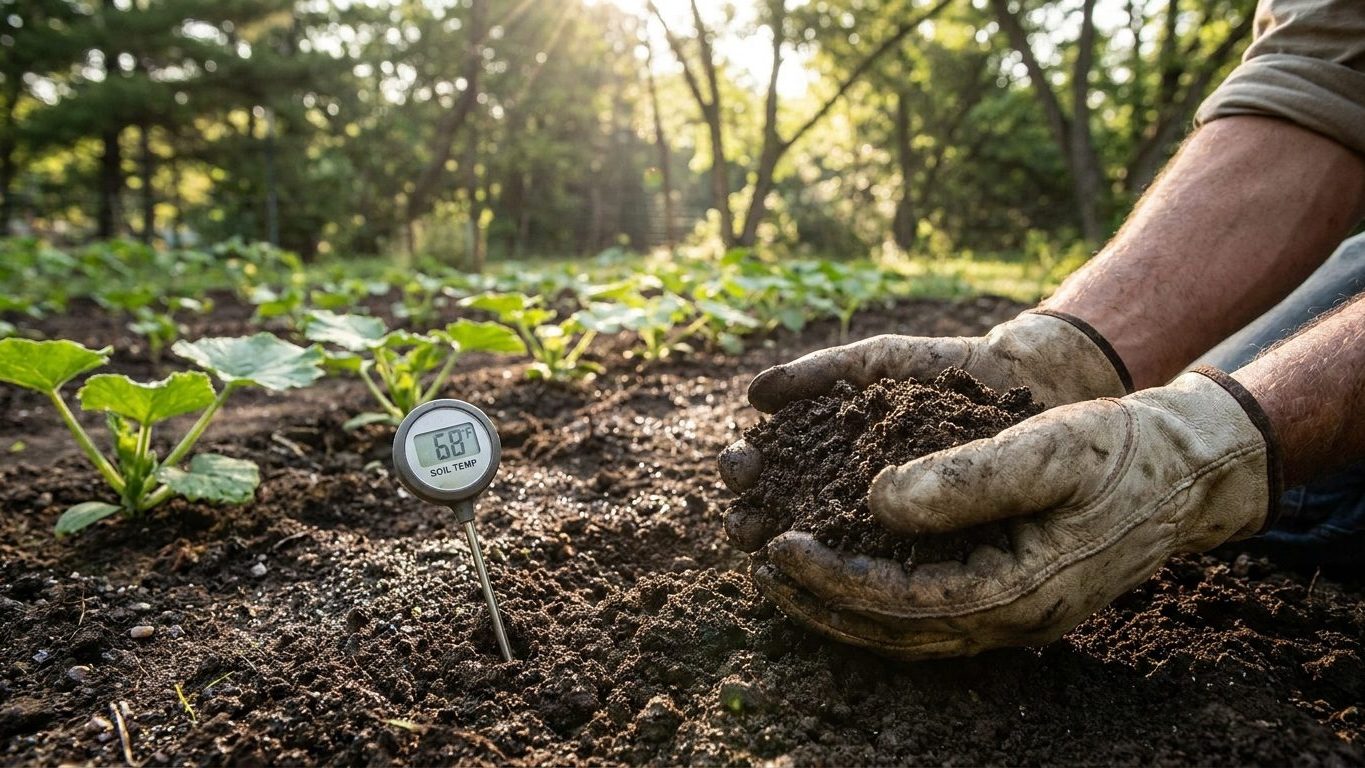

Direct-seed or transplant winter squash in Michigan once the soil has warmed and frost risk has passed, typically from mid-May through early June depending on where in the state you garden. Then count backward from your local fall frost date to make sure the variety you pick has enough season left to mature before the vines go down.
The short answer for Michigan
MSU Extension’s frost-free dates put the last spring frost around April 30 in the Detroit area, and early to mid-May across most of the Lower Peninsula. That date is not a guarantee. It is a statistical marker, usually built around a roughly even chance of frost occurring after it. For a tender crop like winter squash, seeded or transplanted right on that date, you are betting on a coin flip with a plant that has zero tolerance for cold soil or a late cold snap.
That is why most Michigan gardeners push the actual sowing date one to two weeks past the frost-free marker. Soil temperature matters more than the calendar here: squash seed sitting in soil below the mid-60s Fahrenheit tends to rot before it germinates, and a stretch of chilly nights right after transplanting can stall a seedling for a week or more even without an actual freeze. So the practical window most of the Lower Peninsula works with lands in mid- to late May, sliding into early June the farther north or the cooler the microclimate.
The other half of the equation is the fall frost date, and this is where the state’s spread starts to matter. MSU Extension lists the first fall frost for zone 6a landing between October 6 and October 21. That gives a grower in that band roughly 150 to 175 days between the two frost markers, though the usable growing window for a heat-loving vine crop is shorter than the full frost-to-frost span, since squash does little until the soil and air are reliably warm.
The workable math: pick your planting date from the local frost-free guidance, then check the days-to-maturity on the variety you’re growing and make sure it lands comfortably before your area’s first fall frost, with a couple of weeks of cushion. That cushion matters because winter squash needs the vine to die back and the rind to cure somewhat before a hard freeze, not just survive until the calendar date arrives. If a variety’s maturity window pushes right up against your fall frost date with no room to spare, that is the signal to either start earlier under cover or choose a faster-maturing type instead.
What will not work here
The biggest trap in Michigan is mismatching a slow-maturing squash to a short local season. The state’s fall frost dates cited by MSU Extension span from October 6 to October 21 depending on zone, a two-week difference that is significant when you’re already working with a growing season that doesn’t really get moving until late May. A grower near the earlier end of that fall frost range, or farther north where MSU’s zone map trends colder, is working with noticeably fewer usable weeks than someone near Detroit. Planting a long-season type without checking that math against your own fall frost date is the single most common reason winter squash fails to size up or cure properly before frost cuts it down.
Cold, wet soil is the second failure point. Squash seed direct-sown too early, chasing the April 30 last-frost date in the Detroit area rather than waiting for the soil to actually warm, tends to rot in the ground rather than germinate. This is a soil-temperature problem more than an air-temperature one, and it trips up gardeners who plant by the calendar instead of by feel.
Watering on a fixed weekly schedule is the third failure mode, and it’s a heat-load problem specific to Michigan’s summer pattern. The reference station near Detroit averages 10.3 days a year at or above 90°F, according to NOAA’s 1991-2020 climate normals. That heat drives evaporation fast. Meanwhile summer rainfall across June, July and August totals only about 10.0 inches, with August, often the peak of squash fruit-fill, running driest at 3.26 inches. On sandy soil, that rain drains through within a day, so a squash patch can run short of water even in a summer that looks “normal” on paper. A single weekly watering, sized for an average rainfall month, often can’t keep pace during the handful of 90-degree stretches that actually decide fruit size.
Finally, tight spacing struggles here because Michigan’s summer rain frequently arrives as thunderstorms rather than steady soaking rain. That kind of rainfall wets foliage heavily, then leaves it slow to dry in humid air, a combination that favors powdery mildew on vines planted too close together to get airflow.
What changes across Michigan
Michigan is not one garden, and the USDA Plant Hardiness Zone Map, built on the average annual extreme minimum winter temperature, puts the state anywhere from zone 4a to zone 6b. That is a wide spread for a single state, and it is built on winter cold, not summer length, but the two track closely enough here that it’s a useful signal: a zone 4a grower and a zone 6b grower are working with meaningfully different seasons, not a rounding error.
The fall frost data makes the practical version of this clear. MSU Extension’s zone 6a figure alone spans October 6 to October 21, a two-week range within just that one zone. Extend that logic to the full 4a-6b spread across the state and the gap between the earliest fall frost in the coldest pockets and the latest in the warmest ones is substantial, easily three to four weeks by the time you account for the colder end of the range not captured in the zone 6a figure alone.
What that means in practice: a gardener working the colder end of Michigan’s range should lean toward the faster-maturing side of any winter squash variety list, plan to start seed indoors rather than direct-sowing, and build in extra cushion before the expected fall frost. A gardener near the warmer end, closer to the Detroit reference conditions cited in these frost dates, has more room to run a slower-maturing variety and to direct-seed later into warmer soil without losing the season.
None of this replaces knowing your own zone. This page can only describe the range the state covers, not tell an individual reader which slice of it applies to their yard. That determination belongs on the official USDA hardiness zone map, checked by ZIP code, not guessed from a statewide range.
Where to check this for your own county
This page describes Michigan as a whole, and the state’s own range, zone 4a to 6b, a two-week-plus spread in fall frost timing within a single zone, a wide difference in summer heat load between northern and southern counties, is exactly why a statewide answer is a starting point and not a final one. A county-level recommendation will always beat a state-level one, because it accounts for local elevation, lake effect, and soil conditions.
Michigan State University’s Extension service is the source to check next. Once there, look specifically for two things. First, the local planting calendar for your county or region, which will translate the statewide frost windows cited above into dates adjusted for your specific location, whether that’s a warmer lakeshore pocket or a colder inland or northern county. Second, look for any variety trial results or recommendations MSU has published for vegetable crops in your area. Extension services routinely run variety trials adapted to regional conditions, and a squash variety that performed well in a university trial plot near your county carries more weight than a general description of what “should” work statewide.
If your county has a local Extension office or master gardener program, that local contact often has more granular, current information than what’s centrally published, including notes on which pest and disease pressures have been showing up locally that season. That kind of on-the-ground detail is the natural next step after this page, not a replacement for it, but a refinement of it down to the level that actually matters for what you plant this year.
The Moon calendar is a separate, older custom: see when to plant winter squash by the moon, written as tradition rather than fact.
Checking this against your own garden
Every date on this page is a starting estimate built from regional averages. Your own garden will confirm or override it, and three simple observations tell you more than any calendar.
Start with soil warmth, checked by feel rather than a thermometer. Push a hand a few inches into the planting bed in mid-morning. If the soil still feels cool and slightly damp in a way that chills your fingers, squash seed sitting in that ground is more likely to rot than sprout, regardless of what the last-frost date says. Soil that feels merely cool but not cold, with some give and warmth building by afternoon, is a better sign the bed is ready.
Next, watch for the first flush of male flowers on the vine once plants are established. Squash typically produces male flowers before female ones, and a strong early showing of male blooms is a sign the plant has settled in and is building toward fruiting. If male flowers appear but female flowers, the ones with the small bulb at the base, lag well behind by more than a week or two, that gap can signal stress, often heat or water related, worth checking against recent weather rather than assuming it will resolve on its own.
Finally, track how quickly true leaves develop after the first seedling leaves. A slow, stalled seedling that sits for two or three weeks without pushing new true leaves is telling you the microclimate, whether that’s a cold pocket, poor drainage, or compacted soil, is running behind the regional average this page describes. That local signal always outranks the statewide date.