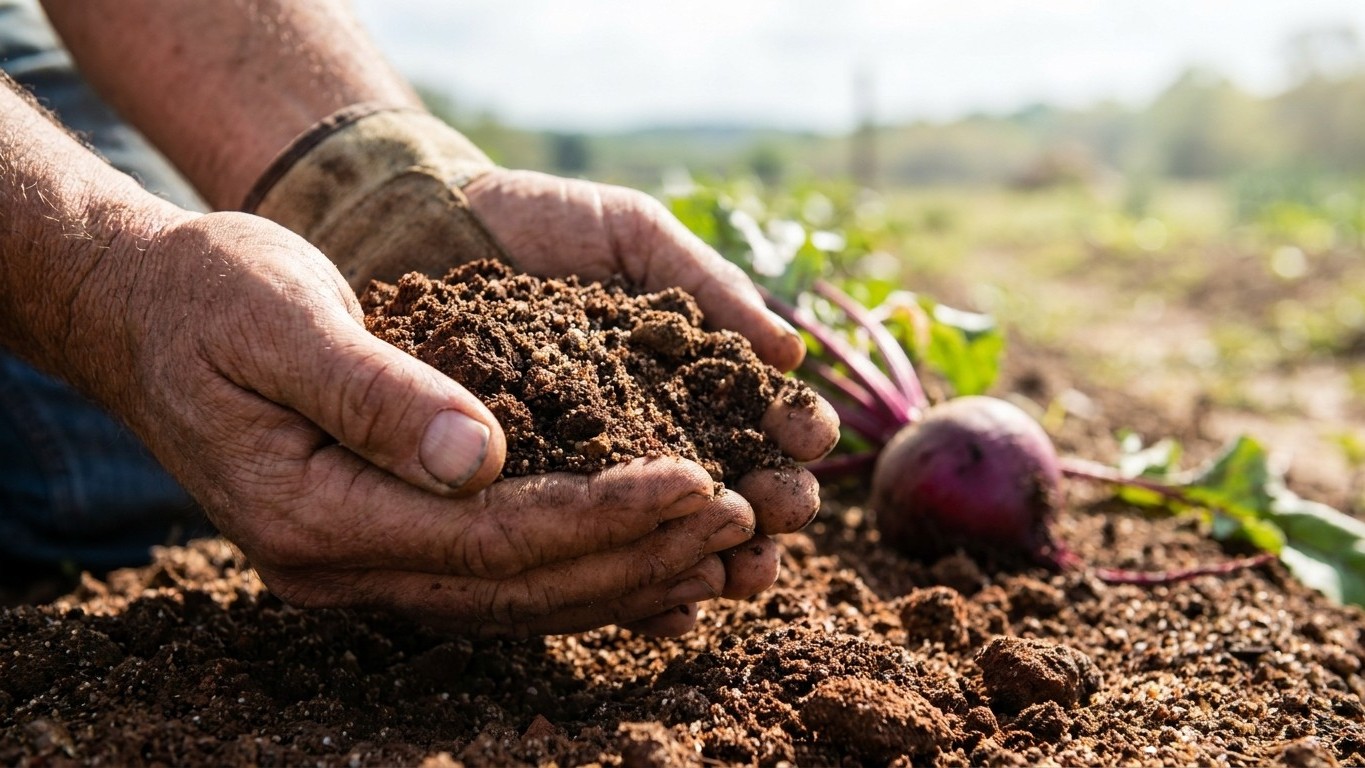

Minnesota’s representative soil, the Lester series, is a well-drained loam that leans slightly sandy and sits at a near-neutral pH, so a beet root can push through it without much resistance. That’s the good news. The catch is timing: the six weeks right after sowing land inside a Minnesota spring that can flip from wet to dry with almost no warning, and that’s the window where a beet decides whether to grow a root or bolt straight to seed.
The short answer
The soil Minnesota lawmakers named the official state soil, the Lester series, is an Alfisol, a forest-derived soil built for holding onto nutrients rather than losing them to every rain. USDA’s Soil Data Access records for the surface horizon put it at 39 percent sand, 24 percent clay and 37 percent silt, with organic matter around 3.0 percent and a surface pH near 6.6. It’s classified well drained. For a beet, that combination reads as workable but not ideal straight out of the ground: the sand fraction keeps the root from hitting a wall, the silt and clay hold enough moisture and nutrients to carry the plant through a dry week, and the pH sits close to where beets grow best without any correction needed.
Where it falls short of the beet’s wish list is depth of tilth and how loose the surface stays after a hard rain. Utah State University Extension describes the ideal beet bed as deep, sandy and well drained, built up with organic matter, capped at about 1 inch of composted material per 100 square feet so the bed stays loose without going soft. A Lester-type loam gets partway there on its own; the organic matter and the workable depth are usually the two things a Minnesota gardener still has to add.
Heat is the other half of the equation, and here the record for this page stops short of a specific number. No count of days above 90 F for a Minnesota reference city is published in the sources behind this article, so that figure isn’t given here. What is documented is the threshold that matters more to a beet anyway: air above 85 F combined with water stress is what turns a root woody, according to Utah State University Extension. Minnesota summers reach and sit above 85 F often enough, especially in the Twin Cities corridor and southern counties, that this threshold is the one worth tracking on a thermometer rather than waiting on a seasonal average.
None of this describes any one garden. Minnesota carries hundreds of mapped soil series, from river-bottom silt to hilltop till to the sand plains up north, and the Lester series is a statewide reference point, not a stand-in for the dirt behind a specific house. A basic soil test remains the only way to know whether a given bed matches this profile or runs heavier, sandier or more acidic than the state figure.
The six weeks that decide it here
Beet seed goes into the ground where it will grow, no transplanting, and the standard advice is to sow it 2 to 3 weeks ahead of the last frost. For the Twin Cities, NOAA’s climate normals put that 32 F freeze probability window between April 17 and April 30, which pushes sowing into the back half of March through the middle of April for most of the mild southern part of the state. Farther north, the same NOAA data runs two to three weeks tighter on both ends, so a grower near the Iron Range or the Canadian border should shift that sowing window later and expect a shorter runway before fall cold returns.
Whatever the exact date, the first six weeks of a beet’s life in Minnesota land squarely inside a spring that has a reputation for swinging hard. Snowmelt can leave soil saturated well into April, then a dry, windy stretch in May can pull moisture out of the top few inches faster than a young beet’s shallow root system can track it down. That swing, wet start followed by an abrupt dry patch, is exactly the pattern that Utah State University Extension flags as the trigger for premature flowering: water stress in the first six weeks after sowing pushes the plant to bolt instead of building a root.
The practical read for a Minnesota grower is that the risk here isn’t a lack of spring moisture overall, it’s the unevenness of it. A bed that gets soaked by snowmelt runoff and then left to dry out under a warm, breezy week in May is under more bolting risk than a bed in a climate with a steadier, if drier, spring. Keeping the top few inches of soil consistently damp through that six-week stretch, rather than letting it swing between soggy and cracked, is the single move that lines up with what the state’s spring pattern tends to do. This is a separate problem from the heat-driven woodiness that shows up later in summer, and the fix for one doesn’t cover the other.
What goes wrong here
- Bolting after a wet spring turns dry. Minnesota snowmelt can leave a bed waterlogged through early spring, then a dry, windy week arrives before the six-week window closes. The beet reads that swing as water stress and starts flowering instead of filling out a root. Keep the top few inches evenly moist through that stretch rather than letting the bed alternate between soaked and cracked.
- Woody roots once summer heat sets in. Once air temperatures climb past 85 F, any lapse in watering during that same stretch pushes the root toward the tough, fibrous texture that ruins a beet’s texture, per Utah State University Extension. This is a separate failure from spring bolting and needs its own fix: steady watering through the hot weeks, not just the seedling weeks.
- Crusted seedbeds that block emergence. The Lester series carries a real clay fraction, 24 percent at the surface, and a hard spring rain on bare soil can seal the surface into a crust that small beet seedlings can’t push through. A light mulch or a raked surface after rain keeps the crust from forming.
- Forked or stunted roots from unamended ground. Beets want a deep, loose bed; a Lester-type loam straight out of the ground hasn’t been built up with the organic matter Utah State University Extension calls for. Work in up to 1 inch of composted material per 100 square feet before sowing, and clear compacted layers or rocks from the top several inches so the root has a straight path down.
- Shallow, quick-drying beds in a sandy pocket. Where a garden runs sandier than the state reference figure, the same soil that lets roots move freely also drains fast enough to undercut the steady moisture beets need in both the spring and summer windows. A soil test flags this before it becomes a pattern of small, misshapen roots.
Common questions
Is Minnesota’s official state soil good for growing beets?
It’s workable but not automatically ideal. The Lester series is well drained with a near-neutral pH, both favorable for beets, but its organic matter and tilth typically need building up with compost to match what Utah State University Extension recommends for a beet bed.
When should I sow beet seeds in Minnesota?
Aim for 2 to 3 weeks before the last frost. In the Twin Cities, NOAA’s climate normals put the last-frost window between April 17 and April 30, which lands sowing in late March to mid-April. Farther north, shift that window two to three weeks later.
Why do my beets taste woody by late summer?
That’s a heat-driven failure, distinct from spring bolting. Utah State University Extension attributes woody texture to air above 85 F combined with inconsistent watering, which is common enough in Minnesota’s warmer weeks that steady irrigation through summer matters as much as it does at planting time.
What causes beets to bolt instead of forming a root?
Water stress in the first six weeks after sowing, according to Utah State University Extension. In Minnesota that risk is highest when a wet snowmelt spring gives way to a sudden dry stretch in May, since the swing between soaked and dry soil is what triggers the plant to flower early rather than build a root.