
Minnesota’s official soil, the Lester series, is a loam built from 39 percent sand, 24 percent clay and 37 percent silt, and it drains well. That mix sits close to what carrots actually want, so in ground that resembles it, forking is unlikely. But that soil profile covers only one mapped series out of hundreds across the state, and your own bed could be built on something else entirely.
The short answer
The Lester series formed under forest cover and carries a surface pH near 6.6, close to neutral, with organic matter around 3.0 percent. It’s classified as an Alfisol, a soil group known for holding onto nutrients reasonably well without turning waterlogged. Minnesota law named it the state soil, and USDA NRCS records those numbers from 251 sampled components of the surface horizon, so they represent an average, not a single test pit.
What the texture tells you
A soil that’s roughly two-fifths sand, a quarter clay and the rest silt isn’t the sandy, loose ground carrots prefer most, but it isn’t a dense clay pan either. Utah State University Extension is blunt about what carrots need: deep, sandy, well-drained soil rich in organic matter. Heavy or rocky ground makes the root fork as it hits resistance and splits around it. Lester loam’s well-drained rating and moderate clay content put it in a middle zone. Straight roots are plausible in a bed that matches this profile, especially once you’ve worked in compost to loosen the top foot or so.
| Property | Lester series (Minnesota state soil) | What carrots want |
|---|---|---|
| Sand | 39% | High sand fraction preferred |
| Clay | 24% | Low clay preferred |
| Silt | 37% | Moderate is workable |
| Drainage | Well drained | Well drained required |
Why compost and depth still matter
Even soil that lands in a favorable range benefits from the same fix Utah State recommends for heavier ground: plenty of compost worked in, and double digging to break up compaction below the surface. Compost loosens the structure further and feeds the organic matter level past that 3.0 percent baseline. If your carrots need a straight run of 8 to 10 inches to form without meeting a rock, a root, or a compacted layer, double digging is what clears that path. A raised bed filled with a sandy, compost-rich mix sidesteps the question of native soil altogether, which is often the simplest answer for gardeners who don’t want to rework existing ground every season.
None of this replaces knowing what’s actually under your feet. The Lester series is a starting point for talking about Minnesota soil in general terms. It is not a diagnosis for any particular yard, and a state this size holds soil series formed by rivers, glaciers, wetlands, and decades of construction fill, all of which behave nothing like a forest-derived loam.
The test that settles it in your own garden
State averages describe a soil series, not the twelve square feet where you plan to sow carrot seed. The only way to know what your own ground will do is to check it directly, and none of the following steps require lab equipment.
- Dig a test hole. Go down about a foot in the spot you intend to plant. Note where the color or texture changes, since a shift often marks a compacted layer or a different soil brought in during landscaping.
- Check for depth and obstacles. Carrots need clear vertical room. Look for rocks, old roots, construction debris, or a hardpan layer that would force a root sideways or make it fork.
- Feel the texture. Grab a handful of moist soil and squeeze it. Soil that forms a slick, sticky ribbon is high in clay. Soil that won’t hold together at all is mostly sand. Something in between that forms a loose ball and crumbles easily is closer to loam.
- Watch how water drains. Fill the hole with water and time how long it takes to disappear. Standing water after a long stretch signals poor drainage, the same condition that leads to forked and misshapen roots.
Run through these steps before you commit a whole bed to carrots, and you’ll know whether you’re working with something like Lester loam, a heavier clay that needs amending, or sandy ground that barely needs help at all. It costs nothing but a shovel and twenty minutes.
What goes wrong here
Three common failure points
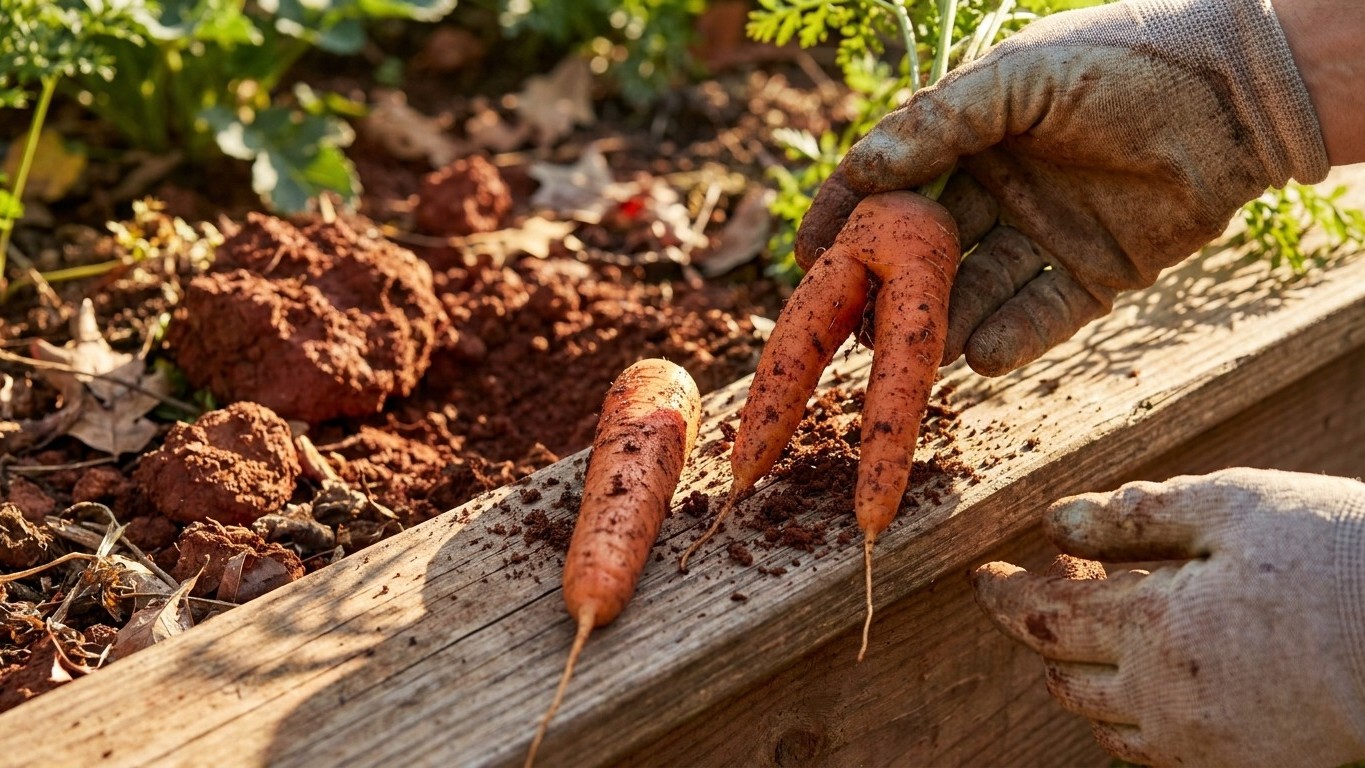
- Forking in heavy ground. When a root meets clay-compacted soil, a stone, or a firm layer, it splits or grows crooked instead of pushing straight down. The remedy Utah State University Extension gives is direct: work in generous compost and double dig the bed before sowing, or move to a raised bed filled with a looser mix.
- Poor germination during a hot, dry stretch. Carrot seed is slow to sprout under the best conditions, and a surface that dries out and crusts over during a warm spell can stop germination before it starts. Keeping the top inch of soil consistently damp until seedlings appear, with light watering rather than a heavy soak, addresses this without waiting on the weather to cooperate.
- Splitting from uneven watering. A root that grows steadily and then gets hit with a sudden heavy watering after a dry stretch can split along its length as the interior swells faster than the skin can stretch. Regular, even watering through the growing season, rather than occasional deep soaks after neglect, keeps that from happening.
Since carrots are sown directly in place and never transplanted, the 70 to 100 days to maturity that most gardeners plan around are counted from the seeding date, not from any later step. Getting the soil right before that seed goes in the ground matters more for this crop than for one you can transplant into a corrected bed later.
Common questions
Does a high clay percentage always mean forked carrots?
Not always, but it raises the odds. Utah State University Extension ties forking specifically to heavy or rocky soil that resists the root’s downward growth. A soil with meaningful clay content can still grow straight carrots if it’s loosened well with compost and double digging, or if the crop goes into a raised bed with amended soil instead.
Is Lester series soil the same as what’s in my backyard?
Almost certainly not exactly. Lester is the soil series named by Minnesota law as representative of the state, based on USDA NRCS sampling across 251 components. It’s a useful reference point, not a stand-in for your specific lot, which may sit on a completely different series depending on local geology and any grading or fill work done during construction.
What organic matter level should I aim for in a carrot bed?
The source material here doesn’t set a target percentage for a cultivated garden bed. The Lester series surface horizon averages around 3.0 percent organic matter as mapped in its natural state, but that figure describes undisturbed ground, not a worked vegetable bed. Utah State University Extension’s guidance is simply to add plenty of compost when soil is heavy, without naming a specific percentage to hit.
Can I just switch carrot varieties instead of fixing the soil?
The sourced guidance here doesn’t name any variety or recommend swapping types as a fix for heavy soil. The remedy given is soil preparation itself, compost and double digging, or a raised bed. If you’re relying on a variety choice to solve a soil problem, that recommendation isn’t supported by what’s covered here.