
Collards in Minnesota go into the ground once the last spring frost has passed, sometime between April 17 and April 30 depending on the year, and they keep producing into fall until the first hard freeze lands between October 11 and October 23. That gives the state a workable but tight window, one shaped less by summer heat and far more by how brutally the coldest month of winter actually runs.
When the soil is warm enough in Minnesota

The calendar date matters less than what’s happening six inches down. NOAA’s 1991-2020 Climate Normals put the last spring frost for the Twin Cities at April 17 to April 30, drawn from freeze-probability data at the Minneapolis-St. Paul reference station. That’s a 30 to 70 percent probability band, not a promise, and it describes the mild southern edge of the state. Gardeners farther north, around International Falls or Bemidji, should push that window two to three weeks later in spring and two to three weeks earlier in fall, since northern Minnesota runs tighter on both ends of the year.
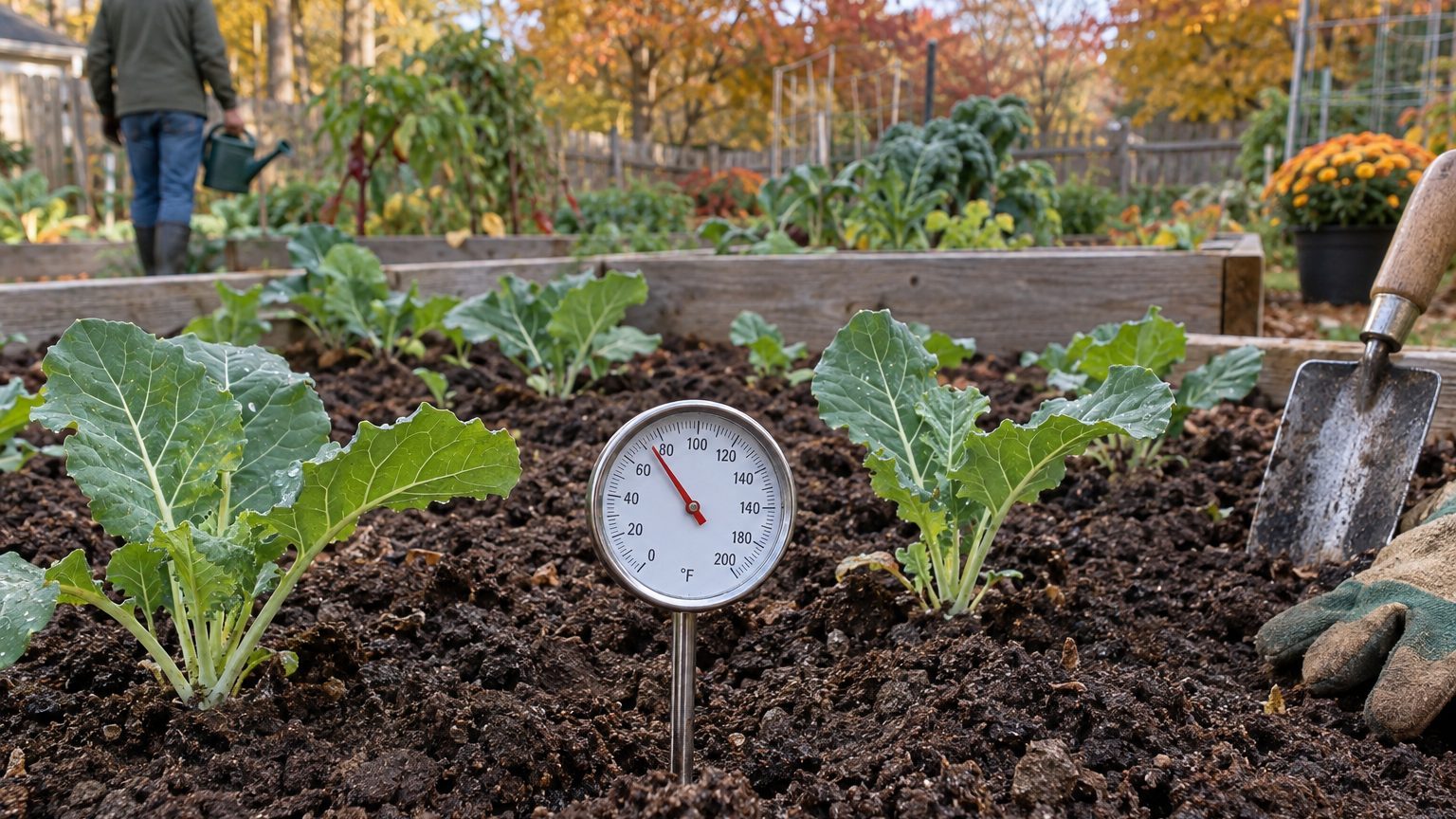
Frost is a proxy, and a rough one. Collards don’t respond to what the thermometer read at sunrise. They respond to soil temperature, and soil warms on its own schedule, typically a week or two behind the point where frost risk drops off. A bed that’s still cold and waterlogged in late April will sulk a transplant no matter how clear the sky looked the night before. Treat the frost date as the earliest possible starting line, then wait for the soil itself to feel workable and crumble rather than stick before setting plants out.
Direct-seeding into cold soil rarely pays off here. Germination slows dramatically below the mid-50s, and that slow start gives cutworms and flea beetles more time to find seedlings before they’ve built any size. Starting transplants indoors three to four weeks ahead, then hardening them off outdoors once the frost window has passed, gives a Minnesota grower a head start direct seeding can’t match. The main collard growing guide covers spacing, soil pH and feeding basics that hold true whatever the local season length, and it’s a useful starting point before narrowing in on Minnesota’s own timing.
Collards belong to the brassica family, alongside cabbage, kale, mustard and turnips, which means they share the same soil-borne diseases and the same appetite from cabbage maggots and flea beetles. Planting them into a bed that grew any of those crops the year before invites the same trouble straight back. Moving collards to a different section of the garden each season, one that didn’t host a brassica the year prior, is the simplest step to cut disease pressure before the first true leaf even shows.
How long the season lasts here
Subtract the two frost dates and Minnesota’s frost-free stretch runs somewhere between 164 and 189 days, depending on where the actual frost falls within each band in a given year. Using the earliest possible spring frost against the latest fall frost gives the long end. Using the latest spring frost against the earliest fall frost gives the short end. Either way, that’s a season built around one planting rather than a string of them.
A window that size allows one full crop, set out after frost risk clears and harvested through summer into fall, but it doesn’t leave the kind of room for a true second sowing that a six-month Southern season would. Some growers still direct-seed a batch in mid-summer for eating through autumn, since collards tolerate light frost and often taste better after it, but that’s not the same double-cropping rhythm gardens further south can run. The 164- to 189-day window is really the ceiling on what’s possible here, not a floor to plan around loosely.
That length also decides whether transplanting is worth the trouble. In a longer growing zone, losing three weeks to transplant shock barely registers. In Minnesota’s tighter window, three weeks lost is close to a fifth of the whole season gone before the first real harvest. Starting seedlings indoors under grow lights in early April, checking that roots are white and unbound before setting them out, and hardening plants off outdoors for several days first are the habits that keep a season this short from stalling out of the gate.
Vermont sits in a broadly similar spot, with a frost-shaped season that forces the same single-planting math, and gardeners there weigh the identical question of whether a second sowing is worth risking an early freeze. In Minnesota, the length of the window matters less than what happens once it closes, since the winter that follows decides whether the last leaves in the bed are worth holding onto into November or whether the season is simply finished.
Heat and water in Minnesota

Minnesota summers rarely deliver the sustained, punishing heat that shapes collard growing further south. Stretches above 90°F happen, but not often enough to be the dominant factor in how this crop performs, and a cool, damp June or July is a far more common problem than a heat wave. That kind of weather slows ripening and creates exactly the conditions powdery mildew needs: still, humid air sitting on wet leaves overnight. Spacing plants generously and watering at the soil line rather than overhead protects a Minnesota collard bed more reliably than shade cloth ever would.
The figure actually running the show here is winter, not summer. The coldest month in the Minneapolis area averages a daily minimum of 8.8°F, per NOAA’s 1991-2020 Climate Normals, and that number decides how the whole bed gets planned. Collards live two different lives depending on how that reading comes in wherever they’re grown. Where the coldest month stays mild, gardeners pick them leaf by leaf as a standing crop clear into March. Where it doesn’t, and 8.8°F puts Minnesota squarely in that camp, collards are an autumn crop that ends the day the first hard freeze finally takes the bed down.
That’s the real split between a Minnesota patch and one in a place like Nova Scotia, where milder coastal winters let some growers treat the crop as a standing one deep into the cold months. Minnesota’s USDA hardiness zone range of 3a to 5a rules that out across nearly the whole state. The practical response is to plan for a hard finish: harvest what remains as the first serious freeze approaches instead of betting on a mild stretch the coldest-month numbers say isn’t typical here.
None of this changes summer watering habits. Even without an exact rainfall figure to lean on, the general rule for a northern climate like this one still applies: deep, infrequent watering that reaches the root zone beats a daily light sprinkle, since shallow watering keeps the top inch of soil damp enough to invite the same fungal problems a cool, humid stretch already brings on its own.
Which collards suit Minnesota
The honest answer to which variety performs best here is that this page can’t say with any authority, and pretending otherwise is the kind of error a gardener notices the moment a plant underperforms. Variety trials run by University of Minnesota Extension test collard types against local conditions every year, and their results are the only recommendation grounded in this specific climate. A cultivar that thrives in Georgia clay under six months of heat has no guaranteed relationship to how it handles a 164-day Minnesota season ending in a mid-October freeze.
What the territory’s numbers do support is reasoning by type instead of by name. The short growing season points toward earlier-maturing types, bred to reach a harvestable size before the calendar runs out rather than optimized for a long, slow build over a Southern summer. The occasional stretch of humid, still weather Minnesota summers produce points toward types selected for disease resistance, especially against fungal problems that thrive when air doesn’t move between plants. Spacing collards wider than a seed packet’s minimum recommendation does more practical good here than any single variety pick.
Airflow and root health work together. A plant stressed by standing water handles neither heat nor cold well, and some of Minnesota’s clay-heavy soils hold water longer than sandy or loamy ground elsewhere. Raised beds or compost worked in to improve drainage give a collard plant a better shot at surviving whatever the season brings, hot spell or cold snap, than any cultivar choice on its own.
For the same type-over-name reasoning worked out under different frost and winter numbers, the collard pages for Vermont and Nova Scotia cover how that logic plays out in a milder companion climate. The University of Minnesota Extension office remains the most useful next stop for a Minnesota-specific list, and the 3a to 5a hardiness range covering most of the state is worth naming when asking local gardeners which types have already worked for them.