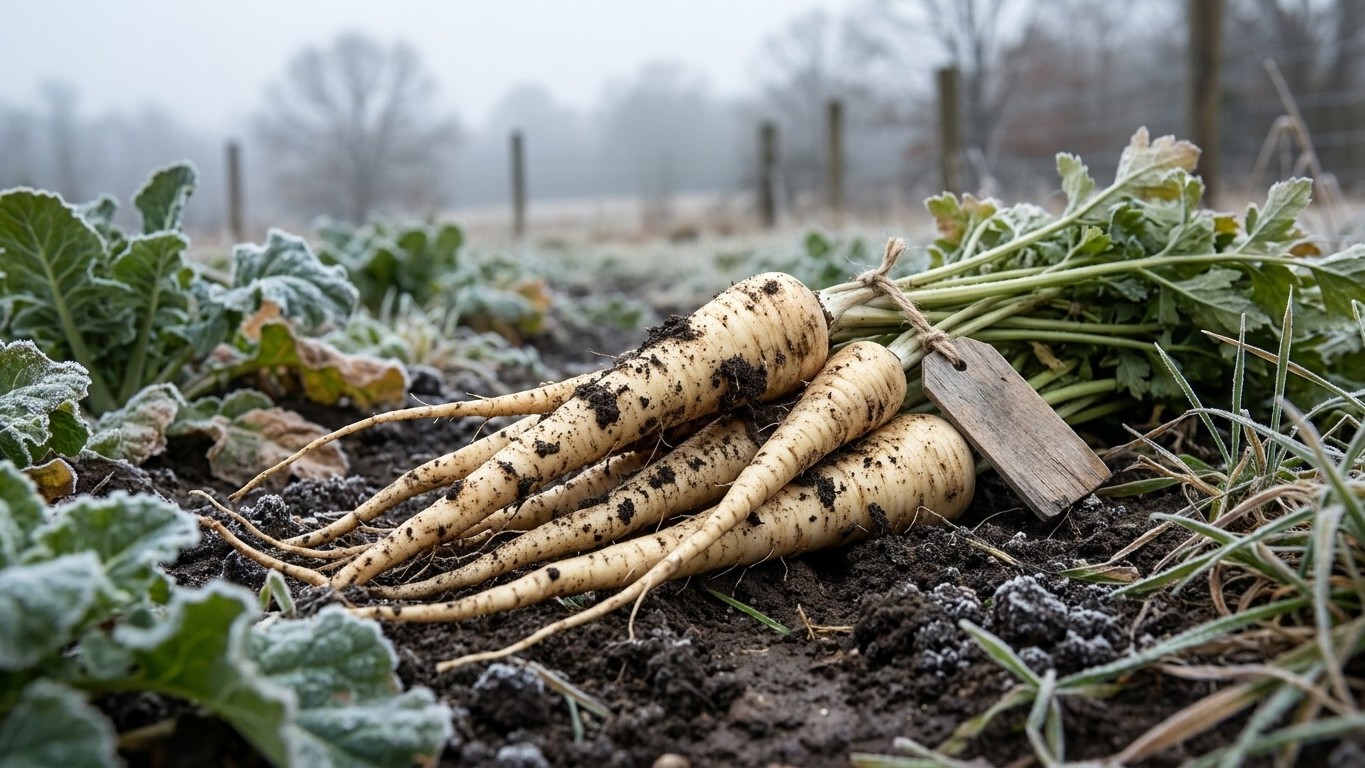

Yes, across most of Minnesota. The state’s winters hand parsnips exactly what they need to turn stored starch into sugar: long stretches of air well below freezing. The mean minimum for the coldest month at the Minneapolis reference station sits at 8.8°F, and that’s the mild end of the state. The real question for a Minnesota gardener isn’t whether it gets cold enough. It’s whether the growing season leaves enough time to grow a full-size root before that cold sets in.
The short answer
Start with the number that actually decides this: 8.8°F. That’s the average daily low for the coldest month at the Twin Cities station, and it comes from three decades of NOAA climate data, not a single hard winter or a fluke cold snap. A mean minimum that far under freezing means the region isn’t flirting with a light frost here and there. It’s locking into weeks of sustained cold every year, and that’s the mechanism that matters for a parsnip root sitting in the ground.
Sweetening isn’t a hardiness-zone question. A plant can survive in a zone rated mild and still never taste sweet, because sweetening depends on direct, repeated frost exposure converting starch to sugar inside the root, not on some general climate label. Minnesota isn’t a borderline case here. With a coldest-month average minimum under 9°F, the frost exposure is not marginal. It’s abundant.
The Twin Cities figure is also the softest number in the state. Northern Minnesota runs colder and holds that cold longer, so if 8.8°F in the south already delivers more frost than a parsnip needs, the rest of the state clears that bar with room to spare. What changes as you move north isn’t whether sweetening happens. It’s how much calendar time you have on either end of the season to grow the root in the first place, and that’s a separate question worth working through on its own.
So the plain version: a parsnip seeded and grown properly in Minnesota will sweeten, not merely mature. The frost exposure that does the converting is there in ample supply, statewide, every single year, without needing a particularly harsh winter to make it happen. What a gardener here has to manage isn’t the cold. It’s the clock.
Does the season fit?
- Sowing window. The last spring frost in the Twin Cities falls between April 17 and April 30. Parsnip seed goes in the ground 2 to 3 weeks before that date, which puts sowing somewhere around late March into mid-April for the southern part of the state.
- Germination lag. Parsnip seed is slow. Expect 14 to 21 days before anything visible breaks the soil surface. A gardener who sows in early April shouldn’t expect to see a row until late April or early May, and shouldn’t dig up the bed in the meantime thinking the seed failed.
- Days to maturity. Count 100 to 120 days from the seeding date, not from germination. A sowing around April 10 reaches full root size somewhere between late July and early August.
- Frost target. The first fall frost in the Twin Cities arrives between October 11 and October 23. That leaves roughly two and a half to three months between a root reaching maturity and the first frost that starts the sweetening process. That’s a wide cushion, not a tight one.
- Northern Minnesota adjustment. The far north runs 2 to 3 weeks tighter on both ends: a later last spring frost and an earlier first fall frost. Even with that squeeze, a root sown promptly at the start of the recommended window still reaches maturity well before the ground freezes hard, because the buffer built into the Twin Cities numbers is large enough to absorb the compression.
- Verdict. The season fits comfortably in southern and central Minnesota, and it fits with a narrower but still workable margin in the north, provided seed goes in early rather than late.
What goes wrong here
- Forked roots from heavy or stony ground. Parsnips want deep, loose, sandy soil. Minnesota gardens sitting on clay or rocky glacial till will produce roots that split and twist around obstructions instead of growing straight. Utah State University Extension’s guidance is direct on this: heavy soil needs to be double dug, worked to a full spade’s depth and then some, before seed goes in, so the taproot has open ground to push through.
- Forked roots from overwatering. This is a separate cause from soil texture, and it’s easy to conflate the two. Even in loose, well-prepared soil, keeping the bed saturated rather than evenly moist encourages the root to branch instead of driving straight down. Water enough to keep the soil from drying out, not enough to keep it soggy.
- Giving up on germination too soon. Parsnip seed takes 14 to 21 days to show. A gardener who doesn’t know that will assume the row failed, dig it up, and resow, which wastes three more weeks that the season, particularly in northern Minnesota, doesn’t have to spare. Mark the row and leave it alone until the full window has passed.
- Harvesting before the frost does its work. A root pulled in September, right after it reaches size, will be a perfectly fine parsnip and a bland one. The sweetening comes from several weeks of frost exposure after maturity, not from the calendar date the root happens to reach full size. Leave it in the ground through the early fall frosts before digging.
- Sowing late in the northern part of the state. A grower who sows at the tail end of the recommended window, rather than the start of it, cuts into the buffer between maturity and first frost. In the south that buffer is wide enough to absorb the delay. In the north it isn’t always. Sow as early as the last-frost window allows, especially above the Twin Cities latitude.
Common questions
Can parsnip seed be started indoors and transplanted in Minnesota?
No. Parsnips are sown in place because the taproot is easily damaged by transplanting, which is what causes forking. The 100 to 120 day count runs from the seeding date in the garden bed, not from any indoor head start.
How long can parsnips stay in frozen ground over winter?
That specific storage window isn’t covered by the figures on this page. What is established is that the root needs several weeks of frost exposure after maturity to sweeten, and that once the ground freezes solid, digging becomes difficult. Plan to harvest once that frost period has passed rather than waiting on the soil to lock up entirely.
Does Minnesota’s soil affect sweetness, or just root shape?
Just shape and size. Heavy or stony ground causes forking and stunted growth, but sweetness comes from frost exposure after the root matures, not from soil type. A parsnip grown in poor soil can still sweeten fully if it gets its weeks of cold; it will just be a misshapen sweet parsnip rather than a straight one.
Is northern Minnesota too cold to grow parsnips at all?
No. The cold is an asset here, not an obstacle, since it’s what makes the sweetening happen. The real constraint up north is the compressed frost-free window, roughly 2 to 3 weeks tighter on both ends than the Twin Cities. Sow at the earliest safe date and the season still works.