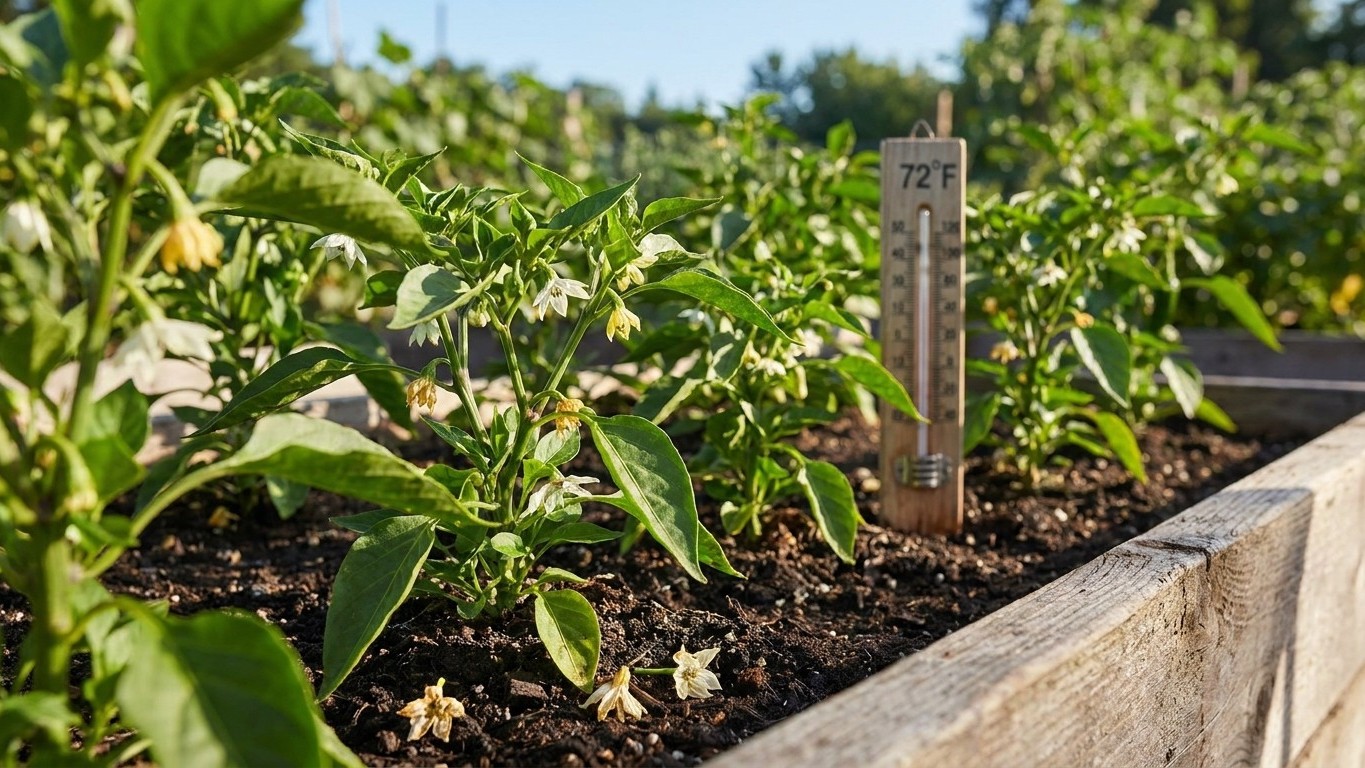

Start pepper seed indoors 8 to 10 weeks before transplant day. In the Twin Cities area, where the last spring frost typically falls between April 17 and April 30, that puts the seed-starting window in mid-February to early March. Soil also needs to reach 60 F before transplants go outside, which usually happens a week or two after that frost date. Gardeners in northern Minnesota, where frost lingers two to three weeks longer, need to shift the whole schedule later.
The short answer
Minneapolis averages 10.6 days a year at or above 90 F, based on NOAA NCEI Climate Normals for 1991-2020. That’s not a brutal number compared to states farther south, but it’s enough to matter for peppers. Fruit set on pepper plants stalls out once daytime highs push past 90 F for a stretch, because the flowers drop instead of holding and setting fruit. Ten or eleven days scattered across a Minnesota summer, often clustered into one or two heat spells in July, is usually enough to knock out a wave of blossoms right when the plant should be loading up.
The practical takeaway: don’t assume a Minnesota summer is too mild to cause heat-related blossom drop. It happens here too, just in shorter bursts than in Kansas or Texas. If a heat wave is forecast, that’s the week to expect a lull in fruit set rather than a plant problem to chase with fertilizer or water.
The other end of the fruit-set window matters just as much, and it’s the one gardeners tend to overlook. Pepper flowers also Fail to Set Fruit when nighttime temperatures drop below 55 F, according to Utah State University Extension. Minnesota nights can dip into that range even in June, especially in low-lying gardens or after a clear, dry night that lets heat radiate out fast.
This site tracks days at or above 90 F for Minnesota, but it does not carry summer night-minimum data. There’s no reliable way to infer how cool your particular nights run just from the state’s latitude or from how cold your winters get. A garden in a river valley, a low spot, or an open field will drop faster and lower on a clear night than one in town surrounded by pavement and buildings. The only real fix is to watch your own thermometer through June, especially in the first few weeks after transplanting, when a run of cool nights can quietly stall a plant that looks perfectly healthy above ground.
When to start seed here
The math is simple once you have three numbers: your last frost date, the point when your soil reaches 60 F, and the 8-to-10-week indoor head start peppers need before they’re ready to go outside. Here’s how it works for a Twin Cities garden, and how to redo it for wherever you actually live.
- Find your transplant date. In the Twin Cities, the last spring frost typically falls between April 17 and April 30, per NOAA NCEI’s 1991-2020 climate normals. Frost date alone isn’t quite enough, though, because peppers also need soil at 60 F, and soil often lags behind the air by a week or more in spring. A safe transplant target for the Twin Cities lands in early to mid-May, once both conditions are usually met.
- Count back 8 to 10 weeks. From an early May transplant target, 8 weeks back lands in early March, and 10 weeks back lands in mid-February. That’s the seed-starting window for the Twin Cities: mid-February through early March, depending on how much time you want to give the plants before they go outside.
- Adjust for northern Minnesota. Frost lingers two to three weeks longer in the northern part of the state, which pushes both the transplant date and the seed-starting window later by roughly the same margin. A gardener near Duluth or International Falls is generally starting seed in late February to mid-March instead.
- Redo it for your own county if you’re between the two. Take your area’s typical last frost date, add a week or two for soil to catch up to 60 F, then count back 8 to 10 weeks from that date to land on your own seed-starting window.
A quick side-by-side makes the shift easier to picture:
| Region | Typical last frost | Suggested seed-start window |
|---|---|---|
| Twin Cities / southern Minnesota | April 17 to April 30 | Mid-February to early March |
| Northern Minnesota | Roughly 2 to 3 weeks later | Late February to mid-March |
Starting earlier than 10 weeks out isn’t a shortcut. Peppers held too long indoors under weak light often stall, get root-bound in small containers, and struggle to catch up once they’re in the ground, sometimes setting fruit later than a plant started right on schedule.
What goes wrong here
- Blossom drop during a July heat spell. With about 10.6 days a year at or above 90 F in the Minneapolis area, a hot stretch in mid-summer is common enough to plan around. Flowers open and then drop without setting fruit. There’s no way to force fruit set during the heat itself; the fix is patience, along with steady watering and light afternoon shade if the heat spell runs several days in a row, so the plant is in good shape to resume setting fruit once temperatures ease.
- Blossom drop from a cool night early in the season. This is the flip side, and it catches more Minnesota gardeners off guard than the heat does. Nights below 55 F stop fruit set just as effectively as heat does, and June nights here can dip that low, especially in a low spot or right after a clear, calm evening. Track your own overnight lows for the first month after transplanting, and don’t blame the plant, the soil, or the fertilizer if blossoms drop during a cool snap; it will usually recover and resume setting fruit once nights warm back up.
- Sunscald on exposed fruit. Minnesota summer sun is strong enough to scald pepper fruit that’s left uncovered by foliage, especially on plants that have been pruned hard or that lost leaves to wind or disease. The scald shows up as a pale, papery, sunken patch on the side of the fruit facing the sun. Keep the plant’s natural leaf cover intact rather than pruning it for looks, and stake or cage the plant so wind doesn’t strip leaves and expose fruit that was otherwise shaded.
- Blossom-end rot on the first fruit of the season. This shows up as a flat, dark, leathery spot on the blossom end of the fruit, and it’s driven by inconsistent watering rather than a soil deficiency in most home gardens. Uneven watering, wet one week and dry the next, interrupts the plant’s ability to move calcium into developing fruit. Keep watering consistent through fruit set, especially during a stretch of hot, dry weather when soil can dry out fast.
Common questions
Can I transplant peppers before the last frost date if I use row cover?
Row cover buys a few degrees of protection from cold air, but it won’t fix cold soil, and pepper roots stall in soil below 60 F regardless of what’s happening above ground. It’s usually better to wait for both the frost date to pass and the soil to warm rather than rushing transplants under cover.
How do I know when my soil has actually reached 60 F?
A basic soil thermometer, pushed a few inches into the bed and checked in the morning before the sun warms the surface, gives a straightforward reading. Air temperature alone isn’t a reliable stand-in, since soil often lags behind by a week or more in spring.
Does starting seed earlier than 10 weeks give me an earlier harvest?
Not usually. Plants held indoors much longer than 10 weeks tend to get root-bound and stressed under indoor light, and they often don’t outperform a plant started on the standard 8-to-10-week schedule once both are in the ground.
If my nights stay below 55 F into June, is something wrong with my garden?
No. Cool nights below 55 F are simply part of a Minnesota spring in some years and in some locations, particularly low-lying yards. The plant will typically resume setting fruit once nights warm, so there’s no need to replant or treat the soil.