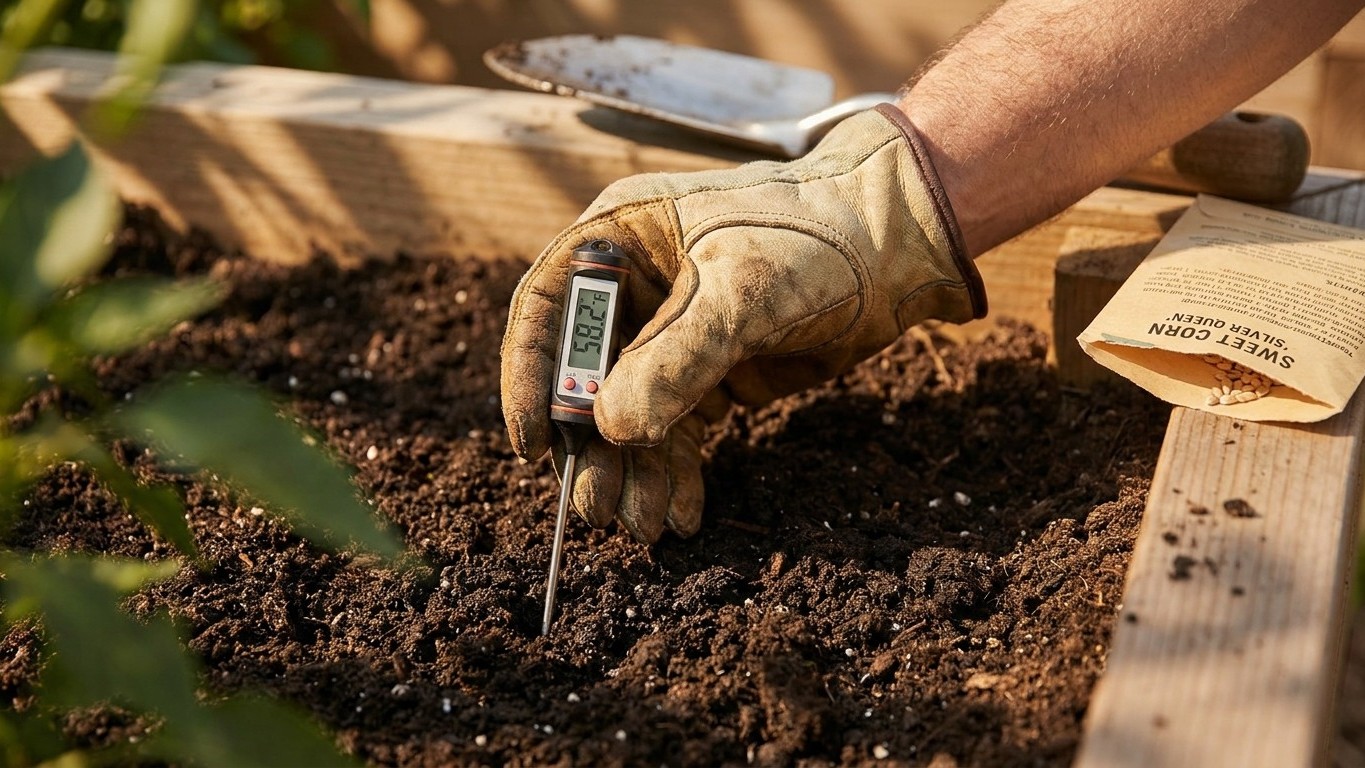

Minnesota’s sweet corn window opens once soil temperatures hold above 60°F, which lands well after the last spring frost (April 17 to April 30 in the Twin Cities area). From there, most sweet corn varieties need 60 to 90 days to mature, and that stretch has to close out before the first fall frost arrives, typically October 11 to October 23. Get the soil timing wrong and the seed simply sits and rots.
The short answer
Frost date and planting date are not the same thing, and treating them as interchangeable is the single most common mistake Minnesota gardeners make with sweet corn. The last spring frost falls between April 17 and April 30 across the Twin Cities region, but soil doesn’t warm at the same pace as the air. Ground temperature lags behind, sometimes by several weeks, so a garden that’s frost-free by late April can still have soil sitting in the low 50s. Sweet corn seed planted into that cold ground doesn’t germinate evenly. It can sit dormant, absorb moisture, and rot before a sprout ever shows.
Soil in Minnesota typically climbs past 60°F several weeks after that last frost, often not settling in reliably until deep into May, and sometimes later still after a cool, wet spring. That’s the number to watch, not the calendar date on a seed packet or a neighbor’s planting habit. A soil thermometer pushed a few inches into the bed, checked in the morning over several consecutive days, tells you more than any frost forecast.
Once that 60°F threshold is met, the next question is whether there’s enough season left. Sweet corn needs 60 to 90 days from planting to harvest, depending on the variety. Counting forward from a mid-to-late May planting toward the first fall frost (October 11 to October 23) leaves a stretch of roughly four to five months, plenty of room for the full range of maturity lengths the source describes. That margin shrinks fast, though, if planting slips into June or if a grower is working in northern Minnesota, where both frost dates run two to three weeks tighter on each end.
Summer heat matters here too, though not as a planting-date factor. Minneapolis averages 10.6 days a year at 90°F or hotter, a modest heat load compared to states further south. That’s not a driver of when to plant, but it does explain why irrigation and consistent moisture through pollination matter as much as timing the seed itself. Corn under heat stress during silking drops kernels and fills ears unevenly, regardless of how well the planting date was chosen.
Does a late variety fit here?
The 60-to-90-day maturity range isn’t a suggestion, it’s the boundary that decides whether a given variety has any business going into a Minnesota garden at all. Working backward from the first fall frost, and forward from a realistic soil-warm date, shows why one end of that range is comfortable and the other is a gamble in parts of the state.
A 60-day variety
A shorter-season type, maturing in roughly 60 days, fits Minnesota’s window with room to spare almost everywhere in the state. Planted once soil holds above 60°F, typically by mid-to-late May in the Twin Cities area, a 60-day crop reaches harvest by mid-to-late July, months ahead of the October frost dates. That slack matters because Minnesota springs are unpredictable. A cool stretch that delays planting by a week or two still leaves a wide safety margin before autumn cold arrives. It’s the lower-risk choice for anyone gardening in the northern part of the state, where the growing season is already compressed by frost dates running two to three weeks tighter at both ends.
A 90-day variety
A longer-season type, at the far edge of the 60-to-90-day range, is a different calculation. In the Twin Cities and southern Minnesota, where the first fall frost holds off until October 11 to October 23, a planting made once soil clears 60°F in mid-to-late May can still close out a 90-day cycle with a few weeks of buffer before frost. It works, but it’s tighter, and a delayed planting caused by a slow-to-warm spring erodes that buffer quickly.
In northern Minnesota, the math doesn’t hold. With both frost dates running two to three weeks tighter, the usable season shrinks from both directions at once: a later last frost pushes soil-warm dates back, and an earlier first fall frost closes the season sooner. A 90-day variety does not reliably fit that shortened window. Gardeners in the northern half of the state are better served sticking closer to the 60-day end of the range, leaving the longer-season types to warmer regions further south.
What goes wrong here
- Soil sown too cold. Planting by the frost date alone, rather than a soil temperature above 60°F, leads to seed sitting in cool, damp ground where it rots or sprouts unevenly. Check soil temperature directly with a thermometer over several mornings before planting, rather than counting days from the last frost.
- A variety too late for the season. Choosing a 90-day type in a shortened growing region, particularly northern Minnesota where frost dates run two to three weeks tighter, leaves the crop racing an early fall frost with little margin. Match maturity length to the actual frost-free window in your specific part of the state, not a statewide average.
- Sweetness lost to nearby tasseling. Su, se, and sh2 sweet corn types lose their sweetness when they tassel at the same time as each other, because cross-pollination changes the kernel’s sugar content. There’s no published isolation distance to fall back on here, so the fix is timing: stagger planting dates so different types don’t tassel in the same window, and keep each type in its own block of three or more rows rather than mixing types in a single planting.
Common questions
Can I plant sweet corn right after the last frost in Minnesota?
Not reliably. The last spring frost (April 17 to April 30) marks when freezing air temperatures ease off, but soil takes longer to warm. Sweet corn needs soil consistently above 60°F, which usually arrives weeks after that frost date. Planting too early into cold soil risks rot rather than germination.
How do I know when my soil has actually reached 60°F?
A soil thermometer pushed a few inches into the planting bed, checked over several consecutive mornings, gives a direct reading. Relying on the calendar or a neighbor’s planting date isn’t a substitute, since soil warming varies by garden location, moisture, and exposure.
Is a 90-day sweet corn variety a safe choice in northern Minnesota?
It’s a tight fit at best. Northern Minnesota’s frost dates run two to three weeks tighter on both ends than the Twin Cities region, which shortens the usable growing season significantly. A 60-day variety is the safer match for that part of the state.
Why did my sweet corn turn out starchy instead of sweet?
This is usually a pollination issue, not a climate one. If su, se, or sh2 types tassel at the same time nearby, cross-pollination can pull the sugar content down. Staggering planting dates so different types silk in different weeks, and keeping each type grouped in its own block, addresses the problem directly.