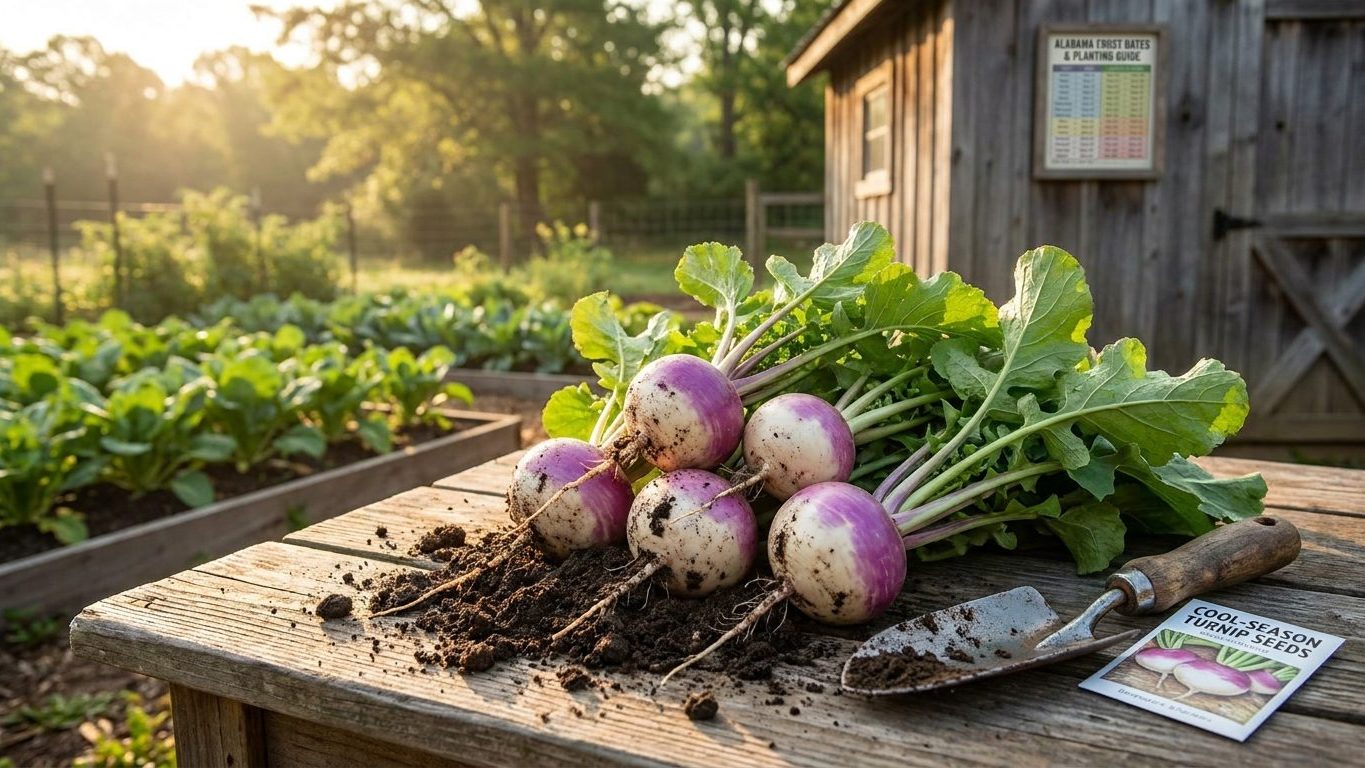

Minnesota gardeners get two sowing windows for turnips: a spring one that opens once soil dries out in late March to mid-April, and a fall one, generally preferred, that runs from mid-July into mid-August. The fall window wins on flavor, since a light frost sweetens the roots.
The short answer for Minnesota
Turnips in Minnesota get planted twice a year, and the two windows are built from opposite ends of the frost calendar. NOAA’s 1991-2020 Climate Normals put the state’s last spring freeze (32°F) somewhere between April 17 and April 30, and the first fall freeze between October 11 and October 23. Those aren’t guarantees. They’re the 30-to-70% probability band, meaning frost has roughly a coin-flip chance of showing up anywhere in that stretch, and it can arrive earlier or later than either edge.
For a spring crop, turnips tolerate light frost as seedlings, so gardeners sow two to three weeks before the last frost date rather than waiting for it. That puts spring sowing at roughly late March through mid-April, depending on how fast the soil dries out that year. Spring turnips mature fast, in 30 to 45 days for most salad and baby varieties, and get pulled before summer heat turns the roots woody and bitter.
The fall crop is the one most Minnesota growers actually rely on for storage roots. Working backward from the earliest fall frost date, October 11, and allowing 55 to 60 days for a standard storage turnip to size up, the sowing window lands in mid-July to mid-August. Sow later than that and the roots run out of season before they run out of size. Sow earlier and July heat stresses the seedlings and invites bolting.
Both numbers come from the same reference station behind Minnesota’s climate normals, not from a single garden or county. A reader farther north or at a colder site inside the state should treat these dates as a starting point, not a fixed rule, for reasons covered below.
What will not work here

Rutabaga is the first casualty of Minnesota’s frost math. A rutabaga needs 90 days on average to reach harvest size, longer than a turnip. Counting back from the earliest fall frost date of October 11 puts the last safe rutabaga sowing in mid-July, and any planting later than that is racing a season that may already be closing. This isn’t a guess: it’s the same subtraction that works for turnips, just with a bigger number on one side.
Overwintering roots in the ground fails here too, and the coldest-month numbers explain why. The average daily minimum temperature in Minnesota’s coldest month sits at 8.8°F, a mean, not a record low. That’s cold enough, sustained over weeks, to freeze turnip and rutabaga roots solid in unprotected native soil. Growers in milder states leave a few roots in the ground under mulch for a late harvest; that gamble doesn’t hold up against a Minnesota winter without a much heavier mulch layer or a cold frame, and even then it’s unreliable.
Summer sowing for a quick July-to-August harvest also runs into trouble, separate from the frost calendar entirely. Turnips sown in the heat of June and early July tend to bolt, sending up a flower stalk instead of bulking the root, and the combination of heat and longer daylight is what triggers it. Root maggot pressure also builds through midsummer in the state’s clay and loam soils, and seedlings started in the hottest weeks face the heaviest pest load just as they’re most vulnerable.
Finally, sowing right at the edge of the last spring frost date, rather than ahead of it, wastes the part of the season turnips are best suited for. Turnips are one of the few crops that shrug off a light frost, so treating April 30 as a starting line instead of a backstop just shortens an already short spring window.
What changes across Minnesota
Minnesota isn’t one growing zone, and the USDA Plant Hardiness Map makes that explicit: the state spans 3a to 5a, a two-and-a-half-zone spread built entirely from average extreme minimum winter temperatures. That range means a garden in the northern part of the state and one near the Twin Cities aren’t playing by the same calendar, even though they’re in the same state and the same NOAA dataset.
The frost dates cited above come from a reference station in the Twin Cities, which sits in the mild south of Minnesota’s range. Northern Minnesota runs two to three weeks tighter at both ends of the season, meaning a later last spring frost and an earlier first fall frost. For a gardener up north, that compresses the entire fall sowing window earlier, likely into early July rather than mid-July, and it makes the spring window both shorter and later to open.
There’s no single date that covers the whole state, and this page won’t pretend otherwise. A grower in a colder pocket, whether from latitude or elevation, should shift both windows earlier in the fall calculation and later in the spring one, using the two-to-three-week adjustment as a starting estimate rather than a precise offset. The USDA map itself is the tool for narrowing this down by location, not a written description of “north” versus “south.”
Where to check this for your own county
State-level frost dates and hardiness zones are a starting point, not a final answer, and the next step is the University of Minnesota Extension at extension.umn.edu. This is the state’s land-grant extension service, and it publishes county-level guidance that accounts for local microclimates NOAA’s statewide averages can’t capture.
Two things are worth looking for once there. First, a county or regional planting calendar, if the local office has published one, which will adjust the statewide frost window for local elevation, lake effect, or urban heat, all of which shift the practical sowing dates by days or weeks in either direction. Second, any variety trial data specific to Minnesota conditions, since university trials often test turnip and rutabaga varieties for bolt resistance and storage quality under the state’s particular combination of short summers and cold winters, information that a seed catalog written for a national audience won’t have.
A county-specific recommendation will always beat a state-level one, for the simple reason that it’s built from a smaller, more relevant sample of local conditions. This page works from statewide climate normals because that’s the best data available at this scale, but it’s a starting framework, not a substitute for what a local extension office already knows about the soil and microclimate a few miles from where the seed goes in the ground.
The Moon calendar is a separate, older custom: see when to plant turnips by the moon, written as tradition rather than fact.
Checking this against your own garden
Calendar dates get a gardener into the right neighborhood, but the plants themselves are more accurate messengers about that particular yard than any regional average. Three signs are worth tracking, and none require anything beyond a hand and a pair of eyes.
Soil warmth by feel comes first. Turnip seed germinates reliably once soil isn’t cold and wet to the touch, roughly the point where a handful crumbles instead of clumping. If that point arrives well before or after the calendar window described above, it says something specific about how that particular spot warms up compared to the regional average, whether from sun exposure, drainage, or soil type.
First true leaves are the second signal. Turnip seedlings send up two round seed leaves first, then the true, slightly fuzzy leaves follow within 5 to 10 days. A pace slower than that in a given planting suggests the soil was cooler than ideal at sowing, useful information for timing the next round.
The third is the one that flags a mistake already made: a flush of yellow flowers before the root has sized up. That’s bolting, and it means the planting date landed in weather too hot or too long-lit for that variety, a direct, on-the-ground correction to whatever the calendar window suggested for that particular season.