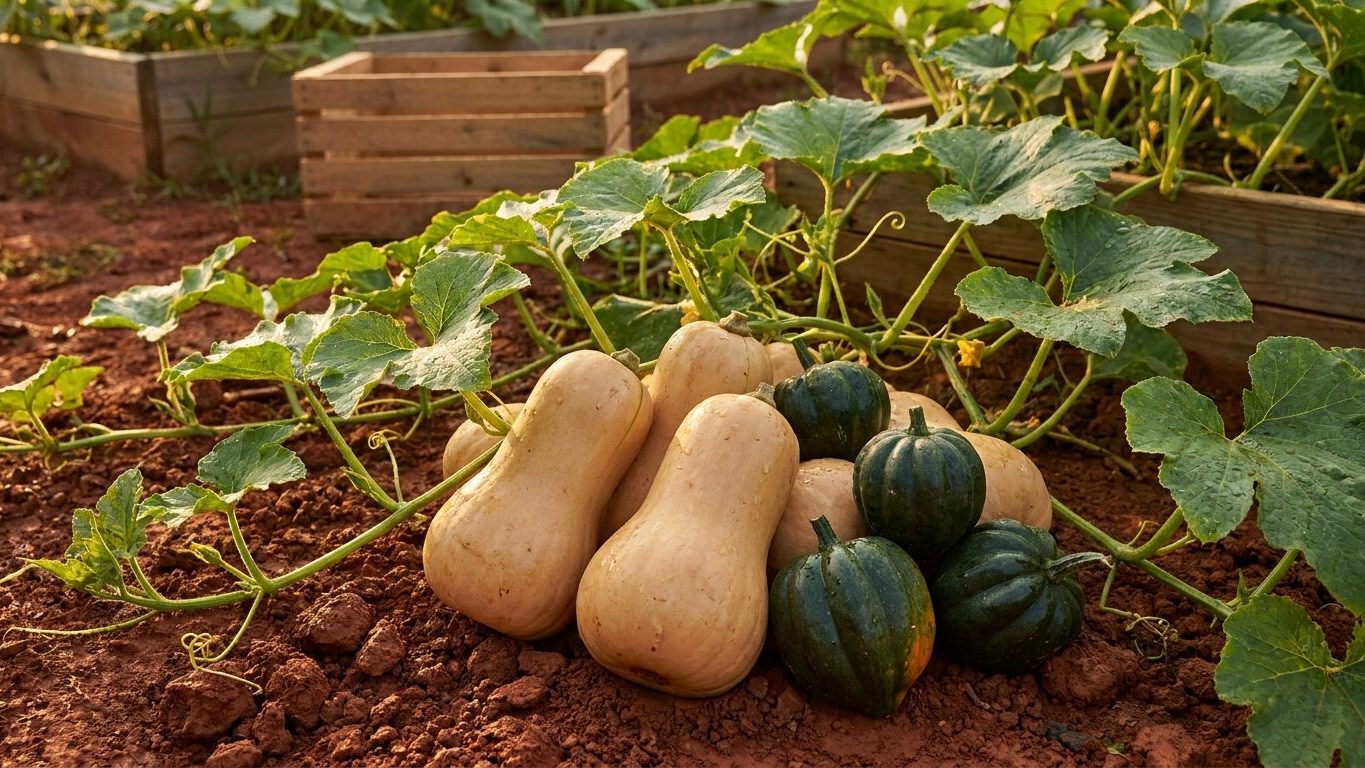

Short-season, moderate-heat types built for 80 to 110 days win in Minnesota: acorn, delicata, buttercup, and most standard butternuts. Anything bred for a 120-day-plus Southern summer, like giant hubbards or banana squash, is a gamble here no matter how much space you give it.
The short answer for Minnesota
The decision comes down to two numbers from the state’s own climate record: how many frost-free days you actually get, and how much heat lands inside them. At the reference station used for these normals, the last spring freeze falls somewhere between April 17 and April 30, and the first fall freeze between October 11 and October 23. Do the math on the two extremes and the frost-free window runs from about 164 days in a tight year to about 189 days in a generous one. That’s a real season, but it’s not endless, and squash seed won’t germinate reliably until the soil itself is warm, which eats into the front end before a single vine gets going.
The second number matters just as much and gets ignored more often: Minnesota averages only 10.6 days a year at or above 90°F. Winter squash don’t just need calendar days to size up, they need heat units to cure and sweeten in the last weeks before harvest. A variety bred for Georgia or Texas summers can hit its day-count in Minnesota and still come off the vine bland and thin-skinned, because the heat load simply wasn’t there.
Put those two constraints together and the types that fit are the ones that finish fast and don’t demand tropical heat to develop flavor.
| Squash type | Typical days to maturity | Fit for Minnesota’s window |
|---|---|---|
| Acorn | 80-95 | Good fit |
| Delicata | 80-100 | Good fit |
| Buttercup | 90-105 | Good fit |
| Standard butternut | 100-115 | Workable if started under warm soil early |
| Kabocha | 95-110 | Workable |
| Large hubbard | 100-120 | Tight, needs the full window |
| Giant or long-vine types (banana squash, some heirloom hubbards) | 120+ | Poor fit |
None of that is a guarantee. It’s a starting filter based on what the state’s own frost and heat data allow, before you get into your own yard’s particulars.
What will not work here

The clearest failure mode is timing math that doesn’t add up. A 120-day hubbard sown the same week as the last frost, in a year that lands on the tight end (April 30 last freeze, October 11 first freeze), gets 164 days on paper but effectively fewer, because squash seed sulks in cold soil and won’t push real growth until the ground warms well past freezing. Growers who direct-seed on the calendar date rather than the soil condition routinely lose two to three weeks they never get back, which turns a marginal variety into one that simply doesn’t finish before frost blackens the vines.
The second failure is chasing flavor that needs heat the region doesn’t supply. Squash varieties selected in hot climates lean on long stretches above 90°F to convert starches to sugar and harden the rind for storage. Minnesota supplies 10.6 such days a year on average, which is a thin ration. Plant one of those heat-hungry types here and you can still get a squash the right size and color, just watery and short on the flavor it’s known for elsewhere.
Watering habits trip people up too, though the fault usually lies with the schedule, not the rainfall. Summer rain averages about 13 inches across June, July and August, with July the driest month at 4.06 inches. That’s not a drought pattern, but it’s uneven, and squash vines carrying a full fruit load in late July can wilt hard between rains if a gardener is watering on a fixed weekly schedule rather than checking the soil. Heavy vining types like large hubbards, with more leaf area and bigger fruit to support, feel a dry week faster than compact bush types like acorn or delicata.
None of these failures are about Minnesota being a hard place to grow squash. They’re about mismatches: a variety’s clock against the state’s clock, a variety’s heat appetite against the state’s heat budget, a watering habit against a rainfall pattern that doesn’t arrive on a fixed schedule.
What changes across Minnesota
Minnesota’s own hardiness range, 3a to 5a on the USDA map, is nearly two full zones wide, and that spread tracks almost exactly with how much growing season a garden actually gets. The frost dates cited above come from a reference station in the Twin Cities, which sits at the mild southern end of that range. Northern Minnesota runs two to three weeks tighter at both the spring and fall ends, which means a garden up there isn’t losing a few days off a 176-day average season, it’s losing closer to a month off the total window.
That shift changes which squash types are even worth planting. A standard butternut at 100 to 115 days is comfortable inside the Twin Cities’ 164 to 189 day range. Push that same variety into a northern garden where the effective window has shrunk by three or four weeks on each end, and it turns from workable into a coin flip most years. The types that stay safe across the whole state, acorn, delicata, and buttercup at 80 to 105 days, do so precisely because they carry enough slack to absorb that northern compression without needing a different variety list altogether.
There’s no single frost date or single season length for Minnesota, and there shouldn’t be one answer to “what will grow” either. A gardener near the Iowa border and one near the Canadian border aren’t gardening in the same climate, even though both are technically in Minnesota. Rather than guess which end of that 3a-to-5a range applies to a given yard, the reliable move is to check it directly on the USDA Plant Hardiness Zone Map, which resolves by ZIP code rather than by state-level averages.
Where to check this for your own county
Everything above comes from statewide climate normals, useful for narrowing down squash types but too broad to be a planting instruction for any one county. The University of Minnesota Extension service, at extension.umn.edu, is the next step, and it exists precisely to close that gap between a state average and a county’s actual conditions.
Two things are worth pulling from that site specifically. First, the local planting calendar for your county, which will reflect actual frost patterns rather than a single reference station’s numbers. A county in the Arrowhead region and a county along the southern border can have meaningfully different safe planting windows even though both fall inside the same statewide frost date range cited earlier. Second, look for the varieties that have actually been trialled in your county or region through Extension’s horticulture program. A variety that performs well in university trials near your county has already been tested against your local soil, disease pressure, and season length, which no statewide list can promise.
This matters more for winter squash than for a lot of other crops, because the margin for error is already thin given the state’s modest heat budget. A county recommendation, built on local trial data and a local frost record, will always beat a state-level generalization. Treat this article as the filter that narrows a long list of squash types down to a short one, and treat the Extension site as the source that tells you which of those short-listed varieties actually perform where you live.
Checking this against your own garden
Every frost date and heat average describes a reference station, not your backyard, and the plants themselves will tell you more than any calendar once the season starts. Three signals are worth watching.
- Soil warmth by feel: squash seed wants soil that’s warmed past the chill of spring, not just air temperatures above freezing. Press a hand into the planting bed a few inches down in the morning. If it still feels cold rather than cool, the ground hasn’t caught up to the calendar yet, whatever the average last frost date says for your area.
- The first flush of male flowers: squash plants typically throw male flowers before the female flowers that actually set fruit. An early, heavy run of males with no females yet is normal and tells you the plant is still building size before it commits resources to fruit, not a sign of trouble.
- The first true leaves: the rounded seed leaves that emerge first aren’t the plant’s real growth engine. Watch for the first set of true, more deeply lobed squash leaves. Their appearance, and how fast they follow the seed leaves, is a rough gauge of how much heat and light your specific spot is actually delivering compared to a neighbor’s yard two streets over.
A state average can point toward the right type of squash. Only the plant in the ground, and the particular patch of soil it’s rooted in, can confirm whether this was the right year and the right spot for it.