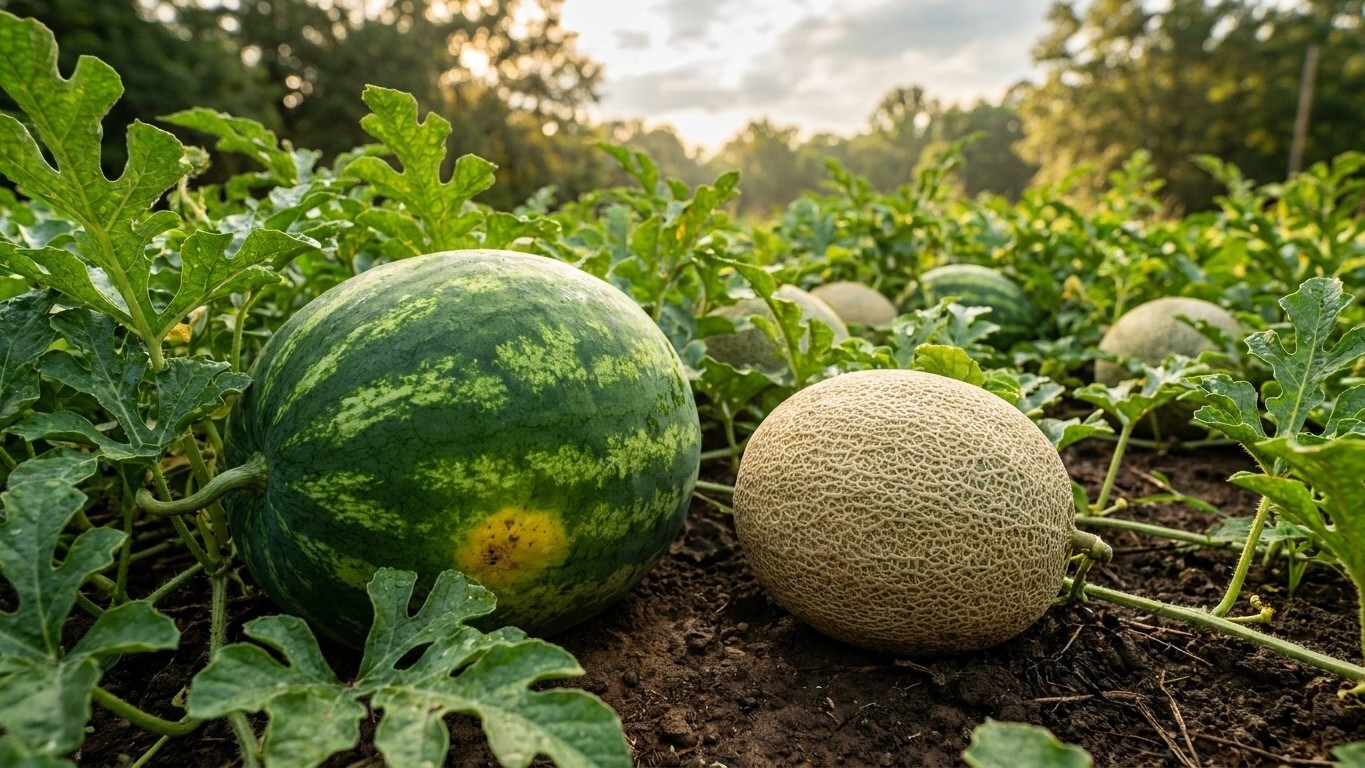

Mississippi’s long, hot season favors heat-loving melons over anything bred for a short northern summer: full-size watermelon and cantaloupe (muskmelon) both finish comfortably here, while thinner-skinned specialty melons and anything without disease resistance tend to struggle against the state’s humidity. The deciding factor isn’t whether there’s enough time to ripen a melon. It’s whether that melon can survive the wet, warm air Mississippi holds onto for months.
The short answer for Mississippi
Start with the calendar. At the Jackson reference station, the last spring frost falls somewhere between March 6 and March 22, and the first fall frost arrives between November 7 and November 22. Even taking the most conservative combination, the latest spring frost date paired with the earliest fall frost date, that’s still roughly 230 frost-free days. Take the earlier spring date and later fall date and the window stretches past 260 days. Either way, that’s a season long enough to finish nearly any melon on the market, including the slow heirloom watermelons that gardeners in shorter-season states have to skip.
That length changes the decision. Instead of asking “will this variety have time to ripen,” Mississippi gardeners should ask “will this variety hold up to the heat and humidity for the extra months it doesn’t strictly need.” The state averages 71.1 days a year at or above 90°F, a heat load that pushes sugar development in melons but also stresses plants during the hottest stretches of July and August. That combination, long season plus heavy heat, rewards vigorous, disease-resistant types over delicate ones.
| Melon type | Typical days to maturity | Fit with Mississippi’s frost-free window | Heat tolerance needed |
|---|---|---|---|
| Icebox watermelon | 70-80 | Comfortable, wide margin | Moderate |
| Full-size/heirloom watermelon | 85-100 | Comfortable even on the conservative 230-day estimate | High |
| Cantaloupe/muskmelon | 75-90 | Comfortable, room for a second planting | High, needs heat to build sugar |
| Honeydew | 95-110 | Fits, but leaves little slack in a cool year | High |
Watermelon is the safest bet for a first-time Mississippi melon grower, precisely because its vigor and vine size give it an edge against disease pressure. Cantaloupe ripens faster and rewards the heat with sweetness, but it needs a variety bred with resistance to powdery mildew and Fusarium wilt to make it through a full Mississippi summer intact. Honeydew works, but its thinner rind and later maturity leave less room for error if disease sets in during August.
What will not work here
Season length isn’t what trips people up in Mississippi. Disease does. The state’s 71.1 annual days above 90°F combine with roughly 14.1 inches of rain across June, July and August, broken down as 4.43 inches in June, 5.02 in July and 4.69 in August, to create a hot, humid environment where fungal and bacterial diseases spread fast. Powdery mildew, downy mildew, gummy stem blight and Fusarium wilt all favor exactly these conditions: warm nights, wet foliage, and vines that stay damp long after a storm passes.
Older heirloom varieties bred in drier growing regions of the country often carry no resistance to these diseases at all. They may have the days to mature in Mississippi’s long season, but they frequently collapse in July or August anyway, wilting from the crown out even while fruit is still sizing. A variety that lists resistance to Fusarium wilt or powdery mildew on the seed packet isn’t a marketing detail here. It’s the difference between a full harvest and a dead vine three weeks before the melons would have ripened.
Spacing matters more than most gardeners expect, too. Planting instructions written for drier or shorter-summer climates often recommend tight spacing to save garden space. In Mississippi, that tight spacing blocks the airflow that dries foliage between rain events, and since summer rain here tends to arrive as a single thunderstorm rather than steady light rain, leaves can stay wet for hours at a stretch. Wider spacing than the seed packet suggests is often the single easiest change that keeps a Mississippi melon patch healthy through August.
Fixed watering schedules fail for a similar reason. A once-a-week watering routine, copied from a drier state’s gardening guide, ignores how Mississippi rain actually falls: unevenly, in bursts, sometimes missing a garden entirely for two weeks and then dumping an inch in an afternoon. Melons watered on a rigid schedule regardless of recent rainfall swing between drought stress and waterlogged roots, and thin-skinned varieties are especially prone to splitting when a heavy rain follows a dry spell.
What changes across Mississippi
Mississippi spans USDA hardiness zones 7b through 9a, a real spread built on one measurement: the average annual extreme minimum winter temperature. That’s a cold-tolerance number, not a growing-season forecast on its own, but it does track loosely with how early spring warms and how late fall frost holds off across the state’s length.
A garden in the northern hill country, closer to zone 7b, sits at the colder end of that range and should expect frost timing closer to the later end of the spring window and the earlier end of the fall window than the Jackson reference station shows. A garden near the Gulf Coast, closer to zone 9a, likely warms earlier in spring and holds off frost later in the fall than Jackson’s numbers suggest, and probably logs more of those 90°F-plus days than the state average implies.
There is no single frost date or heat count for “Mississippi.” The state’s own range says as much. A gardener anywhere between the hill country and the coast should treat the Jackson figures as a middle reference point, not a personal forecast, and check the USDA Plant Hardiness Zone Map for exactly where their county falls within that 7b-9a spread before betting a planting date on it.
Where to check this for your own county
Mississippi State University Extension runs the state’s official planting guidance, and it’s the next stop for anyone deciding between varieties.
Two things are worth pulling from that site before planting. First, the local planting calendar for the specific county, which adjusts for how much earlier or later that county’s frost dates run compared to the Jackson reference figures used on this page. Second, any list of melon varieties the extension office has actually trialed in that county’s soil and climate, which carries more weight than a general statewide recommendation because it’s been tested against the real disease pressure and rainfall pattern of that specific ground.
This page answers the question at the state level, using one reference station’s frost data and one set of statewide heat and rainfall normals. A county extension recommendation is built from closer, more local observation, and it should win every time the two disagree. Mississippi’s spread across three hardiness zones is exactly why that county-level check matters more here than in a smaller, more uniform state.
Checking this against your own garden
None of the numbers above beat what’s happening in the actual soil of a specific garden. Three things to watch tell more than any calendar date.
Soil warmth by feel is the first. Melon seed germinates poorly in cold soil no matter what the calendar says, so pushing a bare hand two or three inches into the planting bed and feeling for warmth, not just the absence of frost, gives a better read than counting days from the last frost date. Cool, damp soil that feels cold to the touch means waiting, even if the date on the calendar has already passed.
The first flush of male flowers is the second. Melon vines produce male flowers before female ones, often by a week or two, and a garden that’s slow to show that first flush is signaling that the plant hasn’t hit the heat and light levels it needs yet, regardless of how far along the calendar season is.
The appearance of the first true leaves, the second set that emerges after the rounded seed leaves, marks the point where a seedling has shifted from surviving on stored seed energy to actually photosynthesizing on its own. Vines that stall here, staying stuck on seed leaves for an unusually long stretch, are usually reporting a microclimate that’s cooler or wetter than the county average, worth noting for next year’s planting date in that same bed.