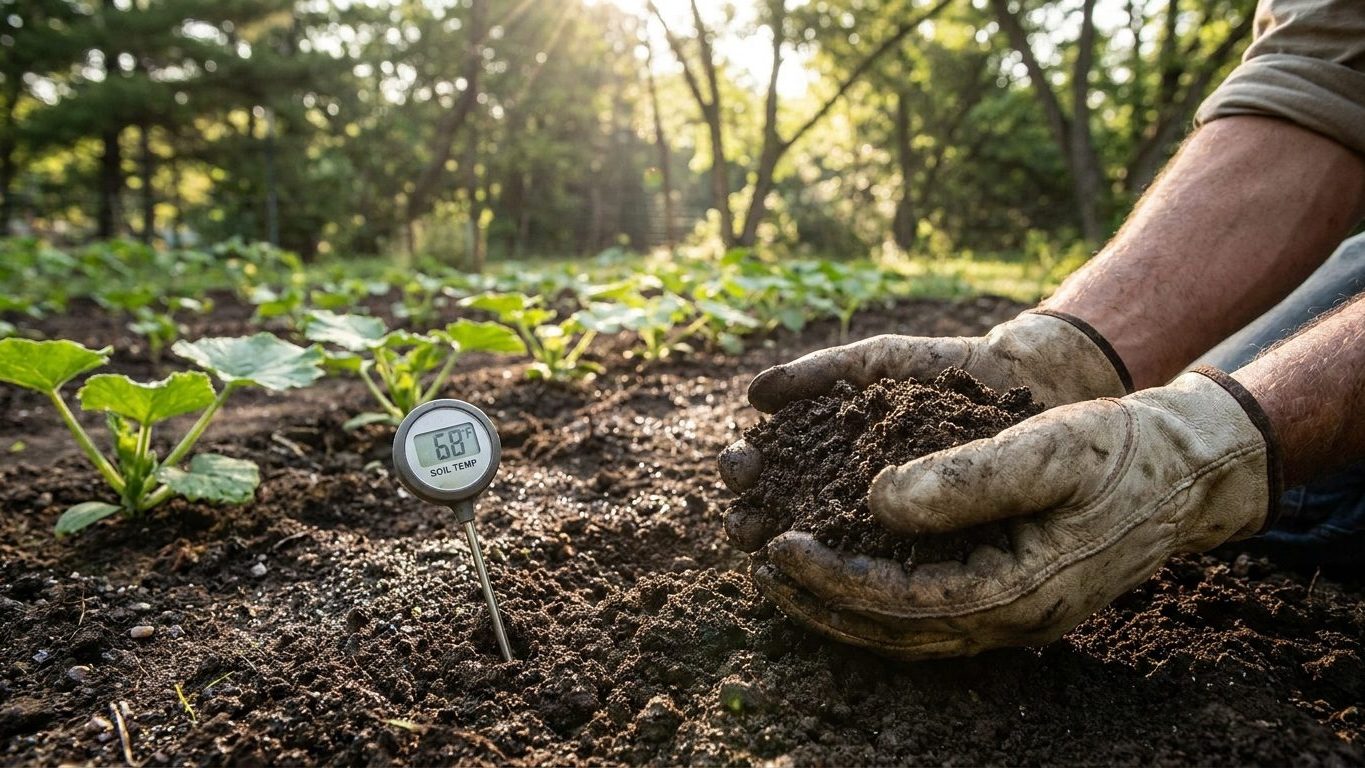

Winter squash goes into Mississippi soil after the last frost risk has passed, generally from late March through the first half of June if you want a second succession planting. The state’s frost dates and summer heat load are what actually draw the boundaries of that window, not a generic calendar date.
The short answer for Mississippi
The reference weather station used for Mississippi’s climate normals shows a 30 to 70 percent probability band for the last spring freeze running from March 6 to March 22. That’s not a single date you circle on the calendar. It’s a range describing when a 32F freeze becomes unlikely enough to risk seed or transplants. Sow before March 6 and you’re gambling against real odds of frost. Wait until after March 22 and you’ve almost certainly missed any lingering cold, though a late-season snap outside that window isn’t impossible, just statistically rare at this station.
On the other end, the same station’s data puts the first fall freeze between November 7 and November 22. That gives Mississippi gardeners a working season of roughly 230 to 260 days between the two probability bands, depending on where in each range the actual year falls.
Winter squash needs time. Most varieties, from acorn to butternut to hubbard, run 80 to 110 days from seed to a cured, storable fruit. Run the math against the frost window and a mid-March to mid-April sowing gets a plant to harvest well before the first fall freeze, with margin left over for curing on the vine. Push a sowing to late June and you’re cutting it close on the slower varieties, especially if fall arrives on the early side of that November 7 to 22 band.
That’s the practical answer: plant after the local last-frost date has passed with reasonable confidence, choose a variety whose maturity length fits comfortably inside the season you have left, and treat mid-June as the last realistic sowing date for anything but the fastest-maturing types. The reference station’s numbers are a starting point, not a guarantee for every county, and that distinction matters more in Mississippi than the frost dates alone suggest.
What will not work here
A short growing season isn’t Mississippi’s problem. With roughly 230 to 260 days between frost bands, there’s more room here than in most northern states, and the slowest-maturing winter squash varieties aren’t automatically ruled out the way they would be somewhere with a 150-day season. What defeats gardeners in Mississippi is heat and moisture working together, not the calendar running out.
The reference station averages 71.1 days a year at or above 90F. That’s not a handful of hot afternoons. That’s more than two months of the year spent above 90 degrees, concentrated in the exact stretch when squash vines are flowering, setting fruit, and trying to size that fruit up before fall. Heat that intense drives water demand hard, and a plant watered on a once-a-week schedule, the kind that works fine in a milder climate, will show stress, dropped blossoms, and stunted fruit here. Squash grown on a casual watering routine in Mississippi’s peak summer heat is a common way to lose a crop that looked fine in June.
Rainfall complicates this rather than solving it. Summer brings about 14.1 inches of rain across June, July and August, with June the driest of the three at 4.43 inches, July at 5.02, and August at 4.69. That’s a fair amount of water on paper, but it rarely falls evenly. A good chunk of it arrives as heavy thunderstorms that run off rather than soak in, especially on clay soils common across much of the state. The result is a garden that can swing between drought stress and waterlogged roots within the same week, and winter squash handles neither extreme well.
That combination, heavy heat load plus humid, storm-driven rainfall, is also what makes tight spacing a mistake here in a way it wouldn’t be in a drier climate. Vines planted close together trap humidity around the leaves, and powdery mildew and other fungal issues move fast through a squash patch once that microclimate sets up. Wider spacing than a seed packet written for a drier region might suggest, and airflow between plants, matters more in Mississippi’s summers than it does further north or west.
What changes across Mississippi
Mississippi spans USDA hardiness zones 7b to 9a, a range built on one measurement, the average annual extreme minimum temperature. That’s a meaningful spread inside a single state, and it maps roughly onto the difference between the hill country in the north and the Gulf Coast counties in the south.
A gardener near the northern edge of that range, in zone 7b territory, should expect a later last frost and an earlier first fall frost than the reference station’s March 6 to March 22 and November 7 to November 22 bands suggest, since those figures come from a single station and don’t represent the entire state. Add another week or two of buffer on both ends if you’re gardening well north of the reference city, or at any meaningful elevation, since colder air pools in low spots and at higher ground the growing season simply runs shorter.
Toward the southern end, in zone 9a along the coast, the opposite pressure applies. Frost arrives later in fall and leaves earlier in spring, stretching the usable season beyond what the reference station’s numbers show. That opens the door to sowing slightly earlier than March and pushing a second succession planting later into the summer than gardeners further north could risk.
There’s no single planting date that fits both ends of that zone range honestly, and a page like this one, built on statewide and single-station data, can’t tell an individual reader which zone their own yard falls into. What it can do is point out that the spread exists and that it’s large enough to shift a sowing date by two weeks or more depending on where in Mississippi a garden sits. The right move is checking the USDA Plant Hardiness Zone Map directly for a specific address, then adjusting the frost-date guidance in this article toward the earlier or later end depending on which zone that address lands in.
Where to check this for your own county
Everything above comes from a single reference weather station and a statewide hardiness zone range. That’s useful for understanding the mechanics of when winter squash can go in the ground, but it’s not a substitute for county-level guidance, and Mississippi has an extension service built specifically to fill that gap.
The Mississippi State University Extension Service publishes planting calendars and variety recommendations trialed against local conditions rather than a single airport station’s climate normals. That distinction matters more than it sounds. A recommendation built from decades of variety trials in a specific county accounts for local soil types, microclimates, and disease pressure in a way a statewide frost-date range simply can’t.
What to look for once there: a county-specific vegetable planting calendar, which will give sowing windows adjusted for that county’s actual frost history rather than the single-station data used above, and any variety trial results for winter squash, which will flag which types have held up against local disease pressure, humidity, and heat load in real garden conditions rather than on paper. Extension offices also field direct questions from county residents, and a phone call to a local office often surfaces guidance that’s never been published as a formal calendar at all.
The statewide picture includes the reference frost dates, the heat and rainfall numbers that explain why certain approaches fail, and the hardiness zone spread that separates the north of the state from the coast. A county extension recommendation will always beat that statewide picture, because it’s built from data specific to the ground a reader is actually planting in. Treat this article as the starting framework and the county extension office as the adjustment layer that makes it accurate for a specific address.
If you follow the almanac, here is when to plant winter squash by the moon. It is a tradition, not a proven method.
Checking this against your own garden
Frost-date ranges and hardiness zones describe averages. A reader’s own garden, checked directly, outranks all of it, and three simple observations tell more than any date on a calendar.
Soil warmth by feel is the first. Winter squash seed sits and rots in cold, wet soil rather than germinating, regardless of what the calendar says. Push a finger a couple of inches into the planting bed. If it feels cool and damp rather than warmed by a few consecutive sunny days, the soil hasn’t caught up to the season yet, even if the frost-date window on paper says it’s time to sow.
The first flush of male flowers is the second. Squash plants produce male blossoms before female ones, and a garden that’s pushing out male flowers early, ahead of typical timing for the variety, is signaling a warmer-than-average microclimate, the kind found in a sheltered, south-facing spot or against a heat-holding wall. That’s useful information for deciding whether to push a second succession sowing earlier than the statewide guidance would suggest.
The first true leaves, the ones that emerge after the initial seed leaves and actually look like squash foliage, are the third. Slow, stunted true-leaf development after germination usually points to soil that’s still too cool or nights that are dipping lower than the reference station’s data implies for that specific plot, often because of a low spot where cold air pools overnight. A garden sitting in a natural cold pocket will consistently run behind the frost dates cited for the wider region, and repeated seasons of slow true-leaf growth are the clearest sign that a plot needs its own, later start date than the county or state average recommends.