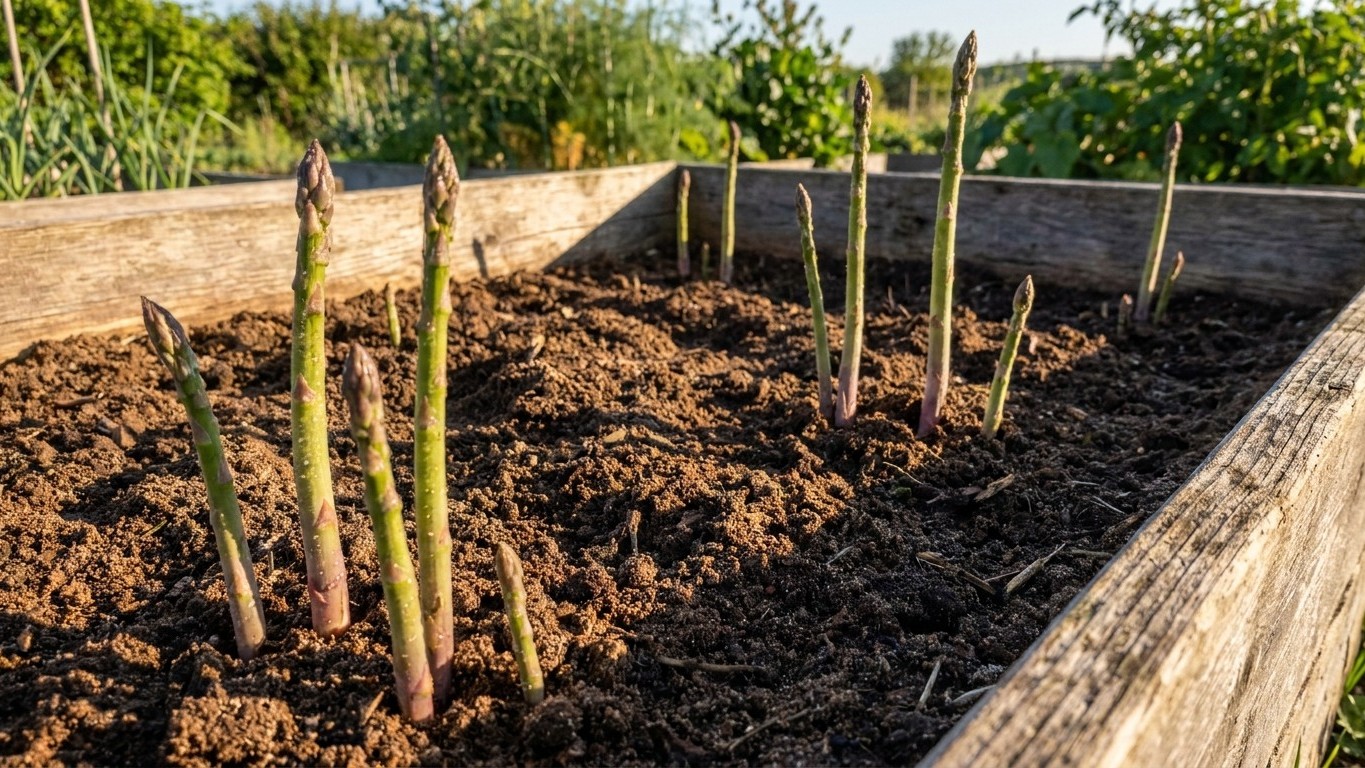

Yes, in most parts of Missouri, the ground under a new asparagus bed will hold up for the full run: ten to fifteen years of harvests before you’d ever need to start over. The state’s representative soil, the Menfro series, drains well, which is the only soil condition asparagus actually asks for. But that’s a statewide average, not your backyard. Whether your own patch drains the same way depends on where you dig, and that’s worth checking before you commit a corner of the yard for over a decade.
The short answer
Asparagus is unusual among garden crops in how little it demands from the ground it’s planted in. Utah State University Extension puts it plainly: most soils will work, provided they are well drained. That single condition matters more here than almost anywhere else in the vegetable garden, because this is the one crop where the gardener picks a spot and lives with the choice for ten to fifteen years. A heavy, slow-draining patch is an annual headache with tomatoes or beans. With asparagus, it’s a decade-long problem you can’t rotate away from next season.
Missouri’s representative soil, the Menfro series, is what the USDA lists as the state’s typical ground. It’s a loam-to-silt profile: about 4 percent sand, 19 percent clay, and 77 percent silt, sitting over moderate fertility with roughly 2.0 percent organic matter. Officially, it’s well drained. That’s a reasonable starting point for a lot of Missouri gardens, especially the loess-covered hill country the series is mapped across. But it’s a state average pulled from 319 sampled components, not a reading of your particular bed. River bottoms, clay-pan ground, and anything a builder has compacted or filled will behave nothing like it.
The practical test isn’t a soil name, it’s water. Dig a hole roughly a foot deep, fill it, and watch how long it takes to empty. If it’s gone within a few hours to a day, you’re in Menfro territory or something close to it, and an Asparagus Bed can go straight into the ground. If water is still sitting there the next morning, that spot will drown crowns over time, no matter how good the soil looks on paper. The fix isn’t complicated: build a raised bed eight to ten inches deep, or work in enough compost to open up a tight clay layer before planting, or simply pick different ground.
The other half of the fifteen-year commitment is patience. There’s no harvest at all in the first two years. Year three brings a short four-week cutting window. Year four stretches to six weeks. From year five on, established beds can be harvested for about eight weeks each spring. The stopping point every year isn’t a date on the calendar, it’s the spears themselves: once most of what’s coming up is thinner than a pencil, harvest stops for the season so the plant can rebuild its root reserves for next year.
Will the summer here water it for you?
Rainfall does most of the heavy lifting for an Asparagus Bed, but not all of it, and the amount it needs changes as the planting matures. Here’s how Missouri’s summer normals stack up against what the crop asks for.
- Years one and two, the establishment phase: the bed wants 1 to 2 inches of water every other week. Spread across a summer month, that works out to roughly 2 to 4 inches a month of combined rain and supplemental watering.
- June supply: the region averages 5.25 inches of rain in June, comfortably above the establishment target on paper. In practice, June rain tends to arrive in a handful of storms rather than evenly, so a two-week dry stretch mid-month can still leave a young bed thirsty even in a wet-looking month.
- July supply: July averages 4.58 inches, right at the upper edge of what a newly planted bed needs. This is the month to start watching the forecast rather than assuming the sky will cover it.
- August supply, the tight month: August is the driest of the three at 4.24 inches, sitting at the low end of the establishment target. Combine that with the higher evaporation of late-summer heat, and a first- or second-year bed will very likely need a supplemental soak or two in August, particularly if the month runs a spell of 90-degree days.
- Year three and beyond, established beds: the water requirement drops to 1 to 2 inches every three weeks, or roughly 1.3 to 2.6 inches a month. Against Missouri’s summer normals of 14.1 inches spread over June through August, an established bed’s needs are usually met by rainfall alone, with dry Augusts being the exception rather than the rule.
- The variable no normal can tell you: these are 1991-2020 averages for one reference station, not a forecast and not a reading of your own yard. A rain gauge stuck in the ground next to the bed is the only way to know, week to week, whether nature covered it or you need to run a hose.
When to put the crowns in
Asparagus crowns go into the ground in early spring, planted about 8 inches deep in a furrow. In Missouri, that window sits around the region’s last spring frost, which the National Centers for Environmental Information’s 1991-2020 normals place between April 6 and April 20 for the reference station used for these figures. That station sits well north of the metro area itself; the downtown station in that same region tends to run about five days earlier in spring, and southern Missouri is milder still. Treat the April 6-to-20 window as a starting point to check against your own local frost history, not a fixed date to circle on the calendar.
The planting itself isn’t a one-and-done job. Crowns go into the bottom of that 8-inch furrow and get an initial light covering of soil, then the furrow is filled in gradually across the growing season, about 2 inches every other month, rather than backfilled all at once. That gradual fill lets the emerging shoots keep pace with the rising soil level instead of getting buried under a full 8 inches of dirt on day one.
Utah State University Extension names four varieties commonly available to home gardeners, and the only distinguishing detail it publishes for any of them is sex, not flavor, not yield, not a reason to prefer one over another.
| Variety | Sex |
|---|---|
| Jersey Giant | All-male |
| Jersey Knight | All-male |
| UC 157 F1 | Male and female |
| Purple Passion | Male and female |
Crowns are the standard route because they save a full year of growing compared with starting from seed. The seed alternative exists and some gardeners use it, but it trades a faster start for extra time: seed-started plants need a season of growth before they’re large enough to move into the furrow as crowns of their own. For a bed meant to produce for a decade or more, that one-year difference is a small trade-off against the whole timeline, but it’s worth knowing before you order either crowns or a seed packet.
Common questions
Does Missouri’s soil pH work for asparagus?
The Menfro series runs a surface pH of about 6.2, slightly acid, but that’s a statewide reference value, not a reading of your garden, and the Utah State University Extension guidance on asparagus doesn’t publish a pH requirement at all. The only reliable way to know your bed’s pH is a soil test through your local extension office.
Do I need to worry about winter cold killing established crowns?
That’s not addressed in the available guidance. There’s no published winter chilling requirement for asparagus, and a hardiness zone rating isn’t the same thing as a chilling figure, so no specific cold threshold is given here.
How do I know exactly when to stop cutting spears each spring?
Not by counting weeks. Stop harvesting for the season once most of the spears coming up are thinner than a pencil. That’s the plant’s signal that it needs to shift its energy into growing fern, not spears, to rebuild the crown for next year.
What if my soil test shows poor drainage?
Since drainage is the one non-negotiable requirement for asparagus, a bed that doesn’t drain needs either a raised structure eight to ten inches deep or heavy amendment with organic matter before planting, or simply a different spot in the yard. Given the fifteen-year timeline, it’s worth fixing before the crowns go in the ground, not after.