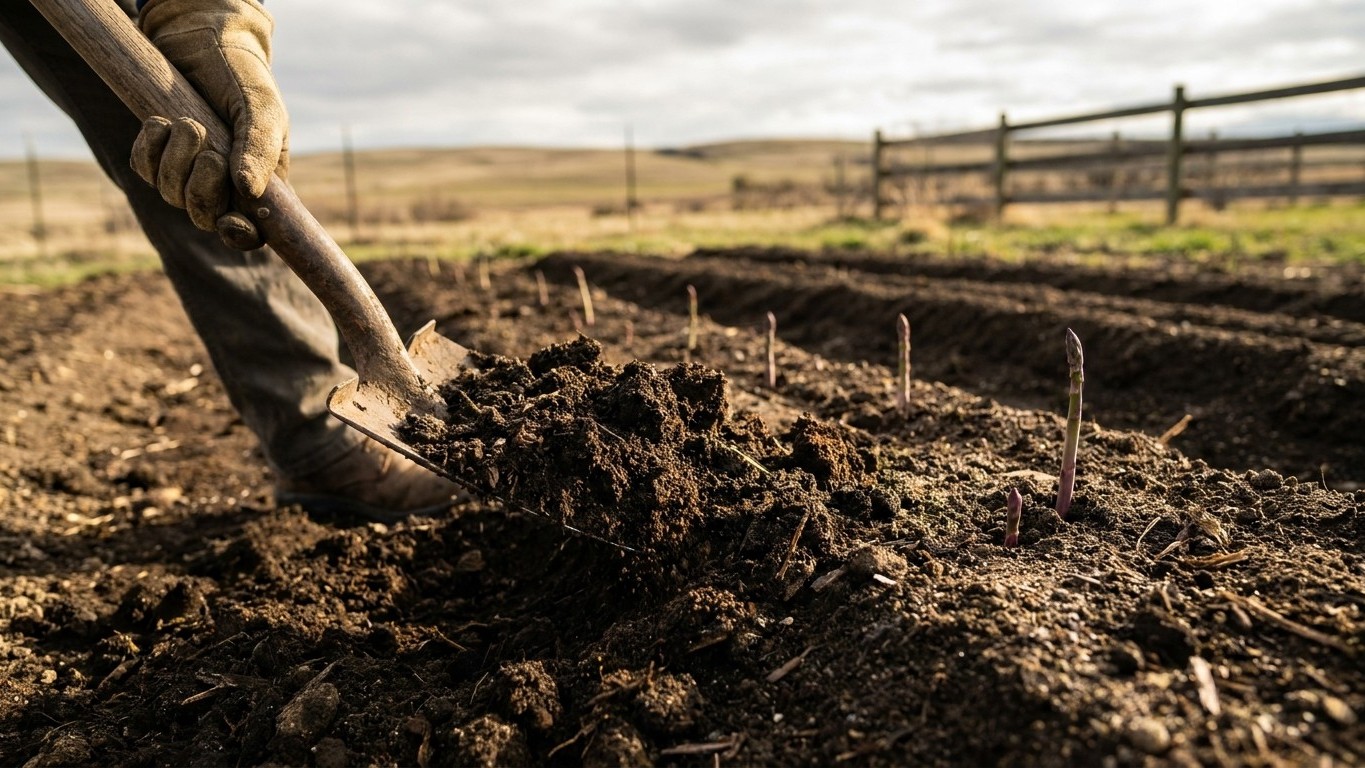

An asparagus bed in Missouri is a fifteen-year bet on one patch of dirt, and the return on that bet depends almost entirely on drainage, which is why the question of Will Missouri Soil Hold an Asparagus Bed for Fifteen Years? is worth answering before a single crown goes into the ground. Crowns go into the ground in early spring, the first cutting waits until year three, and after that the same rows can feed a household for a decade or more, no replanting required.
The short answer
Ten to fifteen years is the production window Utah State University Extension gives for an established asparagus bed, and the crop’s only real soil demand, according to that source, is that the ground drains. Not fertility, not a particular pH, not a specific texture. Just drainage. That single condition matters more here than it would for almost anything else grown in a home garden, because a tomato bed that drains poorly is next year’s problem to fix. An asparagus bed that drains poorly is a problem you live with for over a decade, since the crowns aren’t coming back out, which is why getting the drainage sorted before When to Plant Asparagus Crowns in Missouri matters more than most other planting decisions.
Missouri’s representative soil, the series USDA lists to stand for the state, is the Menfro. It’s an Alfisol, a forest soil of moderate fertility that holds nutrients reasonably well, with a texture that runs 4 percent sand, 19 percent clay and 77 percent silt at the surface, an organic matter content around 2.0 percent, and a surface pH near 6.2, slightly on the acid side. USDA classifies it as well drained. On paper, that’s a workable match for a bed meant to sit undisturbed for fifteen years.
But the Menfro series is a statement about what Missouri’s ground tends to do, not a reading of the particular patch behind any one house. A state this size holds hundreds of mapped soil series, and river bottoms, hill country, and any lot a builder has cut, filled, or compacted during construction can behave nothing like the representative profile. The organic matter figure above is a surface-horizon average for the series as mapped, not a measurement of a cultivated bed, so it isn’t a number to garden by directly either.
If a soil test or simple observation shows standing water after rain, or a shovel that hits gray, mottled subsoil, the fix isn’t to abandon asparagus. It’s to raise the bed. Mounding the rows six to eight inches above grade, or building a framed raised bed filled with a better-draining mix, solves the drainage question without needing to relocate the whole garden. Given that the plant won’t be harvested at all for its first two full seasons and only starts producing in year three, getting the drainage right before planting is the one decision this crop doesn’t forgive after the fact.
Will the summer here water it for you?
The target the crop asks for is specific: 1 to 2 inches of water every other week for the first two years while the crowns establish, easing back to roughly every three weeks once the planting matures. Missouri’s summer rainfall, measured at the reference station behind NOAA’s 1991-2020 normals, doesn’t line up with that schedule as neatly as it might seem.
- What the bed asks for: 1 to 2 inches every other week through the establishment years, so roughly six to seven waterings across a thirteen-week summer if none of it fell as rain.
- What the season actually delivers: about 14.1 inches of rain across June, July and August combined, out of 39.3 inches for the year, at the reference station.
- Month by month: June averages 5.25 inches, July 4.58 inches, and August, the driest of the three, just 4.24 inches.
- Where the gap opens: a full-summer total near 14 inches can cover the low end of the bed’s water requirement, but rain doesn’t fall on a two-week schedule. It arrives as thunderstorms that dump an inch in an afternoon and run off before it soaks in, then leaves stretches of a week or two with nothing.
- The practical read: August, as the driest month on record for this station, is the stretch most likely to need a hose even in a bed old enough that watering has eased to every three weeks.
None of this is a forecast, and it isn’t a reading of any one yard. These are normals for one reference station over a thirty-year period; a rain shadow, a slope, or a paved lot nearby changes what actually falls on a given garden. A rain gauge staked next to the bed is the only way to know, in a given week, whether the sky handled it or the hose needs to.
When to put the crowns in
Early spring is when crowns go into the ground, set into furrows about 8 inches deep. Anchored to the reference station’s normals, the last spring frost in this area falls somewhere around April 6 to April 20, and that’s a thirty-year average, not a promise for any given year. It’s also worth knowing that this reference station sits well north of the city core; the downtown station tends to run about five days earlier in spring, and southern Missouri, in general, trends milder still. “Around” is doing real work in that date range.
Once the crowns are set, the furrow isn’t filled in all at once. It’s backfilled gradually across the season, roughly two inches of soil added back every other month, rather than burying the crowns immediately at full depth.
For gardeners who’d rather start from seed instead of buying crowns, that route exists, but the university guidance behind these figures centers on the crown method and doesn’t detail the extra time or steps the seed route typically involves. Worth flagging plainly rather than guessing at.
On variety, four are named in that same Utah State University Extension guidance, distinguished only by sex, nothing else: Jersey Giant and Jersey Knight are all-male; UC 157 F1 and Purple Passion are male and female. No flavor comparison, no yield figures, no stated reason to prefer one over another appears in that source, so none should be invented here. No nursery is named either.
Then comes the wait built into the crop: no harvest at all in year one or two. Year three brings the first cutting, typically a four-week harvest window, which extends to about six weeks the following year and roughly eight weeks in years after that. The rule for when to stop each season isn’t a date on a calendar, it’s a visual cue: stop cutting once most of the spears coming up are running thinner than a pencil. That signals the plant needs to put its energy back into the crown rather than into spears, and it’s the same rule whether that point arrives in late May or the middle of June.
Checking this against your own county
A state-level soil series and a single reference station’s frost dates are a starting point, not a verdict on one backyard. The reader’s own county sits somewhere on a spectrum this article can’t capture: closer to a river with heavier, slower-draining clay, or up on a ridge with soil that drains faster than the Menfro average and dries out sooner in August.
University of Missouri Extension, at extension.missouri.edu, is the named resource for settling both questions locally. County offices there can run or interpret a soil test for actual drainage and pH on a specific lot, and they carry frost-date guidance tuned closer to the local area than a single statewide reference station can offer. Before committing a bed to Fifteen Years in One Spot, that local check is the step that turns a state-level estimate into a garden-specific answer.
Common questions
Can asparagus grow in Missouri’s clay soils?
It can, provided the bed drains. Heavy clay that holds standing water after rain is the condition to correct before planting, typically by raising the bed, since drainage is the one soil requirement the extension guidance behind these figures actually specifies.
Why does asparagus take three years before the first harvest?
The crowns spend the first two seasons building root reserves. Cutting spears too early would pull energy away from that establishment period, which is why the guidance calls for no harvest at all until year three.
Does soil pH matter for asparagus in Missouri?
The Utah State University Extension source behind these figures is silent on pH requirements for the crop, so no target number is given here. A county extension soil test is the way to learn a specific bed’s actual pH.
How do I know when to stop harvesting each spring?
Watch the spears, not the calendar. Once most of what’s coming up is thinner than a pencil, it’s time to stop cutting for the season and let the plant grow into ferns.