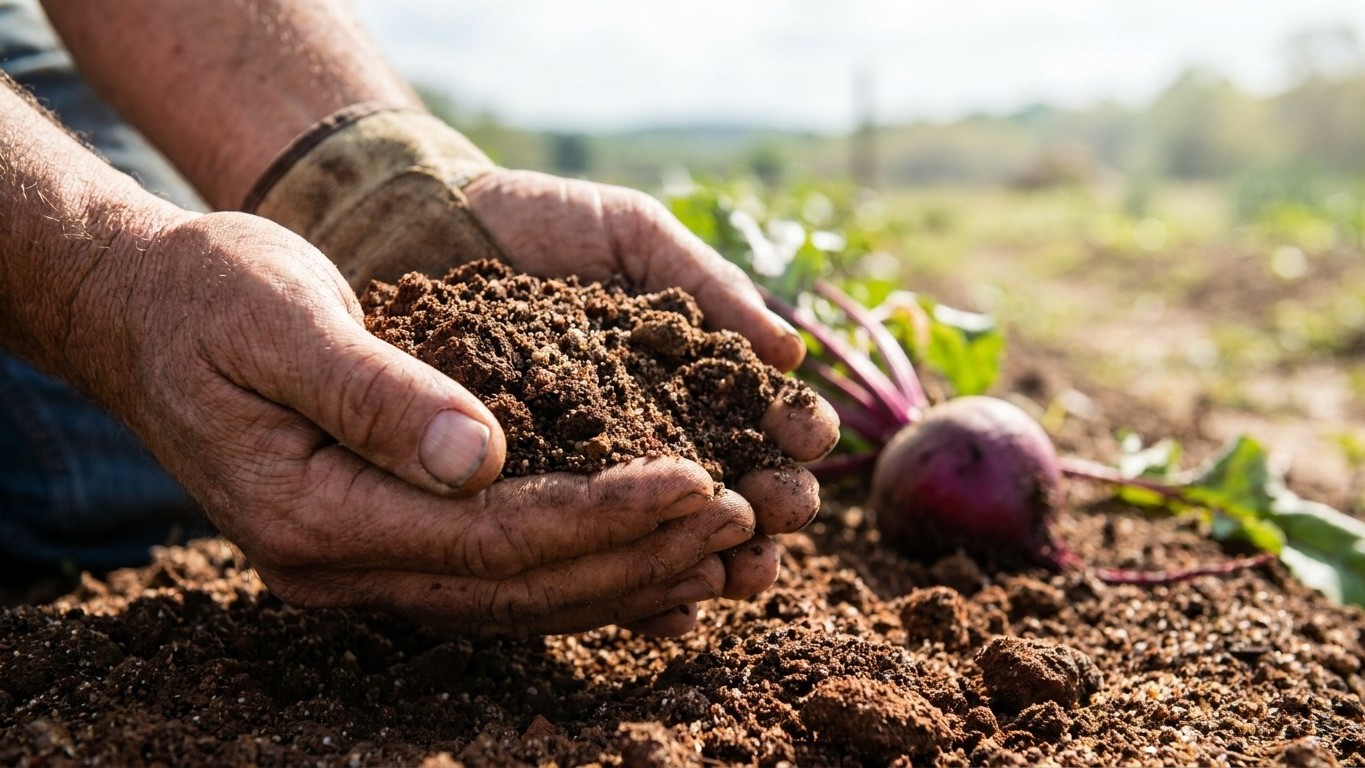

The soil that represents Missouri, the Menfro series, is a well-drained silt loam with just enough clay to hold nutrients but not enough to choke a taproot. That’s a reasonable starting point for beets. The harder problem is timing: the six weeks after sowing land squarely in a Missouri spring that swings between soggy and bone-dry, and that’s where most beet crops here actually fail, not in the ground itself.
The short answer
Menfro is an Alfisol, a forest-derived soil, and its surface horizon runs about 4 percent sand, 19 percent clay and 77 percent silt, which puts it firmly in silt loam territory. It’s well drained, with a surface pH around 6.2, slightly on the acid side, and organic matter near 2.0 percent. None of that is bad news for a beet. Utah State University Extension’s guidance on beets is straightforward: they want deep, sandy, well-drained soil rich in organic matter, worked with no more than 1 inch of composted material per 100 square feet. Menfro’s texture leans siltier than the “sandy” ideal, which means it can crust after a hard rain and compact under foot traffic more readily than a true sandy loam. A beet root pushing through that crust doesn’t stop growing, but it forks or thickens unevenly more often than it would in looser ground.
The pH sits close enough to neutral that most gardeners won’t need to adjust it much, though a beet still prefers a touch higher, closer to neutral than 6.2. The organic matter figure, about 2.0 percent, is a modest number for a cultivated bed, and it’s exactly the kind of thing a season or two of compost addition can move in the right direction, staying within that 1-inch-per-100-square-feet ceiling so the bed doesn’t end up too rich in nitrogen at the expense of root growth.
What Menfro doesn’t tell you is how hot the growing season runs, and that matters as much as texture. The Utah State guidance is specific: heat above 85 F combined with water stress is what turns a beet root woody. A precise count of days above 90 F for a Missouri reference city isn’t part of the sourced data here, so it won’t be guessed at. What can be said plainly is that Missouri summers reach that 85 F threshold with enough regularity that a beet crop timed to mature during the hottest stretch of the season is taking a real risk, water stress or not.
Missouri spans hundreds of distinct soil series, from river-bottom silt to rocky hill-country ground to whatever a builder left behind after grading a new subdivision. Menfro is the state’s representative soil, not a description of any one backyard. Treat it as a baseline for what silt-heavy Missouri ground tends to do, then pull a soil test for the actual bed before making decisions about lime, sulfur or how much compost to add.
The six weeks that decide it here
Beets go in the ground directly, not as transplants, and the standard advice is to sow 2 to 3 weeks before the last frost. NOAA NCEI’s 1991-2020 climate normals put that last spring freeze, the 30 to 70 percent probability band for 32 F, between April 6 and April 20 at the reference station. That puts a typical sowing window somewhere in the back half of March into early April, which means the first six weeks of a beet’s life in Missouri run through the tail end of winter’s freeze risk and straight into the state’s most unpredictable stretch of weather.
That caution matters more than it looks. The station behind that April 6 to April 20 window sits north of the metro area it represents; the downtown station typically runs about five days earlier in spring, and southern Missouri warms up sooner still. A gardener in the Bootheel or the Ozarks is working with a different six-week window than one near the Iowa line, and neither matches the reference date exactly.
Missouri spring doesn’t hold a single pattern from year to year. It’s a continental climate prone to swings, a soaking week followed by a dry stretch, sometimes a late cold snap after a run of warm days that fooled everyone into planting early. That volatility is the real threat to a beet’s first six weeks, because Utah State’s research points to something specific: water stress during that early window is what triggers premature flowering, or bolting, in a beet. A root that bolts stops building sugar and size and instead throws energy into a flower stalk, and there’s no fixing it once it starts.
The practical takeaway is that the calendar date matters less than watching the ground. A beet bed that dries out hard during a rainless stretch in that first month and a half is far more likely to bolt than one kept evenly moist, regardless of whether the six weeks fall in late March or mid-April. Mulching lightly to buffer soil moisture swings, and checking the bed rather than the calendar, does more for a Missouri beet crop than any fixed sowing date can.
What goes wrong here
- Bolting from an early dry spell. A Missouri spring that turns dry for even a week or two during those first six weeks after sowing can push beets into premature flowering. Utah State’s research is clear that this is a water-stress response, not a heat response. The remedy is consistent moisture from the day of sowing, not just once seedlings are up, since the risk window starts at germination.
- Crusting on the silty surface. Menfro’s high silt content, 77 percent in the surface horizon, means a hard rain right after sowing can seal the top of the bed into a crust that small beet seedlings struggle to push through. Raking a light layer of compost or fine mulch over the row after sowing keeps the surface from sealing.
- Woody roots from late-season heat plus dryness. This is a separate failure from bolting, tied to the maturing root rather than the young seedling. Once temperatures climb past 85 F, a beet under water stress builds fibrous, woody tissue instead of tender root. This is a distinct problem from early bolting, and it calls for steady watering through the back half of the growing season, not just the first six weeks.
- Forked or misshapen roots in compacted ground. Silt loam like Menfro can compact under foot traffic or heavy equipment, and a beet root meeting resistance below the surface tends to split or curl rather than push straight down. Working the bed to a full spade’s depth before sowing, and staying off it once seeds are in, avoids most of this.
- Slow starts in acid, low-organic-matter ground. At a surface pH near 6.2 and organic matter around 2.0 percent, Menfro isn’t hostile to beets, but it isn’t generous either. An inch of compost per 100 square feet worked in ahead of sowing, per Utah State’s guidance, gives seedlings a stronger start without over-feeding the bed.
Common questions
Does Missouri’s state soil mean my beets will do well without amendment?
Not automatically. Menfro is a moderately fertile, well-drained silt loam, which is a workable base, but its organic matter, about 2.0 percent, and its silt-heavy texture mean most beds benefit from up to 1 inch of composted organic matter per 100 square feet, per Utah State University Extension. And Menfro is only representative of the state broadly; an actual garden plot may sit on entirely different ground.
When should beet seeds go in the ground in Missouri?
The general rule is 2 to 3 weeks before the last spring frost. NOAA’s 1991-2020 climate normals place that date between April 6 and April 20 for the reference station, with the actual date running earlier downtown and earlier still farther south in the state. Beets are direct-sown, so this window applies to seeding, not to setting out transplants.
Is bolting the same problem as woody roots?
No, and treating them the same is a mistake. Bolting is a response to water stress during the first six weeks after sowing, when the plant is still young. Woodiness comes later, when heat above 85 F combines with water stress on a maturing root. Both come from dryness, but at different stages, and both call for consistent watering across the whole season, not just at the start.
Are certain beet varieties better suited to Missouri conditions?
Utah State University Extension names varieties in its beet guidance but doesn’t attach season length, color or use to any single one, so no variety can be recommended here as better suited to Missouri’s soil or climate based on that source. What matters more than variety choice is managing water through both risk windows, the early weeks and the late heat.