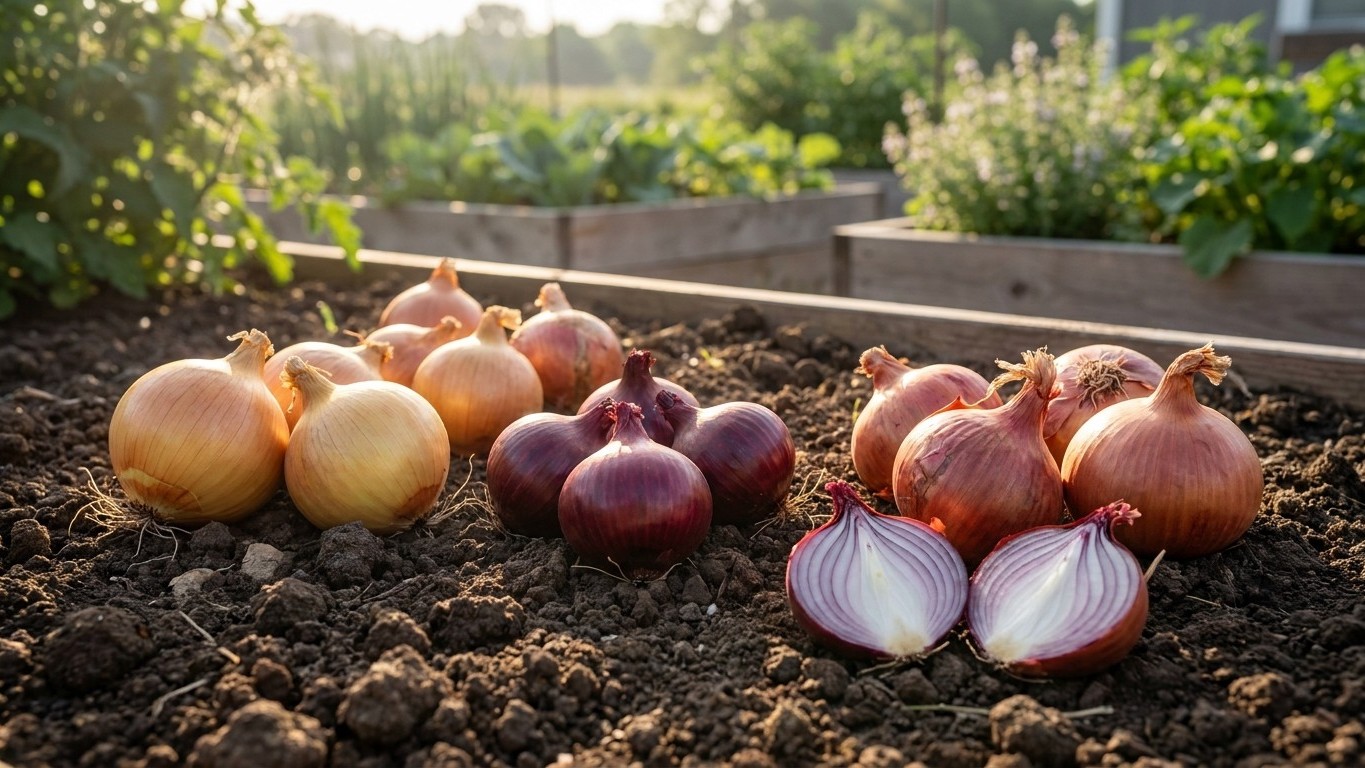

Missouri’s reference weather station sits at 39.30°N, and on the longest day of the year that spot logs 14 hours and 46 minutes of daylight. That single figure decides which onions will actually form bulbs here, because onions respond to day length, not to heat, when they switch from growing leaves to growing a bulb. At this latitude, intermediate-day and long-day varieties are the right call. Short-day onions, the ones that dominate Gulf Coast gardens, are the wrong choice almost everywhere in the state.
The short answer for Missouri

Onions are split into three groups based on how much daylight triggers bulbing: short-day types start at around 12 hours, intermediate-day types need roughly 12 to 14 hours, and long-day types wait for 14 to 16 hours before they’ll bulb at all. Missouri’s 14 hours 46 minutes on the June solstice clears the short-day threshold with room to spare and lands squarely in the window that satisfies both intermediate-day and long-day varieties. That’s why the state supports a wider range of onions than either the Deep South or the northern tier of states.
Eighteen documented varieties have a published latitude range that covers 39.30°N, split fairly evenly between the two groups that work here.
Long-day varieties that fit
- Ailsa Craig
- Barolo
- Blush
- Bridger
- New York Early
- Patterson
- Rossa di Milano
- Walla Walla Sweet
Intermediate-day varieties that fit
- Cabernet
- Calibra
- Candy
- Elsye
- Expression
- Monastrell
- Red Long of Florence
- Red Long of Tropea
- Scout
- Sierra Blanca
Any of these eighteen is a reasonable starting point for a Missouri garden. The choice between the two groups comes down to what you want out of the harvest, which is the subject of a later section here.
What will not work here
Ten varieties on record simply don’t match this latitude, and they fail for two opposite reasons. One group bulbs too early because the day length trigger arrives while the plant is still small. The other group never bulbs at all because the day here never gets long enough to flip the switch.
Too far south for this latitude
Short-day onions are bred for latitudes well below 39.30°N. Planted in Missouri, they hit their 12-hour trigger early in the season, before the plant has built much leaf mass, and that leaf mass is what becomes the bulb. The result is a tiny onion, not a delayed one.
- Gabriella (20-35°N) — bulbs while the plant is still undersized this far north
- Madalyn (20-35°N) — same early-trigger problem, small bulbs guaranteed
- Red Rock (30-36°N) — misses Missouri’s latitude even at the state’s southern tip
- Red Sensation (25-35°N) — day length arrives too soon for full-size growth
- Texas Grano 1015Y (25-35°N) — a Gulf Coast variety, not a Missouri one
- Vidora (25-35°N) — bulbs before the plant is ready, every year
Too far north for this latitude
Long-day onions bred for the far north need 16 or more hours of daylight to start bulbing. Missouri’s longest day never reaches that mark, so these varieties never get the signal. They don’t stall or shrink. They keep making leaves all season, then rot in the ground with no bulb at all.
- Powell (43-47°N) — the trigger day length never arrives here
- Redwing (43-65°N) — built for Canadian and far-northern summers
- Safrane (42-50°N) — several degrees north of where Missouri’s day length tops out
- Talon (42-50°N) — leaves all season, no bulb, then rot
What changes across Missouri
The 39.30°N figure comes from the NOAA station near Columbia, in the center of the state, and it’s a useful baseline rather than a rule that applies with equal force from one end of Missouri to the other. The state runs from around 36.0°N at the Bootheel, on the Arkansas line, to roughly 40.6°N at the Iowa border, a span of about 4.5 degrees of latitude. That’s enough to shift which borderline varieties are worth a try.
Gardeners in the northernmost counties sit close enough to 40°N that two varieties in the blurred zone, published for 40-50°N and 40-45°N, become plausible rather than off-limits.
Gardeners at the southern tip, in the Bootheel, land inside the 30-38°N range published for a short-day variety that fails everywhere else in the state, since the rest of Missouri’s short-day exclusions all require latitudes below 36°N.
| Location | Approx. latitude | Longest-day daylight | What it changes |
|---|---|---|---|
| Northern border, near Iowa | ~40.6°N | Slightly more than 14h46 | Frontier (40-50°N) and Red Carpet (40-45°N) move from marginal to plausible |
| Reference point, central Missouri | 39.30°N | 14h46 | Baseline for the 18 varieties listed above |
| Southern Bootheel, near Arkansas | ~36.0°N | Slightly less than 14h46 | White Castle (30-38°N) enters its published range; other short-day exclusions still apply |
Treat these edge varieties as worth testing on a small scale, not a sure thing. A published range is a continuum, and 36°N or 40.6°N sits inside it without sitting comfortably in the middle of it.
Sweet now, or onions that last
University of Missouri Extension puts the trade-off plainly: sweet onions do not store as well as pungent ones. That’s not a marketing distinction, it’s chemistry. The bite in a sharp onion comes from volatile sulfur compounds, and those same compounds are what slow spoilage in storage. A variety with fewer of them tastes milder raw but breaks down faster in the pantry.
Missouri’s day-length window sits in the middle of the national range, which means gardeners here aren’t locked into one end of that trade-off the way a Georgia or Minnesota grower might be. Lean toward the intermediate-day varieties, Candy or Sierra Blanca among them, and you get a sweeter onion suited to eating within weeks of harvest. Lean toward the long-day side, Patterson or Bridger for example, and you get a sharper onion that holds up in storage far longer.
What that means for the pantry in March depends on which side of the list you planted. A bin of sweet, intermediate-day onions harvested in July is usually gone or going soft well before winter ends. A batch of properly cured long-day onions, the ones with more sulfur compounds built in, can still be sound months after the last frost. Growing both, in separate rows, is the practical way to get fresh eating in summer and something left in the pantry come late winter.
Checking this against your own garden
Every figure in this article comes from one station near Columbia, at 39.30°N, and a state that stretches 4.5 degrees north to south won’t behave identically at both ends. Before betting a whole row on a borderline variety, a few checks take less time than starting the seedlings.
- Look up your own county’s latitude if you garden near the Iowa line or in the Bootheel; either edge shifts which day-length group actually fits.
- Call your local MU Extension county office for exact frost dates in your area, since those set transplant timing no matter which variety you’ve chosen.
- If you’re within a couple of degrees of 40°N or 36°N, plant borderline varieties like Frontier, Red Carpet, or White Castle in a small test row rather than committing your full onion bed to them.
- Ask your extension office whether local growers have reported results with intermediate-day or long-day types specifically, since county-level experience often fills in gaps that latitude alone doesn’t explain.