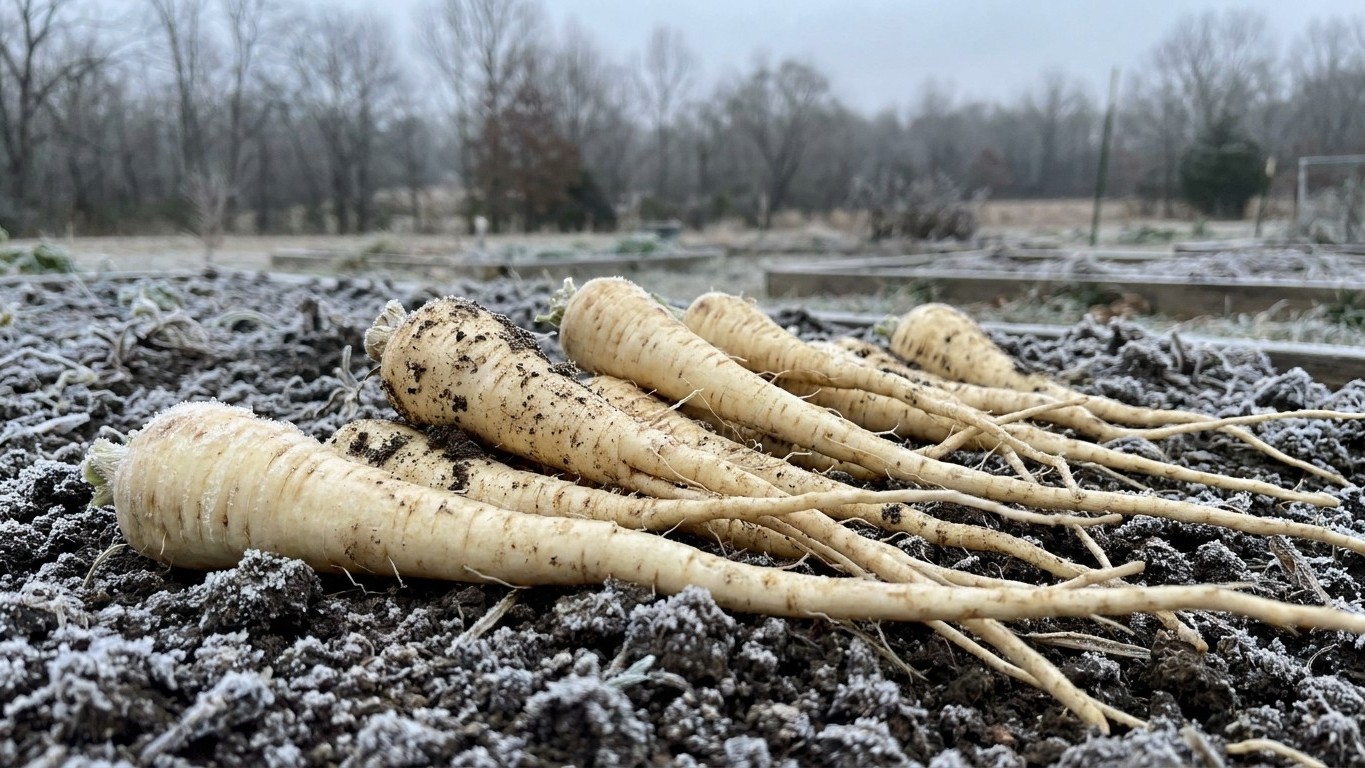

Yes, parsnips grown in Missouri will sweeten, and the reason has nothing to do with the state’s official hardiness zone. What decides it is how many weeks of real, sustained frost the ground delivers before the roots come up. Missouri’s winters supply exactly that kind of cold. The real question isn’t whether the climate cooperates. It’s whether the sowing date and the harvest date line up so the crop is ready and waiting when that frost finally arrives.
The short answer
Does this territory hand a parsnip several straight weeks of hard frost, or just a stray cold snap that melts off by noon? That question decides whether the root turns sweet in the ground or stays merely starchy. For the Kansas City reference station, NOAA’s 1991-2020 Climate Normals put the mean daily minimum temperature for the coldest month at 19.5 degrees Fahrenheit. That isn’t one bad night. That’s an entire month averaging well below freezing on its cold end, which means weeks of sustained cold reaching down into the soil where the roots actually sit.
That distinction matters because a hardiness zone rating tells you whether a perennial can survive a winter here at all. It says nothing about how many frosty weeks a root vegetable gets exposed to before someone digs it up. Parsnips aren’t grown for winter survival. They’re grown to sit in cold ground long enough for enzymes to convert stored starch into sugar. A zone map won’t confirm that happens. A coldest-month average of 19.5 degrees will, because it shows the ground stays cold for an extended stretch instead of warming back up within a few days.
Compare that to a state where winter lows hover closer to the 40s. Parsnips there still grow a fine-looking root, full sized and firm, but they never build the same sweetness, because the ground never gets cold enough for long enough. Missouri doesn’t run into that problem. A 19.5-degree average minimum for the coldest month sits squarely in the range that produces the flavor gardeners are actually chasing with this crop.
So the plain answer here: parsnips left in Missouri ground through the fall frost season will sweeten, not just grow. The cold runs deep enough and long enough to do the job. What can go wrong isn’t the climate. It’s the calendar, whether the roots finish sizing up before that cold sets in, and whether the gardener leaves them in the ground long enough to catch it instead of pulling them early out of impatience.
Does the season fit?
Utah State University Extension puts the timeline at 100 to 120 days from seeding, with sowing done 2 to 3 weeks before the last spring frost. Laid against Missouri’s own frost dates, here’s how that arithmetic works out.
- Start with the last spring frost window. NOAA’s Climate Normals set it at April 6 to April 20 for the Kansas City International Airport reference station. Sowing 2 to 3 weeks ahead of that puts the seeding window at roughly March 16 through April 6.
- Wait out germination before judging anything. Parsnip seed takes 14 to 21 days to sprout, longer than most root crops. Nothing visible happens in that stretch, and gardeners who dig up the row assuming it failed usually just disturb seed that was already on its way up.
- Count 100 to 120 days forward from the seeding date, not from when seedlings appear. That lands root maturity somewhere between late June and early August, depending on exactly when the row went in.
- Set that maturity date against the first fall frost, which NOAA’s Normals put at October 18 to October 29 for the same station. Between a summer maturity date and an October frost, Missouri gardeners have roughly two to three extra months where the roots simply sit and continue sizing up.
- That gap answers whether the season fits: comfortably, with weeks of margin on both ends. The risk in Missouri isn’t running out of season. It’s the opposite, harvesting the moment the roots look done in July or August and skipping the frost exposure that makes the crop worth growing at all.
One caution on those dates: the reference station sits well north of Kansas City itself. Downtown runs about five days earlier in spring, and gardens across southern Missouri see frost even later in fall and drop it earlier in spring, stretching that comfortable margin further still.
What goes wrong here
- Forked, twisted roots in heavy or stony ground. Missouri’s clay-heavy soils, especially an unbroken clay pan, split a taproot the moment it meets a rock or a compacted layer. Utah State University Extension recommends deep sandy soil for this crop, or double-digging heavy ground about 18 inches deep before sowing, clearing stones and loosening the clay so the root has a straight path down instead of splitting around an obstacle.
- Forked roots from overwatering, a separate cause from the soil itself. Even a well-prepared bed produces split roots if watering swings between soaked and bone dry. Keep the bed evenly moist through the season rather than drenching it after a dry spell, since that swing, not the dirt, is usually what triggers the fork.
- A row abandoned as a failure before it ever germinated. Because parsnip seed needs 14 to 21 days to sprout, gardeners dig up soil that looks bare and re-sow, losing three weeks and pushing the harvest date later into a Missouri summer that’s already hot and dry. Mark the row and wait out the full germination window before assuming anything failed.
- Roots pulled too early, before any real frost has touched them. Missouri’s frost-to-frost window leaves plenty of room to mature by midsummer, which tempts an early harvest. Pulled in July or August, ahead of the coldest month’s frosts, the roots come up perfectly edible and completely bland. Leave them in the ground through several fall frosts before digging them up.
Handle the tops with care
North Carolina State Extension’s Plant Toolbox states it plainly: “All parts of this plant contain furocoumarins which can make skin sensitive to light causing burns so be sure to wear gloves, long sleeves and long pants when dealing with it.” That’s the whole plant, not just the leafy tops a gardener handles while weeding or clearing foliage before storage.
What catches people off guard is the mechanism. The burn doesn’t come from the sap by itself. It needs the sap and then sunlight on top of it, the compounds only turn reactive once ultraviolet light hits the skin they’re sitting on. That’s why the injury shows up after a bright afternoon spent harvesting or pulling tops, and why it doesn’t appear right away. The reaction develops over the hours afterward, long after the gloves have come off and the work is done.
That also explains why washing up afterward isn’t the real protection. By the time anyone notices redness, the sunlight exposure that triggered it has already happened. The point where prevention actually works is before handling any part of the plant: gloves, long sleeves, and long pants during harvest, weeding, or foliage removal keep the sap off skin in the first place.
Checking this against your own county
Every figure on this page comes from a single reference station, and Missouri stretches across enough latitude that conditions shift from the northern border to the Bootheel. NOAA’s own data notes that stations closer to downtown Kansas City run about five days earlier in spring, while southern Missouri counties see frost arrive later in fall and let go earlier in spring still.
For a county-specific read rather than a single-station estimate, University of Missouri Extension maintains local offices with soil testing and planting guidance tailored to each part of the state. Bootheel gardeners, Ozark growers, and those farming the northern prairie counties are all working with different frost windows and different soil, even though the same statewide averages get cited for all of them. A call to the local office, or a look at their county-specific planting calendar, swaps this article’s regional estimate for numbers measured closer to the actual garden.
Common questions
Can parsnips be left in the ground once winter arrives in Missouri?
The roots tolerate cold far better than the tops do, and gardeners commonly leave mature parsnips in place through the fall frosts that trigger the sweetening rather than digging them the moment they reach full size. This page doesn’t have published figures on overwintering beyond the frost data already covered, so treat harvest timing as flexible within that fall frost window rather than fixed to one date.
Does the variety of parsnip change how much it sweetens?
The sourced guidance here doesn’t name a specific variety, and none should be assumed. The sweetening mechanism, cold converting stored starch to sugar, applies to the crop generally rather than to one cultivar over another.
Why does parsnip seed take so long to sprout compared to other root crops?
Utah State University Extension puts germination at 14 to 21 days, slower than carrots or radishes sown in the same bed. That slow start is exactly why bare-looking soil during that window shouldn’t be treated as a failed planting.
Is handling parsnip greens risky even if the sap never touches bare skin directly?
The safety concern applies to all parts of the plant, not only the foliage, and the reaction requires both sap contact and sunlight afterward. Covering skin with gloves, long sleeves, and long pants before handling any part of the plant is the protection that actually matters, since the exposure happens outdoors in daylight, not indoors after the fact.