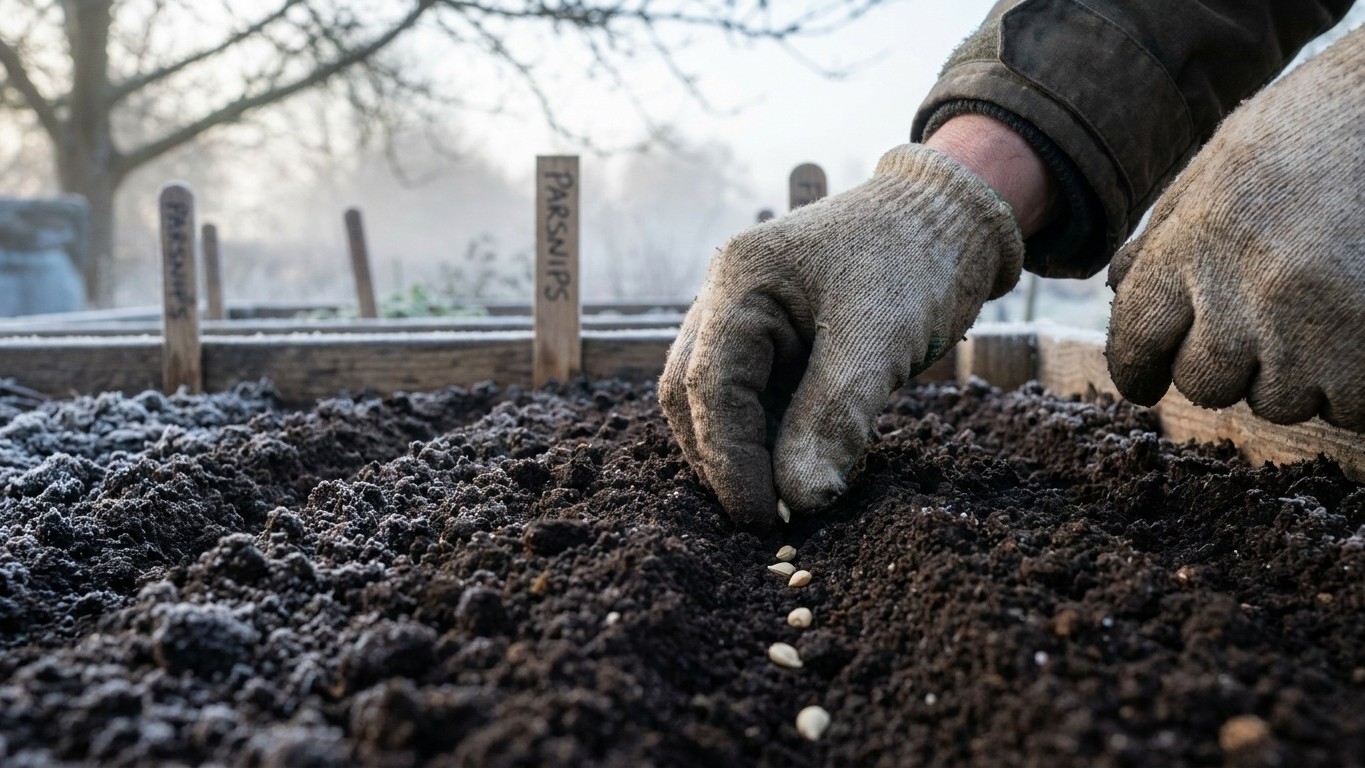

In the Kansas City area, the sowing window falls between March 16 and April 6, roughly two to three weeks ahead of the last spring frost. That timing matters more than the calendar date itself, because it sets up everything that follows: how the root develops, whether it forks, and whether it ever turns sweet.
The short answer
The question that actually decides parsnip success here isn’t “what zone am I in.” It’s simpler and colder: does this stretch of Missouri deliver several weeks of real frost? The answer, based on NOAA NCEI Climate Normals for 1991-2020 at the Kansas City reference station, is yes, decisively. The mean minimum temperature during the coldest month sits at 19.5°F. That’s not a dip below freezing for a night or two. That’s a sustained, month-long pattern of nights well into the teens, repeated across an entire winter month on average.
Why that number matters more than a hardiness zone rating is worth spelling out. A hardiness zone tells you the coldest extreme a perennial plant might survive over the years. It says nothing about how much cold exposure a root vegetable gets during a normal season, and it says nothing about duration. Parsnips don’t need to survive an extreme. They need weeks of cold weather working on them while they sit in the ground, because that cold is what converts stored starch into sugar. A single light frost does almost nothing. Weeks of consistent, cold exposure do the job the Utah State University Extension describes: starch breaks down, sugar builds up, and the root goes from merely edible to genuinely sweet.
A mean minimum of 19.5°F in the coldest month means Missouri gardeners aren’t gambling on whether cold arrives. It arrives, reliably, and it sticks around for weeks rather than days. That puts this territory solidly in the category of places where parsnips can develop real sweetness, provided the gardener does the one thing that ruins it: pulling the roots too early. The climate does its part. The rest is patience.
None of this means every root will taste the same. Soil type, moisture consistency, and how long the roots stay in the ground after the first hard frost all shape the final flavor. But the baseline condition, several weeks of genuine cold, is met here without much argument. Gardeners in warmer, milder-winter states don’t get this for free. Missouri does.
Does the season fit?
Parsnips need 100 to 120 days from seeding to maturity, and they’re sown directly in place rather than started indoors and transplanted, since disturbing the taproot early on tends to produce forked or stunted roots. Laying the math out step by step shows how comfortably that timeline fits into a Missouri growing season.
- Start with the sowing window. Two to three weeks before the last spring frost (April 6 to April 20 at the Kansas City reference station) puts seeding between roughly March 16 and April 6.
- Add germination time. Parsnip seed is slow to sprout, typically 14 to 21 days. A March 16 sowing might not show green until early April; an April 6 sowing might not emerge until late April. This is normal for the species and not a sign of failed seed.
- Count forward to maturity. From a March 16 sowing, the 100-day mark lands around June 24 and the 120-day mark around July 14. From an April 6 sowing, 100 days lands around July 15 and 120 days around August 3.
- Compare against the first fall frost. The first frost at the reference station arrives between October 18 and October 29. Even the latest maturity date in this range, early August, leaves ten to twelve weeks of open season before frost even begins.
- Account for the sweetening period. Parsnips are typically left in the ground after they mature, so they can sit through the cool weeks leading into and through the first frosts. In Missouri, that means roots maturing in July can stay in the ground through October and into the cold weeks beyond, absorbing exactly the frost exposure that develops sweetness.
Put together, the arithmetic isn’t close. This isn’t a season that fits tightly with no room for error. There’s slack built in on both ends, enough that a late sowing in early April still matures with two and a half months to spare before the ground freezes hard. The tighter constraint isn’t the calendar. It’s remembering not to harvest the moment the roots look ready, because the best flavor is still weeks away at that point.
What goes wrong here
- Forked roots from heavy or stony clay ground. Missouri clay soils are common, and a parsnip taproot pushing down into compacted or rocky ground splits around the obstruction instead of growing straight. The Utah State University Extension recommends deep, sandy soil as ideal, and specifies that heavy soil must be double dug, meaning worked to a depth well beyond a single spade’s reach, before sowing. A raised bed filled with loose, stone-free soil solves the same problem without reworking existing clay.
- Forked roots from overwatering. This is a separate cause from soil texture, not a variation on it. Inconsistent or excessive watering, especially heavy soaking after the taproot has already started forming, encourages side roots to branch off rather than one root growing straight down. Even, moderate watering through the growing season keeps this from happening, independent of how good the soil structure already is.
- Sowing late enough that the season runs out. Given the 100 to 120 day maturity window and the 14 to 21 days germination alone takes, sowing much past early April starts eating into the buffer before fall frost. The fix is simple: sow within the established window, March 16 to April 6, rather than waiting for warmer soil out of caution.
- Harvesting before the cold has done its work. This is the mistake that actually costs Missouri gardeners flavor, more than a mild winter ever would. With a coldest-month mean minimum of 19.5°F, the cold exposure needed for sweetening is available here in abundance. The failure is impatience: pulling roots as soon as they’re mature-sized instead of leaving them through several weeks of frosty weather first.
Common questions
Can I start parsnip seeds indoors and transplant them in Missouri?
No. Parsnips are sown directly in place. The long taproot doesn’t tolerate the disturbance of transplanting well, and disturbed roots are more prone to forking, one of the two issues Missouri’s clay-heavy soils already make more likely.
How long does it take parsnip seed to come up in Missouri soil?
Germination runs 14 to 21 days according to the Utah State University Extension. That’s slow compared to many garden vegetables, and it’s normal. Digging up the row and re-sowing after a week of nothing showing is a common, unnecessary mistake.
Does mulching before winter help Missouri parsnips taste better?
Sweetening comes from exposure to frost itself, not from insulation against it. Heavy mulch that blocks cold from reaching the roots works against the process rather than helping it. Mulch applied later, mainly to keep the ground workable enough to dig roots out once it’s cold, serves a different, practical purpose.
What soil should I prepare for parsnips in Missouri clay?
The Utah State University Extension points to deep, sandy soil as the target, with heavy soil requiring double digging to loosen it well below the surface. In much of Missouri, where clay is the default, that prep work or a raised bed filled with looser soil addresses the forking risk that heavy, compacted ground otherwise creates.