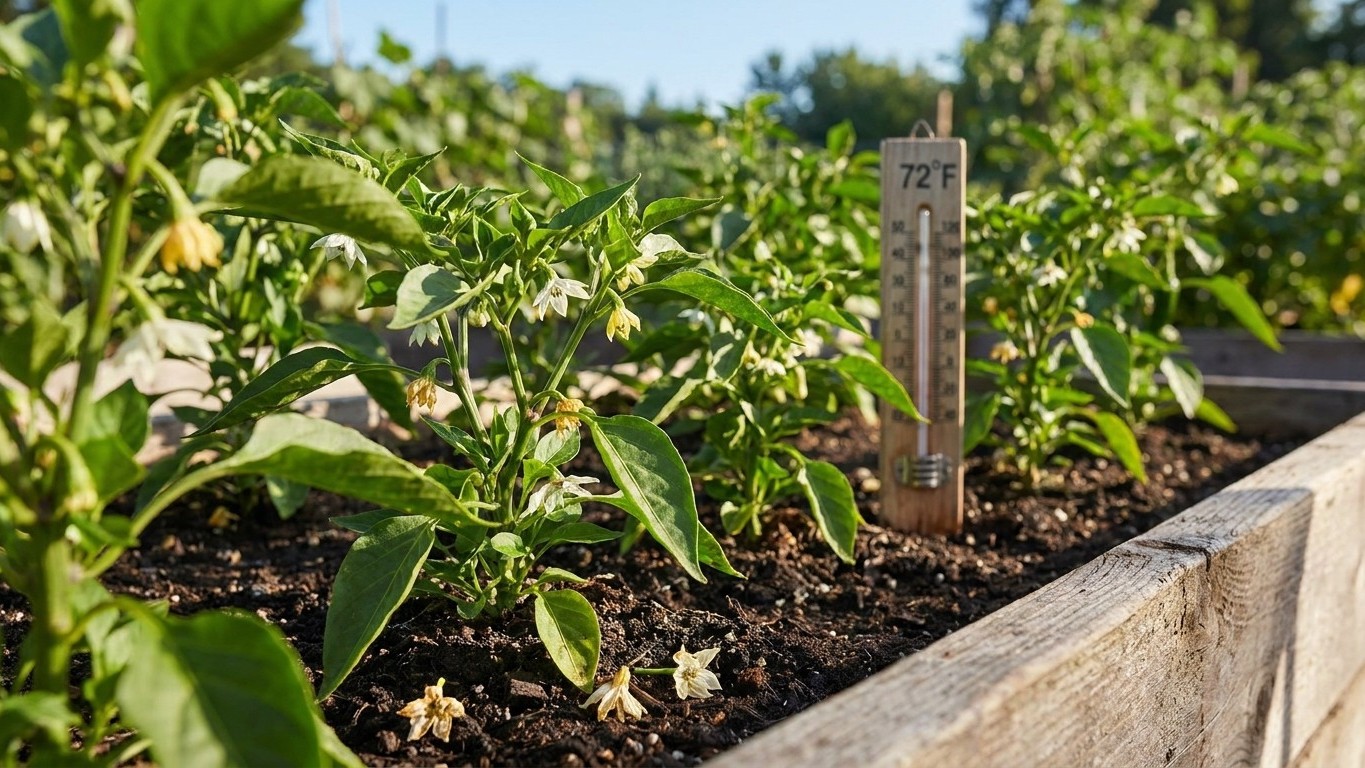

The short version: most Missouri gardeners should start pepper seed indoors sometime in early-to-mid February, counting back 8 to 10 weeks from a transplant date somewhere in mid-to-late April. But that window only holds if you check two things this site doesn’t guess at for you: how hot your local July gets and how cold your local nights run in early summer. Get either wrong and the seedlings you started right on schedule still won’t set fruit.
The short answer
Around the Kansas City reference station, the National Centers for Environmental Information’s 1991-2020 Climate Normals put the average count of days at or above 90 F at 32.7 days a year. That’s not a record or a bad-summer outlier. That’s the typical year. Thirty-two days of 90-plus heat is enough stretch that pepper flowers sitting through an afternoon in that range can drop before they ever set fruit, because pollen gets sticky and less viable once daytime highs push past that mark. If your part of Missouri runs closer to or above that number, plan on losing some blossoms in mid to late summer no matter how well you timed the seed.
That’s one end of the failure window. The other end matters just as much and gets ignored far more often: pepper fruit set also fails when nights drop below 55 F. A grower who nails the heat side and still loses a flush of blossoms to a cool snap in late spring or early fall is running into the exact same mechanism from the opposite direction. Low night temperatures interfere with pollen the same way excess heat does, just through a different pathway.
This is where a straight answer has to stop short. This site tracks days above 90 F for Missouri territories, because that data is measured and published at the county and regional level. It does not carry summer night minimum temperatures, and there’s a real reason for that: night lows vary by elevation, by how close you are to a river bottom or a ridge, by whether your yard sits in a frost pocket or on a breezy slope, in ways that a single statewide or even county-level number can’t capture. Latitude alone tells you nothing reliable about how cold your particular nights run in June. Neither does the coldest month of your year, since a location’s winter low and its early-summer night low don’t move in lockstep.
What that means practically: track your own overnight lows once your peppers are flowering, especially in a year that runs cool into early summer. A basic min-max thermometer in the garden, checked over a couple of weeks, tells you more about your fruit set odds than any regional average could.
When to start seed here
Utah State University Extension’s guidance on peppers gives the framework that applies here: transplants need 8 to 10 weeks indoors, and they go into the ground only after frost has passed and the soil has warmed to 60 F. Missouri’s own frost timing is the piece that turns that framework into an actual date on your calendar.
- Find your last spring frost window. NOAA NCEI’s 1991-2020 Normals put the 30-70% probability band for the last 32 F freeze in the Kansas City area between April 6 and April 20. That’s the reference station reading. The downtown Kansas City station itself tends to clear frost about five days earlier than that outlying reference point, and southern Missouri, further from any cooling influence, typically clears frost earlier still. Pull up your own county’s normal if you’re outside the immediate Kansas City area, since a location in the Bootheel and one near the Iowa line aren’t working from the same calendar.
- Wait for 60 F soil, not just a frost-free date. Air temperature clearing 32 F doesn’t mean the ground has caught up. Soil holds cold longer than air does, so check with a soil thermometer a few inches down before moving transplants outside, even if the calendar says you’re past your frost window.
- Count back 8 to 10 weeks from that transplant date. If your soil typically hits 60 F and your frost risk has passed by the third week of April, count back 8 weeks and you land in the last week of February for starting seed indoors. Count back the full 10 weeks and you’re starting in mid-February instead. Gardeners in the immediate Kansas City metro, working from that five-days-earlier frost clearance, can nudge their whole schedule a few days earlier. Growers in southern Missouri, with an earlier and milder spring, can start later and still hit their transplant window.
- Build in a buffer for a late soil warm-up. Pepper seed started too early just sits in pots getting rootbound and stressed if a cool spring delays your transplant date. It’s better to land on the early side of the 8-to-10-week range than the late side if you’re not sure which way your spring is trending.
What goes wrong here
Missouri’s swing between a cool, unpredictable spring and a summer with over 30 days of 90-plus heat sets up a specific set of failures. None of them come from bad seed or bad luck so much as timing against the climate itself.
- Blossom drop from a hot spell. When daytime highs push into the 90s during flowering, especially with several days in a row, plants can drop blossoms wholesale before fruit ever forms. There’s no fix once it’s happening beyond waiting it out; the remedy is upstream, in choosing a transplant date and variety maturity that puts peak flowering before or after the heaviest run of 90-degree days rather than squarely inside it.
- Blossom drop from a cool night. The same drop shows up when nights fall below 55 F, which is a real risk in Missouri in the first couple of weeks after transplant, before the season has fully warmed. Watching your own overnight lows during that early flowering stage, rather than assuming the frost-free date means you’re clear on all fronts, catches this before it costs you a flush of fruit.
- Sunscald on exposed fruit. Missouri’s summer sun, paired with those 30-plus days of serious heat, can scald pepper fruit that’s left exposed after a plant loses leaf cover to wind, hail, or aggressive pruning. The fix is simple: keep foliage full through the hottest stretch and avoid heavy pruning once fruit is setting, so leaves keep shading developing peppers.
- Blossom-end rot. Uneven watering during a hot, dry stretch interferes with calcium movement into developing fruit, showing up as a sunken, leathery patch on the blossom end. Consistent soil moisture, particularly during the same 90-degree runs that stress flowering, is the practical fix, since it’s a watering problem more often than a soil-nutrient one.
Common questions
Can I start pepper seed too early in Missouri?
Yes. Starting more than 10 weeks before your transplant date usually leaves seedlings rootbound and stressed in their containers while they wait for the soil to hit 60 F. That stress carries over after transplant and can delay flowering more than starting a bit later would have.
Does the Kansas City frost date apply to all of Missouri?
No. It’s a reference point from a station north of the city. Downtown Kansas City typically clears frost about five days earlier, and southern Missouri clears earlier still. Check your own county’s normal frost dates rather than applying the Kansas City figure statewide.
What temperature actually stops pepper fruit from setting?
Two thresholds, not one. Fruit set fails when nights drop below 55 F and also when days climb above 90 F. Missouri sees an average of 32.7 days a year at or above 90 F at the Kansas City reference station, which is the heat-side risk. The cold-side risk depends on your own local nights, which this site doesn’t track and which you’ll need to monitor directly.
How do I know when my soil has reached 60 F?
A soil thermometer, pushed a few inches into the bed and checked in the morning before the sun has warmed the surface, gives a reliable reading. Don’t rely on air temperature or the calendar date alone, since soil lags behind air temperature by days or even a couple of weeks in a slow spring.