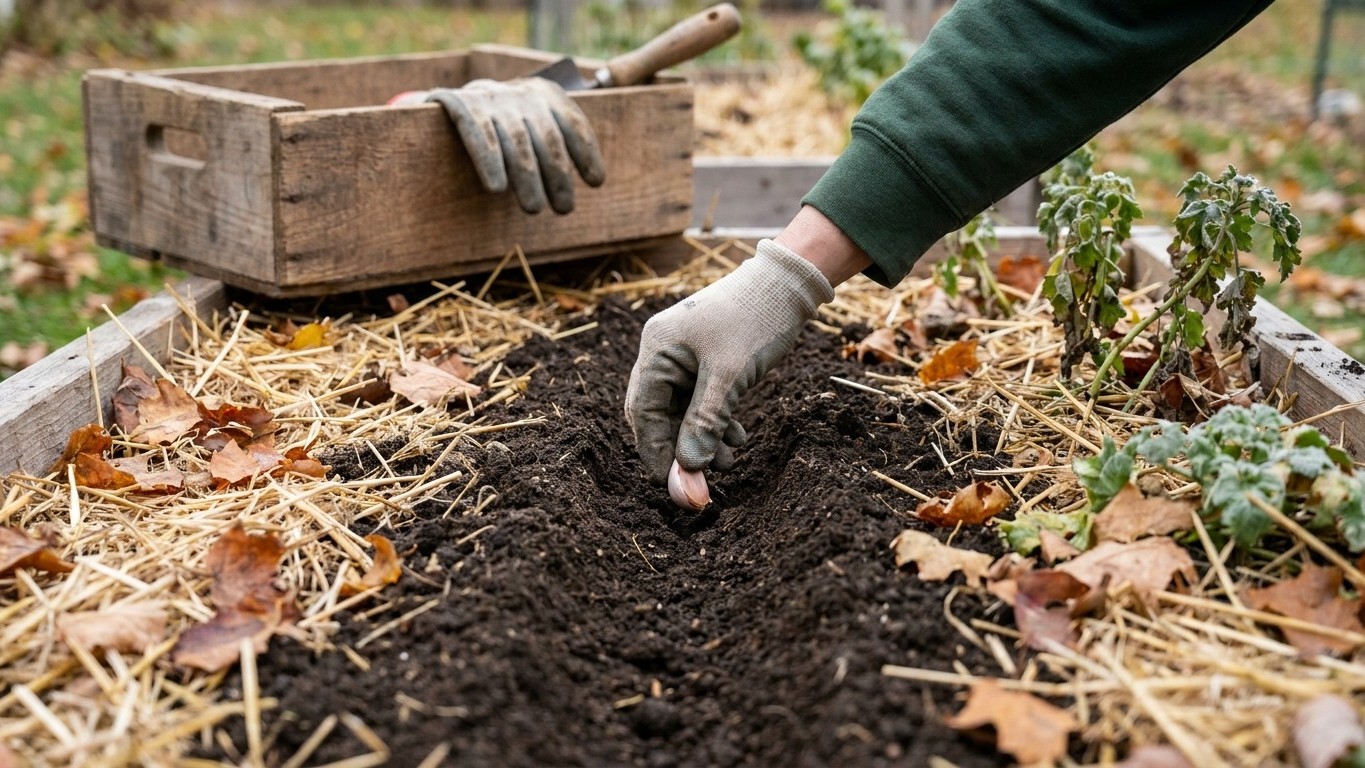

By November, most of Missouri has already crossed its first fall frost, somewhere between October 18 and October 29 in the Kansas City area, and earlier or later elsewhere depending on elevation and latitude. That closes the door on nearly every vegetable seeded straight into open soil. What’s left is a short, specific list: garlic and shallots going into workable ground, cold frames and low tunnels doing the heavy lifting, and dormant, bare-root planting for trees, shrubs, and perennials while the soil still allows it.
What goes in the ground in November

The calendar says November, but the soil doesn’t care what month it is. What decides whether anything survives going into open ground is soil temperature and how far past the first freeze a location sits, not the date on the seed packet. The National Centers for Environmental Information’s 1991-2020 climate data puts the first fall frost for the Kansas City reference station between October 18 and October 29, which means that by November, most of the state has already had at least one hard freeze on the books. That reference station sits north of the city itself; downtown tends to run about five days earlier in spring, and southern Missouri is milder still. The four-week window this article covers should be treated as a closing door, not an open one.
That mechanic matters because it rules out almost every vegetable seeded straight into bare dirt. Lettuce, peas, beans, anything tender, none of it belongs in open soil now. What does belong is a short list of crops built to root before winter and wait: garlic cloves and shallot sets, pushed 1 to 2 inches deep and mulched heavily, use the weeks before the ground locks up to grow roots without top growth, then sit dormant until spring pushes them up. USDA hardiness zones across Missouri run from 5b in the north to 7b in the south, based on the average annual extreme minimum temperature under the USDA Plant Hardiness Zone Map, and that range decides how much working time is actually left. A zone 7b garden near the Bootheel may still have a couple of weeks of unfrozen ground, while a zone 5b spot near the Iowa line may already be locked.
Beyond garlic and shallots, the other honest options are protective, not productive:
- Cold frames and low tunnels, set over whatever greens survived the first frost
- Bare-root and dormant planting of fruit trees, roses, and shrubs while the ground still takes a shovel
- Indoor forcing of rhubarb crowns or chicory roots, dug from the garden and tricked into pale, tender growth in a dark basement or box
None of that is planting in the traditional sense, but all of it uses November for something.
What to start under cover
Run the arithmetic backward from the last spring frost, and November stops looking like a seed-starting month at all. The Kansas City area’s last spring frost falls between April 6 and April 20, and most transplants that need real head-start time, onions, leeks, slow perennial herbs, want 8 to 14 weeks indoors before that date. Counted backward, that lands in December through February, not November. Start seeds now under that math and the result is the first failure mode: leggy, rootbound plants sitting in trays for months longer than they should, stretched toward whatever light they can find and stressed before they ever see soil.
That doesn’t mean cover-grown planting has nothing to offer this month. Microgreens and sprouts skip the frost calculation entirely, since they’re harvested in one to three weeks and never go outside, so a windowsill tray started now is ready well before the holidays arrive. The other real option is winter sowing: seeds that need a cold, damp stratification period to break dormancy, things like many native perennials and some hardy tree seeds, can go into covered containers or an unheated cold frame set outside now, where the freeze-thaw cycle does the work a refrigerator would otherwise have to do. Left out through winter, they germinate on their own once the soil warms.
The second failure mode runs the other direction: seeds that need a long cold spell won’t get enough of it if they go outside after the ground is frozen solid, so November, while the ground still allows a container to sit in contact with damp soil, is closer to a deadline than an early start.
What is ready to pick
Outdoors, the honest answer is: not much, and what’s there depends on what survived the first frost rather than anything freshly planted. Kale, collards, and Brussels sprouts left standing actually improve after a freeze, since cold triggers the plant to convert starches to sugars, which is why sprouts and kale picked after a hard frost taste sweeter than the same plants picked in warm weather. Leeks, buried deep and mulched, can often be pulled straight through the freeze as long as the ground under the mulch hasn’t turned to concrete.
Root crops left in the ground under a thick mulch layer, carrots and parsnips especially, hold there far longer than most gardeners expect; the mulch insulates, and the vegetables underneath are largely unbothered by freezing soil above them. Anything under a cold frame or low tunnel, spinach, mache, arugula, claytonia, keeps growing slowly on sunny days even after the open garden has shut down, and a cold frame with a working lid can push a small salad harvest well into winter.
Indoors, sprouts and microgreens started earlier in the month are the only truly fresh harvest, ready on a rolling basis. The other job this month is inspection, not harvest: stored winter squash, potatoes, and onions from earlier crops need a hands-on check for soft spots, sprouting eyes, or a sour smell, since one rotting squash in a bin will take its neighbors down with it if it’s not pulled early.
The jobs that matter this month
Dormant pruning tops the list, and timing is the whole point: once fruit trees and cane berries have dropped their leaves and gone fully dormant, cutting them back no longer risks pushing new, freeze-vulnerable growth the way a late-summer cut would. Apple, pear, and stone fruit trees, along with raspberry and blackberry canes, take structural pruning well right now, and the wounds have all winter to close before spring sap starts moving.
Seed ordering belongs on the same list, and it’s a deadline more than a chore: popular varieties, especially heirloom tomatoes and anything from a small seed house, sell out well before spring planting season, and ordering now means first pick instead of leftovers. Pair that with planning next season’s rotation while the current layout is still fresh in mind; walking the beds now and noting what grew where makes it far easier to move nightshades, brassicas, and legumes to new ground come spring instead of repeating a spot that’s building up disease pressure.
Soil work pays off precisely because nothing is actively growing to get in the way. A soil test taken now gives results back in time to plan amendments, and any lime or slow-release organic matter applied in the fall has months to work into the soil before planting starts. Turning the compost pile, even just once, keeps decomposition moving through the cold months instead of stalling into a frozen brick.
The rest is maintenance that has real consequences if skipped:
- Cleaning and sharpening pruners and shovels before they sit unused all winter, since rust and dull blades cost more time to fix later than a quick cleaning now
- Repairing raised beds, trellises, and fencing while there’s no crop in the way
- Rechecking stored crops one more time, since a single overlooked soft potato can spread rot through an entire bin before the next check
What not to do in November
The most common mistake is trusting a warm afternoon over the calendar and the soil. A stretch of 60-degree days can feel like an invitation to get warm-season starts in the ground, but air temperature swings fast and soil temperature doesn’t; a tomato or pepper transplant set out during a mild spell is still sitting in soil that will drop back below survivable levels within days. If it’s a warm-season crop, November isn’t a gray area, it’s a no.
The second mistake runs the other direction: pulling covers off cold frames or low tunnels too early after a few mild days, then getting caught by the next freeze with plants that had already started hardening off in the warmth and lost some of their cold tolerance. Covers should come off gradually, on mild days only, and go back on well before evening rather than being left off on the assumption that the warm stretch will hold.
Nitrogen timing trips people up too. Feeding a high-nitrogen fertilizer to trees, shrubs, or perennials this late pushes soft new growth right when the plant should be shutting down for winter, and that new growth has no time to harden off before a hard freeze kills it back, sometimes taking winter-hardiness with it. Any feeding this month should be limited to what’s actively growing under cover, not the dormant landscape.
Bare-root and dormant planting has its own version of the same trap: setting a bare-root tree or shrub into soil that’s already starting to freeze at the surface, rather than soil that’s still workable a few inches down, leaves roots sitting in a cold pocket without making real contact before a hard freeze locks everything in place.
Checking this against your own county
A statewide November guide is a starting point, not an instruction sheet. Missouri’s elevation runs from river bottoms along the Mississippi and Missouri Rivers up through the Ozark Plateau, and that relief, combined with the straightforward north-south stretch of the state, can shift frost timing by weeks between the Bootheel and the northern border. A garden in a low river valley also holds cold air differently than one on a nearby ridge; frost pools in the low ground first.
The frost windows and hardiness zone described here are built on data from one reference station near Kansas City; a county further south or at a different elevation runs on its own schedule. The University of Missouri Extension service maintains county-level guidance and a state planting calendar that accounts for those local shifts.
Common questions
Can I still plant garlic in Missouri in November?
Yes, in most of the state, as long as the soil is still workable with a shovel. Garlic planted in fall needs several weeks of root growth before the ground freezes solid, so November is often the last realistic window, especially in northern Missouri where the ground locks up earlier.
What USDA hardiness zone is Missouri in?
Missouri spans USDA Plant Hardiness Zones 5b through 7b, based on the average annual extreme minimum temperature recorded under the USDA Plant Hardiness Zone Map. Northern counties sit closer to zone 5b, while southern counties run closer to 7b, which changes how long the ground stays workable into late fall.
Is it too late to plant trees in Missouri in November?
Not necessarily, as long as the planting is bare-root or dormant and the ground hasn’t frozen at planting depth. Trees and shrubs planted while dormant establish roots slowly through winter without needing to support leaf growth, but once the soil surface starts freezing consistently, it’s time to wait for spring instead.
What vegetables survive winter in a Missouri garden?
Kale, collards, Brussels sprouts, and leeks can survive standing in the open garden through hard frosts and often taste better for it. Carrots and parsnips left in the ground under heavy mulch, along with anything growing in a cold frame or low tunnel, spinach and mache especially, round out what’s realistically still edible once the open season has ended.
Gardeners who plant by the Moon can check the November 2026 moon planting calendar, a tradition rather than a proven method.
Related guides
Elsewhere? See what to plant in November in every state and province.