
December in Missouri sits deep in the dormant season, weeks after the first fall frost and months from the last one. Almost nothing goes into open ground from seed. The real work this month is garlic and shallots where soil is still workable, bare-root and dormant plantings, cold frames, and forcing a few crops indoors. Hardiness zones across the state run 5b to 7b under the USDA system, and that range changes what’s possible between the Bootheel and the northern counties.
What goes in the ground in December

The decision here isn’t the calendar. It’s soil temperature and whether the ground can even be turned with a spade. At the Kansas City station, the first fall frost lands between October 18 and October 29, so by December most of the state has already had six to eight weeks of freezing nights. The last spring frost doesn’t arrive until April 6 to April 20, which puts December roughly four months from the point when tender crops could safely go outside. That gap is the whole story: nothing warm-season survives this window, and pretending otherwise wastes seed and money.
What still works depends on latitude and whether the soil is frozen solid. In southern Missouri, closer to zone 7a and 7b, the ground often stays workable into early December. That’s a window for planting garlic cloves and shallot sets if it hasn’t been done already, pushed in an inch or two below the surface and mulched heavily with straw. Further north, in zone 5b and 6a counties, the ground has usually locked up by now, and garlic planted this late risks not rooting before hard freeze.
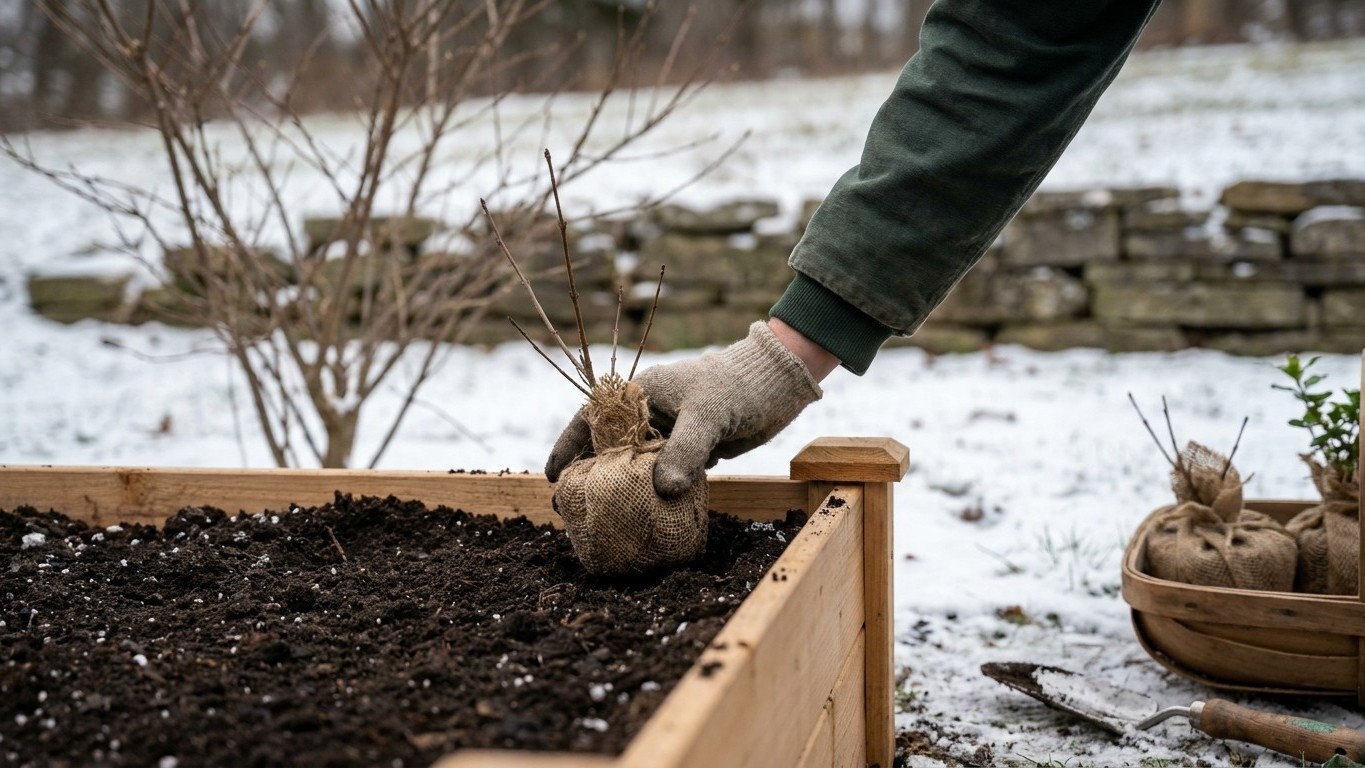
Bare-root fruit trees, roses, and cane fruits like raspberries can still go in the ground anywhere the soil isn’t frozen, since they’re dormant and won’t push top growth until spring. Cold frames and low tunnels aren’t for starting new crops this month, but they buy extra weeks for hardy greens already established, spinach, mache, and kale mostly. Indoors, forcing rhubarb crowns or chicory roots in a dark, cool space produces tender shoots without any outdoor planting at all. That’s the honest list. Anything beyond it is a gamble against frozen ground and a four-month wait for warmth.
What to start under cover
Counting backward from the last frost window of April 6 to April 20 is the only reliable way to time indoor starts, and December lands too early for most of them. Peppers and eggplant, for example, typically need eight to ten weeks under lights before they’re ready to transplant. Counted back from mid-April, that puts their start date in early to mid-February, not now. Starting them in December means leggy, rootbound plants sitting in small pots for two extra months before the ground is even close to warm enough.
The exceptions are the long-season crops. Onions grown from seed, rather than sets, often want ten to twelve weeks indoors before transplant, and some gardeners in the northern part of the state begin them in late December to hit a February or early March sowing under lights, timed for an April move outside. Leeks follow a similar arithmetic. Outside of those, December’s under-cover work is mostly cold-frame sowing, hardy lettuce, spinach, and mache seeded directly into frame soil to crop through late winter, plus indoor sprouts and microgreens that need no outdoor timing at all.
The two failure modes worth naming plainly: starting too early leaves plants stretched and stressed by the time it’s actually safe to transplant, while starting too late means running out of the growing days a crop needs to mature before summer heat or the next frost window closes in. Both mistakes trace back to the same fix, working the math from the frost dates instead of a fixed date on the wall.
What is ready to pick
Little to nothing comes out of open ground in Missouri this month, and there’s no point dressing that up. What’s still edible outdoors is whatever was planted to overwinter. Kale and collards that were left standing after fall harvest often sweeten under repeated frost and can be picked leaf by leaf even under a light snow cover. Leeks mulched heavily in October or November usually pull fine straight through winter, since the soil around the root zone rarely freezes as hard as the surface.
Cold frames extend this further. Spinach, lettuce, and mache sown in September or October and sheltered under glass or plastic keep producing small harvests on any stretch of mild days, though growth slows to a crawl compared to fall speed. Indoors, sprouts and microgreens are the most dependable fresh crop of the month, ready in one to two weeks from seed with no outdoor conditions to work around at all.
The other job this month is checking what’s already in storage. Winter squash, potatoes, and onions all need a look every week or two. Squash with a soft spot near the stem or a sour smell should be used immediately, not left to spread rot to the rest of the bin. Potatoes that have started sprouting eyes are still edible once the sprouts are removed, but any that have gone soft or green should be pulled and composted. Onions with a wet neck or a strong smell coming from the pile are the ones to use first.
The jobs that matter this month
Pruning and dormant work
Fruit trees and cane fruits are fully dormant now, which makes December through late winter the window for structural pruning on apples, pears, and peaches, and for cutting back raspberry and blackberry canes to their strongest wood. Pruning while the plant is dormant reduces stress and disease risk compared to cutting into active spring growth, and it’s far easier to see branch structure without leaves in the way.
Ordering and planning
Seed catalogs move fast in the weeks after the new year opens, and popular varieties, particular tomato and pepper cultivars especially, can sell out before February. Ordering now avoids scrambling for substitutes later. This is also the natural point to sketch next season’s crop rotation, since nothing is actively growing to work around and the previous season’s problem spots are still fresh in memory.
Soil, tools, and storage
Soil samples can still be pulled and sent to a lab for testing even with the ground partly frozen at the surface, and any lime or amendment recommended by the results needs months to break down before it helps a spring planting, so applying it now rather than in April actually matters. Compost piles benefit from a turn to keep them from going anaerobic in the cold, and garden tools pulled out of use for the season should be cleaned, sharpened, and oiled before they sit idle. Raised beds, trellises, and fencing that took damage over the growing season are easiest to repair now, with no plants in the way and no rush to get a crop in the ground. None of this is filler work. Skipping it costs real time once spring planting actually opens up.
What not to do in December
The classic mistake this month is treating a mild afternoon like spring. Soil takes weeks to warm even after the air feels comfortable, and any warm-season transplant put into ground that’s still near freezing at root depth will stall, or rot outright if the soil is also wet. The fix is simple: check soil temperature, not the thermometer on the porch, before anything goes in.
A close second is uncovering cold frames or pulling back mulch after a few warm days, on the assumption the cold snap has passed. Missouri’s frost pattern doesn’t work that way this time of year. Plants that get hardened off during a mild stretch are far more vulnerable to the next freeze than ones left fully covered, and reversing that damage often costs the whole planting.
Feeding nitrogen now is the third trap. Nitrogen pushes soft, leafy growth, and that new growth has no time to harden before the next hard freeze arrives. It’s tempting to fertilize overwintering greens or newly planted garlic to give them a boost, but that boost turns into frost damage instead. Wait until active spring growth resumes before feeding anything. And for anyone assuming there’s still time to get bare-root stock or garlic into frozen ground because “it’s still technically fall planting season,” the ground itself makes that decision, not the calendar. If a spade won’t go in cleanly, the window has already closed for the season in that spot.
Checking this against your own county
A statewide month is a starting point, not an instruction. Missouri’s hardiness zones span 5b to 7b under the USDA system, and that range alone means weeks of difference in frost timing between the Bootheel and the counties along the Iowa border. Elevation and local cold pockets shift things further within a single county. The Kansas City station itself sits well north of downtown, running about five days earlier in spring than the city center, and southern Missouri runs milder still. For a planting decision that actually holds up on a specific piece of ground, check current soil conditions directly and cross-reference with the University of Missouri Extension, which publishes county-level guidance and a state planting calendar built for these local differences.
Common questions
Can garlic still be planted in Missouri in December?
Yes, in southern parts of the state where soil hasn’t frozen, though it’s later than ideal. Cloves planted this late need a heavy mulch layer to root before hard freeze sets in. In northern counties where the ground is already frozen, it’s too late until soil thaws in late winter.
Is it too late to plant bulbs or perennials outdoors?
It depends entirely on whether the soil can still be worked. Bare-root trees, shrubs, and dormant perennials can go in as long as the ground isn’t frozen solid. Once frost has locked the soil, planting has to wait for a thaw or for late winter.
What indoor seed starting actually makes sense this month?
Long-season crops like onions from seed and leeks are the main candidates, counted backward from the April 6 to April 20 frost window. Most other transplants, peppers and tomatoes especially, are still too early and will end up leggy by transplant time.
Why does the same month look so different across Missouri?
The state spans USDA zones 5b to 7b, a range built on average extreme minimum winter temperature. That spread, combined with elevation and local microclimates, means frost dates and workable soil windows can differ by several weeks between the northern and southern parts of the state.